
Marcus Junius Brutus
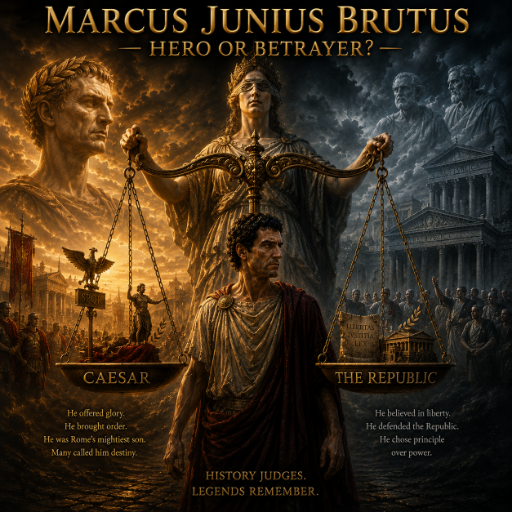
1. Who Was Brutus?
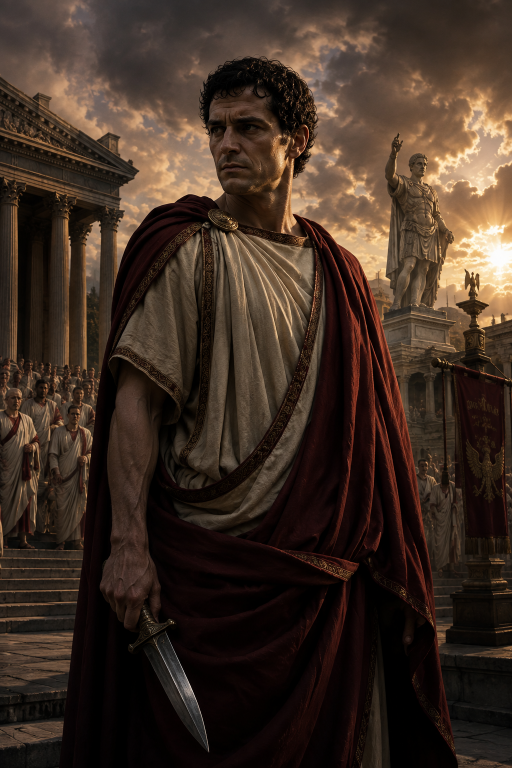
Marcus Junius Brutus was a politician and philosopher of the late Roman Republic, best known as one of the leading figures in the assassination of Julius Caesar.
He is often regarded as one of the most famous traitors in history, and many people know his name through the famous phrase, “Et tu, Brute?”
However, the real Brutus was far more than simply a traitor.
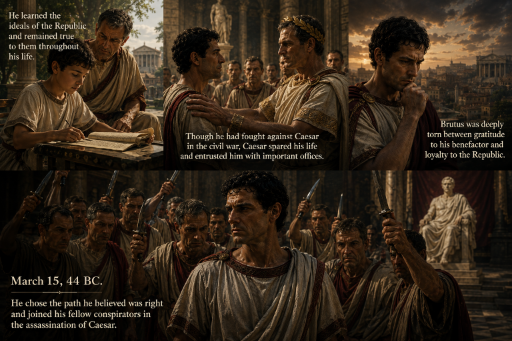
From an early age, he was taught the republican ideal that “a nation should be governed not by a single ruler, but by law.” He remained devoted to that belief throughout his life.
Although Brutus had fought against Caesar during the civil war, Caesar spared his life and later entrusted him with important political offices.
This left Brutus deeply torn between gratitude toward the man who had shown him mercy and loyalty to the Republic he had sworn to defend.
Then came March 15, 44 BC.
Brutus chose the path he believed was right and joined his fellow conspirators in the assassination of Julius Caesar.
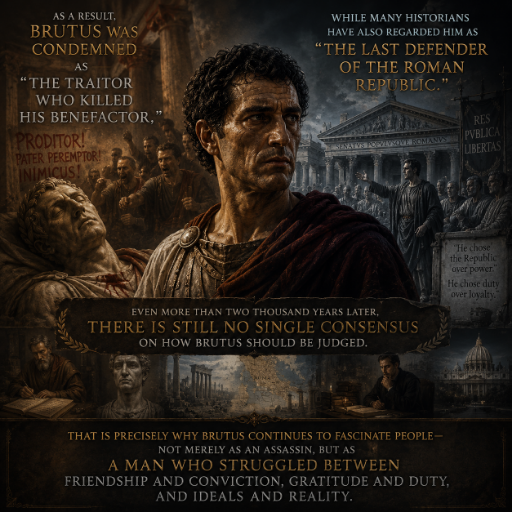
As a result, Brutus was condemned as “the traitor who killed his benefactor,” while many historians have also regarded him as “the last defender of the Roman Republic.”
Even more than two thousand years later, there is still no single consensus on how Brutus should be judged.
That is precisely why Brutus continues to fascinate people—not merely as an assassin, but as a man who struggled between friendship and conviction, gratitude and duty, and ideals and reality.
2. Basic Profile
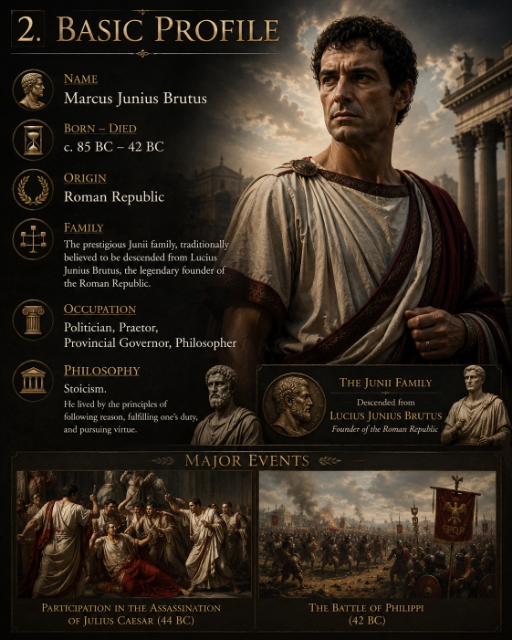
Name: Marcus Junius Brutus
Born – Died: c. 85 BC – 42 BC
Origin: Roman Republic
Family: The prestigious Junii family, traditionally believed to be descended from Lucius Junius Brutus, the legendary founder of the Roman Republic.
Occupation: Politician, Praetor, Provincial Governor, Philosopher
Philosophy: Stoicism. He lived by the principles of following reason, fulfilling one’s duty, and pursuing virtue.
Major Events: Participation in the assassination of Julius Caesar (44 BC); the Battle of Philippi (42 BC)
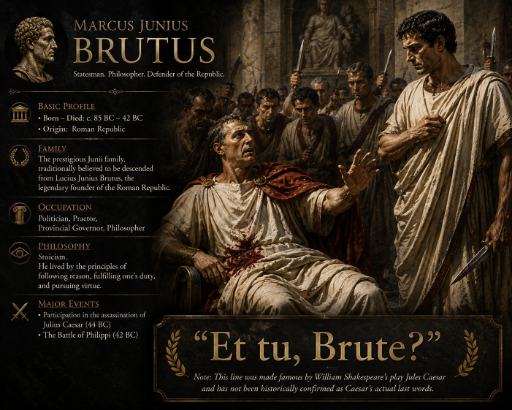
Famous Quote: “Et tu, Brute?”
Note: This line was made famous by William Shakespeare’s play Julius Caesar and has not been historically confirmed as Caesar’s actual last words.
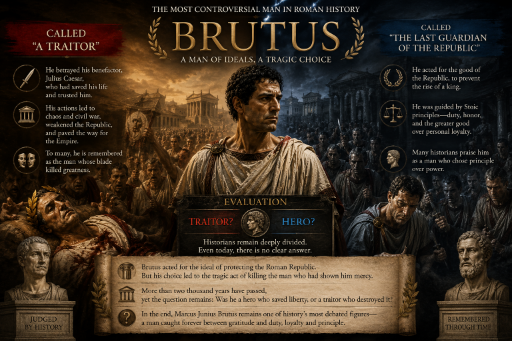
Evaluation: While Brutus is regarded by some as “a man who betrayed his benefactor,” other historians praise him as “the last defender of the Roman Republic,” and opinions about him remain deeply divided to this day.
Brutus is one of the most controversial and widely debated figures in ancient Roman history.
He acted in pursuit of his ideal of defending the Republic, but his decision ultimately led to the tragedy of killing his benefactor, Caesar, with his own hands.
As a result, even more than two thousand years later, there is still no definitive answer to the question of whether Brutus was a hero or a traitor.
3. Brutus’s Life (Timeline)
Childhood (c. 85 BC)
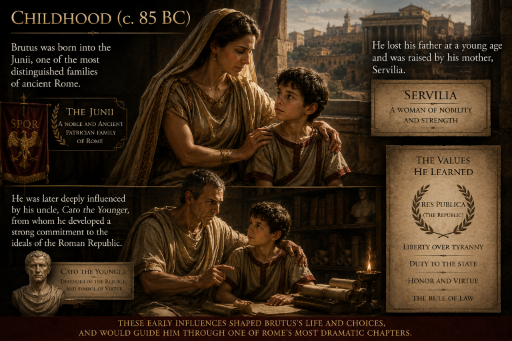
Brutus was born into the Junii, one of the most distinguished families of ancient Rome.
He lost his father at a young age and was raised by his mother, Servilia. He was later deeply influenced by his uncle, Cato the Younger, from whom he developed a strong commitment to the ideals of the Roman Republic.
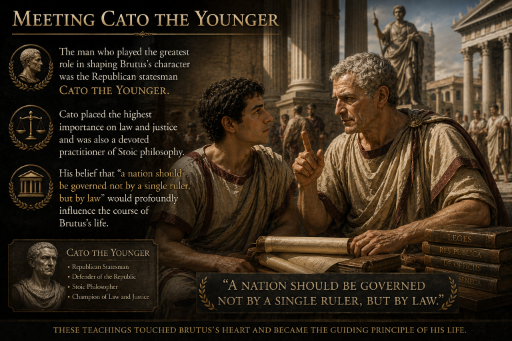
Meeting Cato the Younger
The man who played the greatest role in shaping Brutus’s character was the Republican statesman Cato the Younger.
Cato placed the highest importance on law and justice and was also a devoted practitioner of Stoic philosophy.
His belief that “a nation should be governed not by a single ruler, but by law” would profoundly influence the course of Brutus’s life.
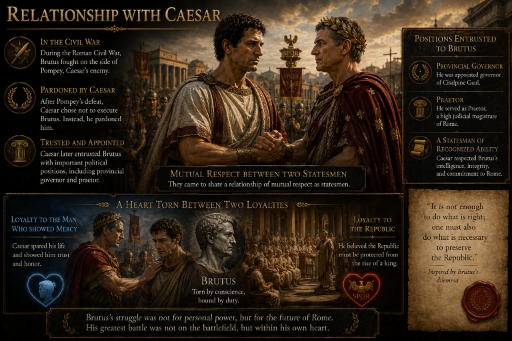
Relationship with Caesar
During the Roman Civil War, Brutus fought on the side of Pompey, Caesar’s enemy.
After Pompey’s defeat, however, Caesar chose not to execute Brutus. Instead, he pardoned him and later entrusted him with important political positions, including provincial governor and praetor.
The two came to share a relationship of mutual respect as statesmen. But as Caesar’s power continued to grow, Brutus found himself increasingly torn between loyalty to the man who had shown him mercy and loyalty to the Roman Republic.
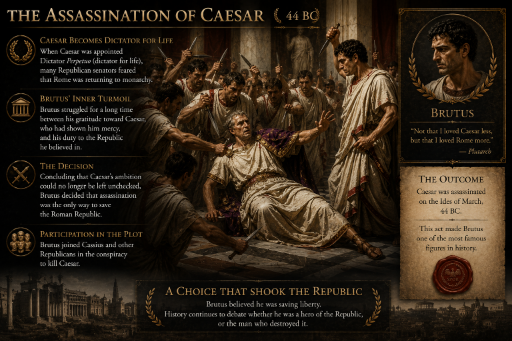
Assassination of Caesar (44 BC)
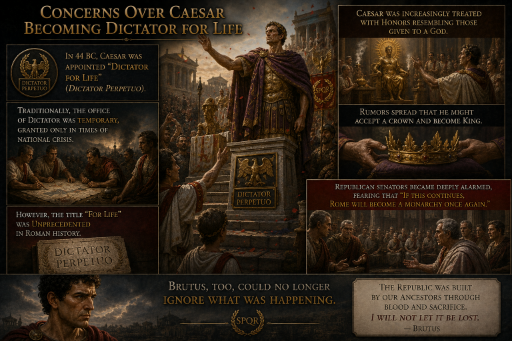
When Caesar became dictator for life, many Republican senators feared that Rome was moving toward a return to monarchy.
After a long and painful struggle with his conscience, Brutus concluded that Caesar’s assassination was necessary to defend the Republic. He joined Cassius and the other conspirators in the plot to kill Caesar.
This event would make Brutus one of the most famous—and controversial—figures in history.
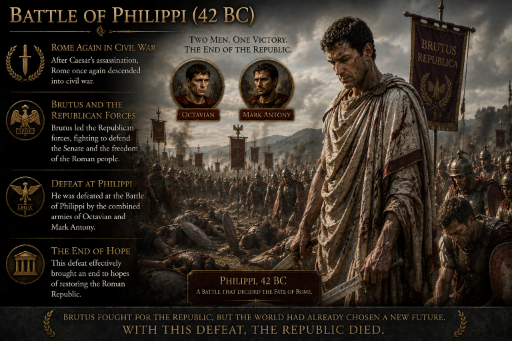
Battle of Philippi (42 BC)
After Caesar’s assassination, Rome once again descended into civil war.
Brutus led the Republican forces, but was defeated at the Battle of Philippi by the combined armies of Octavian and Mark Antony.
This defeat effectively brought an end to hopes of restoring the Roman Republic.
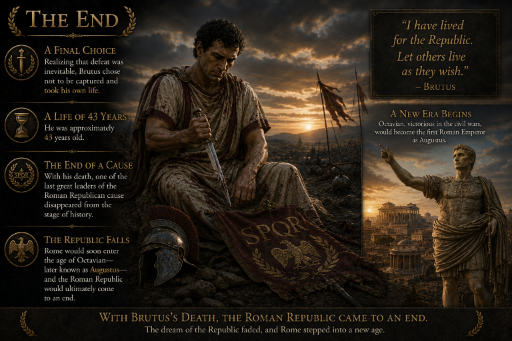
The End
Realizing that defeat was inevitable, Brutus chose not to be captured and took his own life.
He was approximately 43 years old.
With his death, one of the last great leaders of the Roman Republican cause disappeared from the stage of history.
Rome would soon enter the age of Octavian—later known as Augustus—and the Roman Republic would ultimately come to an end.
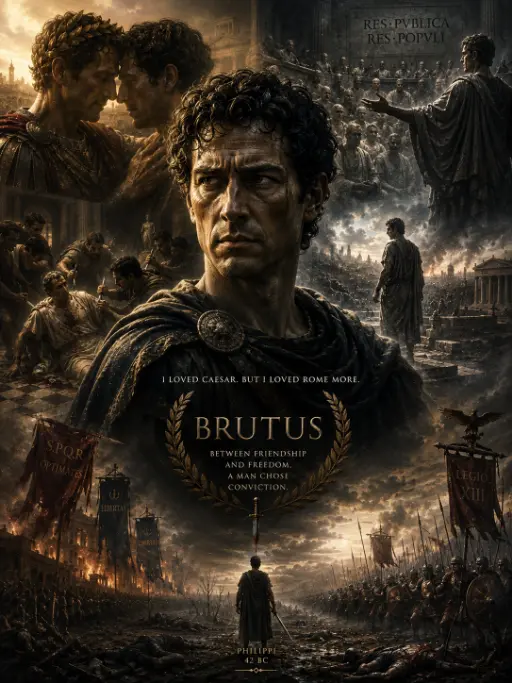
📖 Read Brutus’s Life in Detail
In this chapter, we have provided a brief overview of Brutus’s life.
If you would like to explore his story in greater detail—from his childhood and relationship with Caesar to the events of the assassination and his final days at Philippi, read:
“The Man Who Killed Caesar — The Tragic Life of Brutus”
4. Why Did Brutus Assassinate Caesar?
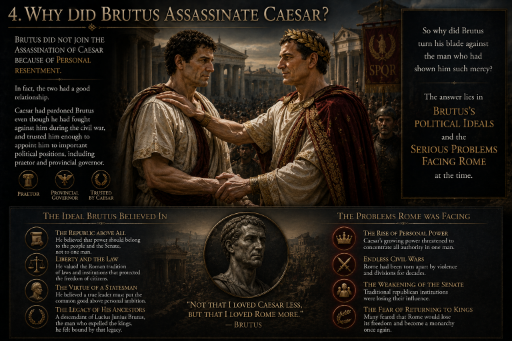
Brutus did not join the assassination of Caesar because of personal resentment.
In fact, the two had a good relationship.
Caesar had pardoned Brutus even though he had fought against him during the civil war, and trusted him enough to appoint him to important political positions, including praetor and provincial governor.
So why did Brutus turn his blade against the man who had shown him such mercy?
The answer lies in Brutus’s political ideals and the serious problems facing Rome at the time.
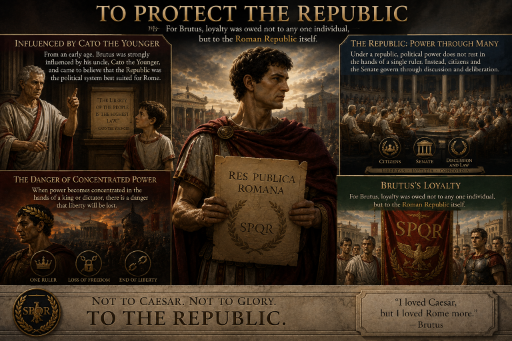
To Protect the Republic
From an early age, Brutus was strongly influenced by his uncle, Cato the Younger, and came to believe that the Republic was the political system best suited for Rome.
Under a republic, political power does not rest in the hands of a single ruler. Instead, citizens and the Senate govern through discussion and deliberation.
By contrast, when power becomes concentrated in the hands of a king or dictator, there is a danger that liberty will be lost.
For Brutus, loyalty was owed not to any one individual, but to the Roman Republic itself.
The Influence of Cassius
The assassination plot was initially led not by Brutus, but by Gaius Cassius Longinus.
Cassius was deeply concerned about Caesar’s growing power and worked with a number of senators to organize the assassination.
However, for the conspiracy to succeed, the participation of Brutus—who commanded considerable respect—was seen as essential.
Cassius repeatedly tried to persuade him, appealing to Brutus’s sense of duty and arguing that “only you can save the Republic.”
Brutus did not make his decision immediately.
After a long and painful inner struggle, he ultimately chose to join the conspiracy, believing that doing so was consistent with his principles.
Concerns Over Caesar Becoming Dictator for Life
A Decision Guided by Conviction
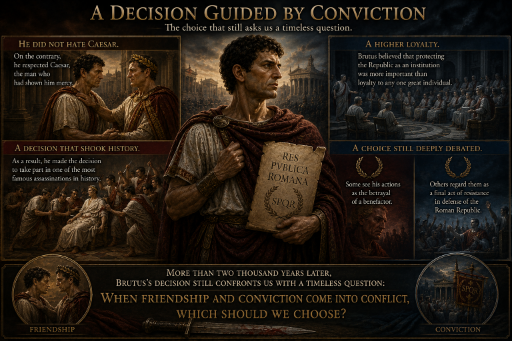
Brutus did not hate Caesar as a person.
On the contrary, he respected Caesar, the man who had shown him mercy.
Even so, Brutus believed that protecting the Republic as an institution was more important than loyalty to any one great individual.
As a result, he made the decision to take part in one of the most famous assassinations in history.
Even today, opinions remain deeply divided over his choice.
Some see his actions as the betrayal of a benefactor, while others regard them as a final act of resistance in defense of the Roman Republic.
More than two thousand years later, Brutus’s decision still confronts us with a timeless question:
When friendship and conviction come into conflict, which should we choose?
5. Achievements
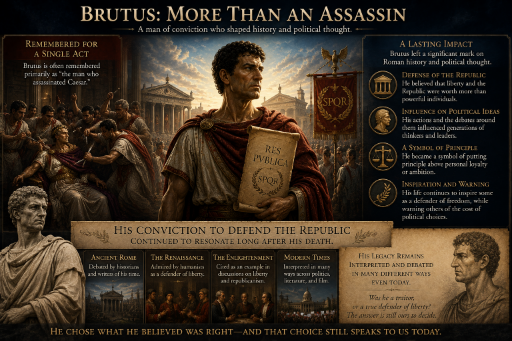
Brutus is often remembered primarily as “the man who assassinated Caesar,” but he also left a significant mark on Roman history and political thought.
His determination to defend the Republic continued to resonate long after his death, and his legacy remains interpreted and debated in many different ways even today.
A Symbol of the Republican Cause
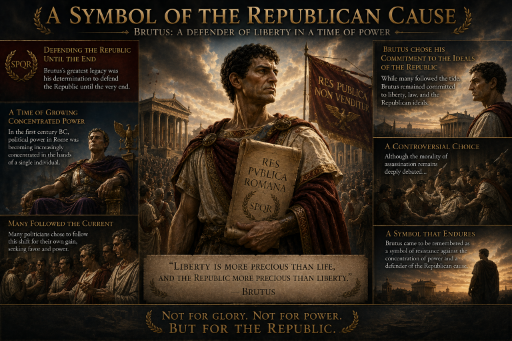
Brutus’s greatest legacy was his determination to defend the Republic until the very end.
In the first century BC, political power in Rome was becoming increasingly concentrated in the hands of a single individual.
While many politicians chose to follow this shift, Brutus remained committed to the ideals of the Republic.
Although the morality of assassination remains deeply controversial, Brutus came to be remembered as a symbol of resistance against the concentration of power and a defender of the Republican cause.
Highly Regarded as a Philosopher
Brutus was known not only as a politician, but also as a highly respected philosopher.
He studied Greek philosophy extensively and was particularly influenced by Stoic philosophy.
He also associated with leading intellectuals of his time, including Cicero, and was respected for his education and intellect.
As a result, in ancient Rome, Brutus was regarded not only as “a statesman who carried a sword,” but also as “an intellectual who loved learning.”
A Man Who Put Stoic Philosophy into Political Practice
Stoic philosophy emphasizes reason, virtue, and duty, encouraging people to choose what they believe is right rather than be ruled by personal emotions.
Brutus applied these principles to his political life.
For him, what mattered most was not personal interest or emotion, but his duty to the state.
That is why, even when faced with Caesar—the man who had shown him mercy—Brutus chose the path he believed to be right.
As a man who attempted to put philosophical ideals into practice in the harsh realities of politics, Brutus is remembered as one of the notable figures associated with Stoic thought in ancient Rome.
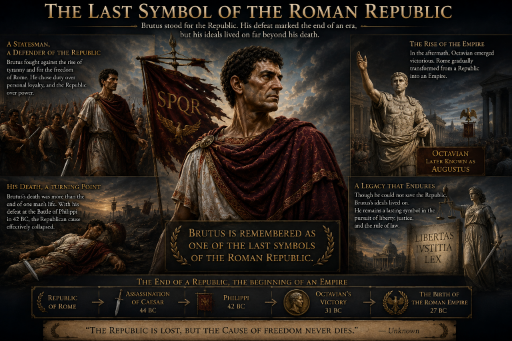
The Last Symbol of the Roman Republic
Brutus’s death marked more than the end of a single politician’s life.
With his defeat, the Republican cause effectively collapsed, and Rome eventually entered the age of imperial rule under Octavian, later known as Augustus.
For this reason, Brutus is often remembered as “one of the last symbols of the Roman Republic.”
Although he failed to save the Republic, its ideals lived on after his death, making Brutus an enduring figure in later discussions about liberty and the rule of law.
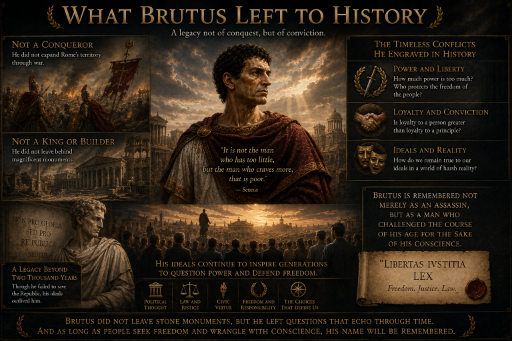
What Brutus Left to History
Brutus was neither a conquering hero who expanded Rome’s territory nor a king who left behind magnificent monuments.
Yet he left something equally enduring: the timeless conflicts between power and liberty, loyalty and conviction, and ideals and reality.
That is why, more than two thousand years later, Brutus is remembered not merely as an assassin, but as an essential historical figure for understanding political thought and the difficult choices that define human life.
6. Failures
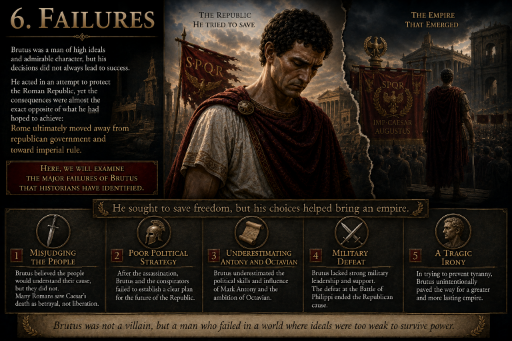
Brutus was a man of high ideals and admirable character, but his decisions did not always lead to success.
He acted in an attempt to protect the Roman Republic, yet the consequences were almost the exact opposite of what he had hoped to achieve: Rome ultimately moved away from republican government and toward imperial rule.
Here, we will examine the major failures of Brutus that historians have identified.
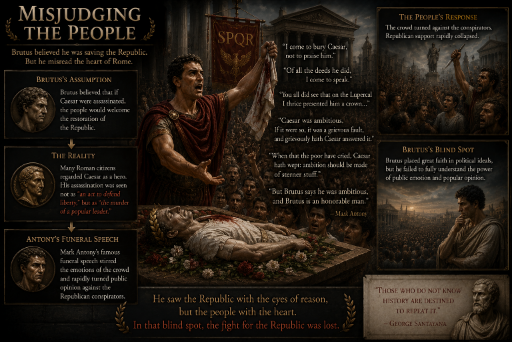
Misjudging the People
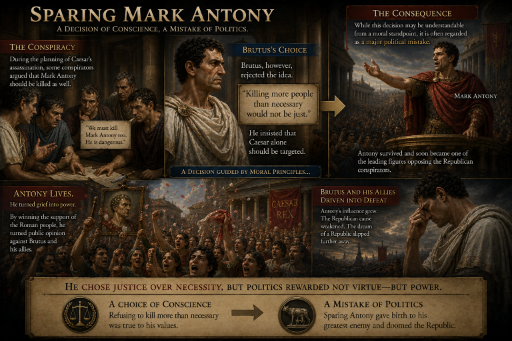
Sparing Mark Antony
During the planning of Caesar’s assassination, some conspirators argued that Mark Antony should be killed as well.
Brutus, however, rejected the idea.
He believed that killing more people than necessary would not be just, and insisted that Caesar alone should be targeted.
While this decision may be understandable from a moral standpoint, it is often regarded as a major political mistake.
Antony survived and soon became one of the leading figures opposing the Republican conspirators. By winning the support of the Roman people, he helped turn public opinion against Brutus and his allies and ultimately drove them into an increasingly desperate position.
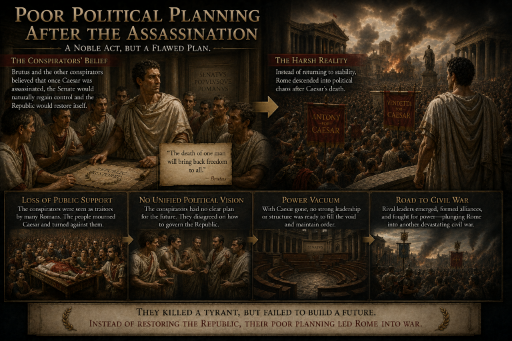
Poor Political Planning After the Assassination
Brutus and the other conspirators believed that once Caesar was assassinated, the Senate would naturally regain control and the Republic would restore itself.
But reality proved far more complicated.
Instead of returning to stability, Rome descended into political chaos after Caesar’s death.
The conspirators lost public support and failed to present a unified political vision or a clear plan for governing Rome.
Their failure to adequately prepare for the power vacuum left by Caesar’s death is considered one of the major factors that ultimately led Rome into another civil war.
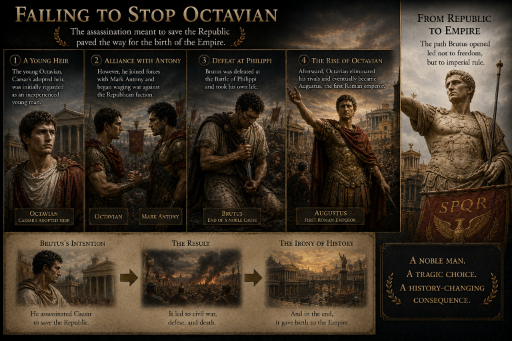
Failing to Stop Octavian
The young Octavian, Caesar’s adopted heir, was initially regarded as an inexperienced young man.
However, he joined forces with Mark Antony and began waging war against the Republican faction.
Brutus was defeated at the Battle of Philippi and took his own life.
Afterward, Octavian eliminated his rivals and eventually became Augustus, the first Roman emperor.
Ironically, the assassination Brutus carried out in an attempt to save the Republic ultimately helped pave the way for the birth of the Roman Empire.
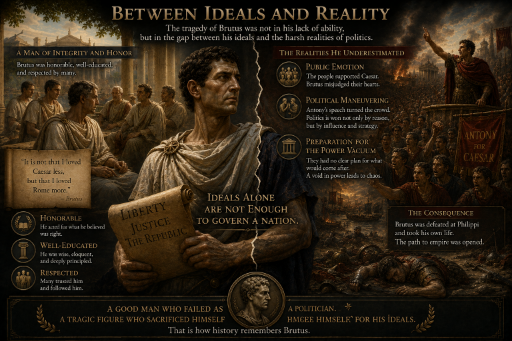
Between Ideals and Reality
Brutus’s failures were not the result of a lack of ability.
He was an honorable, well-educated politician who was respected by many.
However, ideals alone are not enough to govern a nation.
Public emotion, political maneuvering, and preparation for the power vacuum that would follow Caesar’s death—all of these were realities that Brutus failed to fully anticipate.
His inability to account for these factors was one of the main reasons he ultimately failed to achieve the ideals he fought to defend.
That is why Brutus is remembered as “a good man who failed as a politician” and “a tragic figure who sacrificed himself for his ideals.”
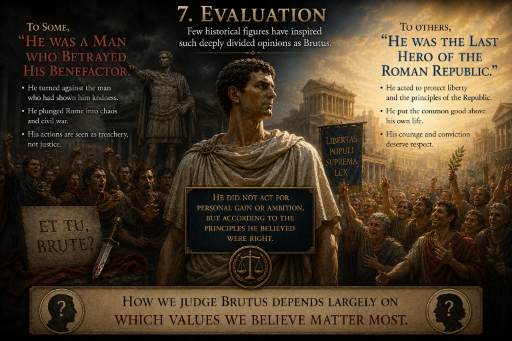
Few historical figures have inspired such deeply divided opinions as Brutus.
Some condemn him as “a man who betrayed his benefactor,” while others praise him as “the last hero of the Roman Republic.”
This division exists because Brutus did not act out of personal ambition or self-interest, but rather according to the principles he believed were right.
How we judge Brutus therefore depends largely on which values we believe matter most.
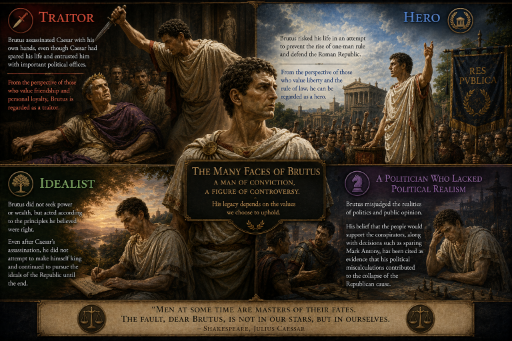
Traitor: Brutus assassinated Caesar with his own hands, even though Caesar had spared his life and entrusted him with important political offices. From the perspective of those who value friendship and personal loyalty, Brutus is regarded as a traitor.
Hero: Brutus risked his life in an attempt to prevent the rise of one-man rule and defend the Roman Republic. From the perspective of those who value liberty and the rule of law, he can be regarded as a hero.
Idealist: Brutus did not seek power or wealth, but acted according to the principles he believed were right. Even after Caesar’s assassination, he did not attempt to make himself king and continued to pursue the ideals of the Republic until the end.
A Politician Who Lacked Political Realism: Brutus misjudged the realities of politics and public opinion. His belief that the people would support the conspirators, along with decisions such as sparing Mark Antony, has been cited as evidence that his political miscalculations contributed to the collapse of the Republican cause.

Historians’ Views
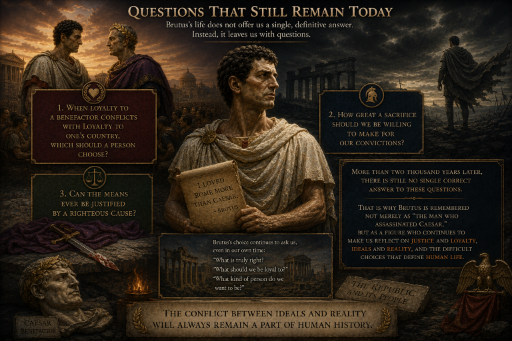
Questions That Still Remain Today
8. Trivia
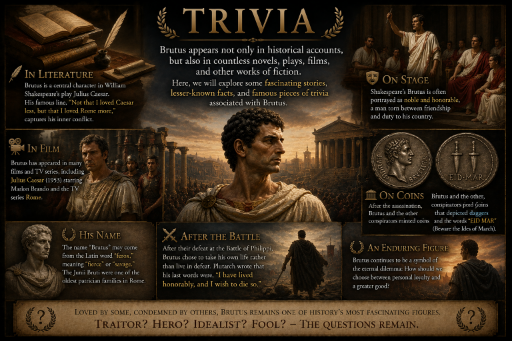
Brutus appears not only in historical accounts, but also in countless novels, plays, films, and other works of fiction.
Here, we will explore some fascinating stories, lesser-known facts, and famous pieces of trivia associated with Brutus.
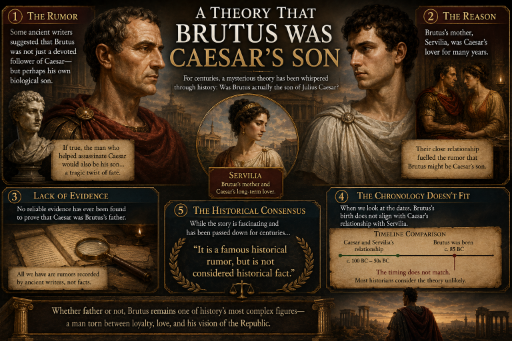
A Theory That Brutus Was Caesar’s Son
For centuries, there has been a theory that Brutus may have been Caesar’s biological son.
The theory arose because Brutus’s mother, Servilia, was Caesar’s lover for many years.
However, no reliable evidence has ever been found to support this claim.
Moreover, the chronology does not fit well with Brutus’s birth, leading most historians to reject the theory.
Today, the generally accepted view is that “it is a famous historical rumor, but is not considered historical fact.”
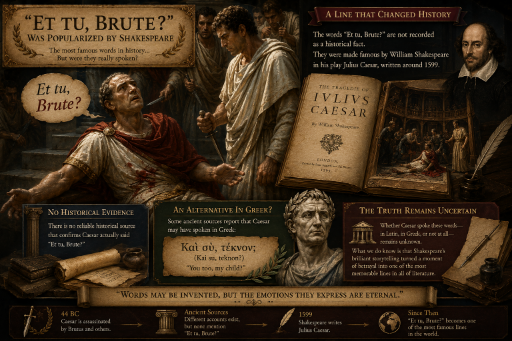
“Et tu, Brute?” Was Popularized by Shakespeare
When people think of Brutus, many immediately remember the famous words, “Et tu, Brute?”
However, there is no historical evidence confirming that Caesar actually said these words.
The phrase was made famous around the world by William Shakespeare’s play Julius Caesar, written at the end of the 16th century.
Some ancient sources instead report that Caesar may have spoken in Greek, saying “Kai su, teknon?” (“You too, my child?”)
However, whether Caesar actually uttered these words remains uncertain to this day.
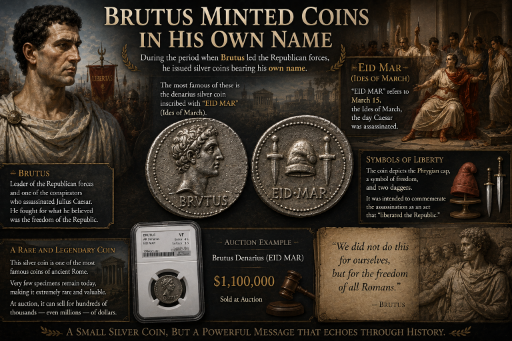
Issued Coins Bearing His Own Name
During the period when Brutus was leading the Republican forces, he issued silver coins bearing his own name.
Among the most famous is the denarius inscribed “EID MAR,” referring to the Ides of March.
“EID MAR” commemorates March 15, the Ides of March, the date on which Caesar was assassinated.
The coin depicts a Phrygian cap, a symbol of liberty, between two daggers. It is believed to have been intended to commemorate Caesar’s assassination as an event that “liberated the Republic.”
The coin remains one of the most famous ancient Roman coins in the world. Because only a small number are known to survive, examples have sold for extraordinarily high prices at auction.
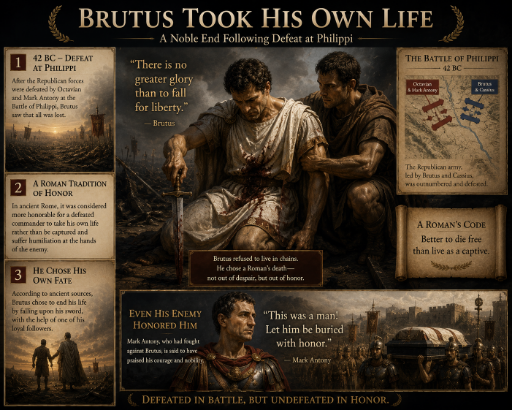
Brutus Took His Own Life
In 42 BC, after his defeat at the Battle of Philippi, Brutus refused to allow himself to be captured.
In ancient Rome, it could be considered more honorable for a defeated commander to take his own life rather than be captured and subjected to humiliation by the enemy.
Following this tradition, Brutus is said to have ended his life by falling upon his sword with the assistance of one of his followers.
Even his enemy, Mark Antony, is said to have praised Brutus for his courage and character and ordered that he be buried with honor.
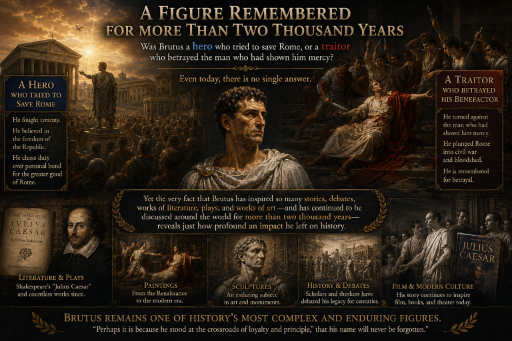
A Figure Remembered for More Than Two Thousand Years
Was Brutus a hero who tried to save Rome, or a traitor who betrayed the man who had shown him mercy?
Even today, there is no single answer.
Yet the very fact that Brutus has inspired so many stories, debates, works of literature, plays, and works of art—and has continued to be discussed around the world for more than two thousand years—reveals just how profound an impact he left on history.
9. Frequently Asked Questions (FAQ)
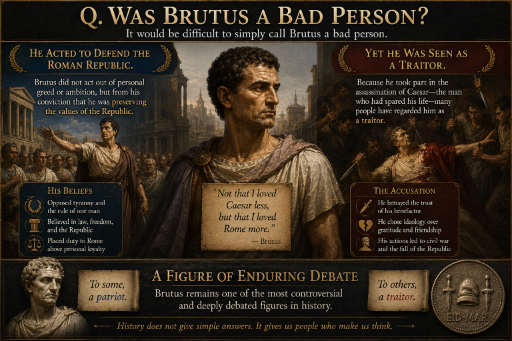
Q. Was Brutus a Bad Person?
It would be difficult to simply call Brutus a bad person.
Brutus did not act out of personal greed or ambition, but from his conviction that he was defending the Roman Republic.
On the other hand, because he took part in the assassination of Caesar—the man who had spared his life—many people have regarded him as a traitor.
For this reason, Brutus remains one of the most controversial and deeply debated figures in history.
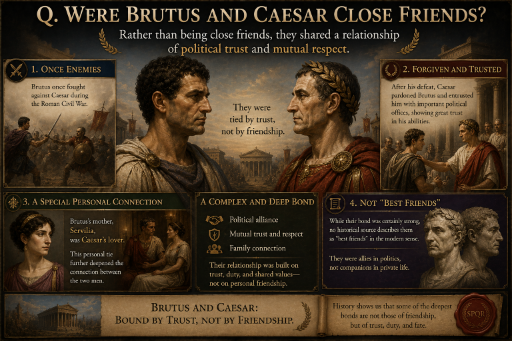
Rather than being close friends, they shared a relationship of political trust and mutual respect.
Brutus had once fought against Caesar, but after his defeat, Caesar pardoned him and later entrusted him with important political offices, demonstrating considerable trust in him.
Brutus’s mother, Servilia, is also well known for having been Caesar’s lover.
These connections suggest that Brutus and Caesar shared a particularly close relationship. However, there is no surviving historical evidence that allows us to confidently describe them as “best friends” in the modern sense.
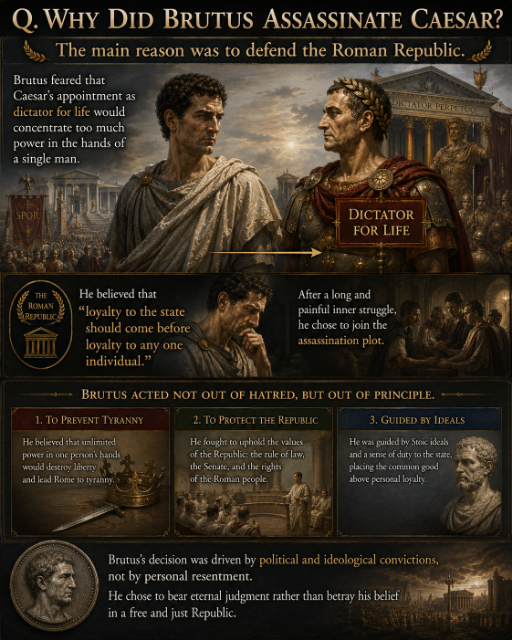
Q. Why Did Brutus Assassinate Caesar?
The main reason was to defend the Roman Republic.
Brutus feared that Caesar’s appointment as dictator for life would concentrate too much power in the hands of a single man.
He believed that “loyalty to the state should come before loyalty to any one individual,” and after a long and painful inner struggle, he chose to join the assassination plot.
In other words, his decision is generally understood to have been motivated not by personal resentment, but by political and ideological convictions.
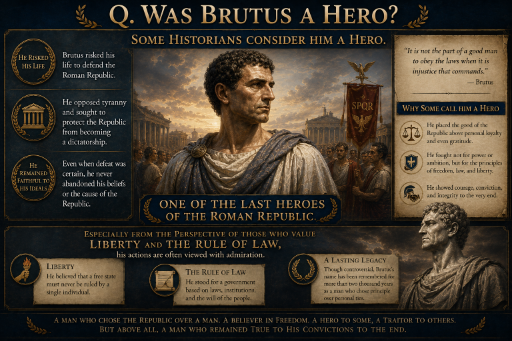
Some historians consider him a hero.
Because he risked his life to defend the Roman Republic and remained committed to his ideals until the very end, Brutus is sometimes regarded as “one of the last heroes of the Roman Republic.”
Especially from the perspective of those who value liberty and the rule of law, his actions are often viewed with admiration.
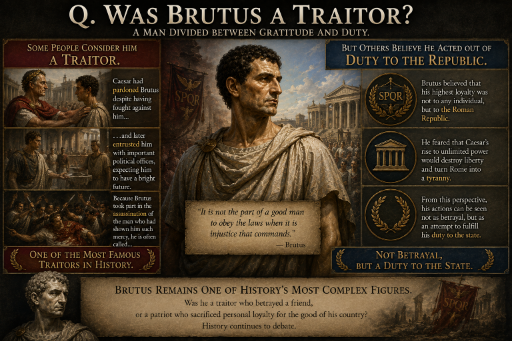
Q. Was Brutus a Traitor?
Some people certainly consider him one.
Caesar had pardoned Brutus despite having fought against him and later entrusted him with important political offices, expecting him to have a promising future.
Because Brutus ultimately took part in the assassination of the man who had shown him such mercy, he is sometimes regarded as “one of the most famous traitors in history.”
On the other hand, Brutus himself believed that his highest loyalty was not to any individual, but to the Roman Republic. From this perspective, his actions can be seen not as betrayal, but as an attempt to fulfill “his duty to the state.”
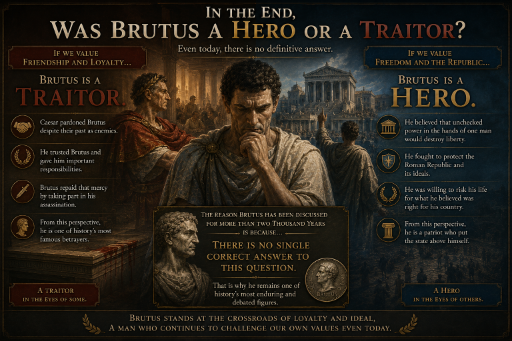
Q. In the End, Was Brutus a Hero or a Traitor?
Even today, there is no definitive answer.
If we place the greatest value on friendship and personal loyalty, Brutus can be seen as a traitor.
On the other hand, if we emphasize his determination to defend liberty and the Roman Republic, he can also be regarded as a hero.
The reason Brutus has continued to be discussed for more than two thousand years is precisely because there is no single correct answer to this question.
That is why he remains one of history’s most enduring and debated figures.
10. Related Figures
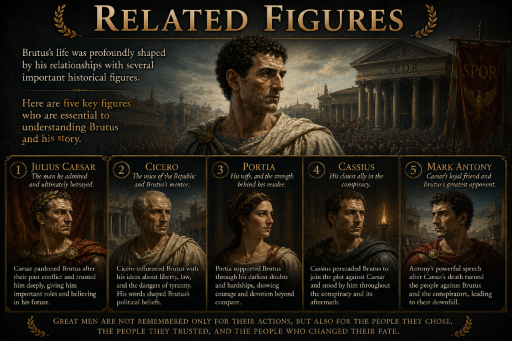
Brutus’s life was profoundly shaped by his relationships with several important historical figures.
Here are five key figures who are essential to understanding Brutus and his story.
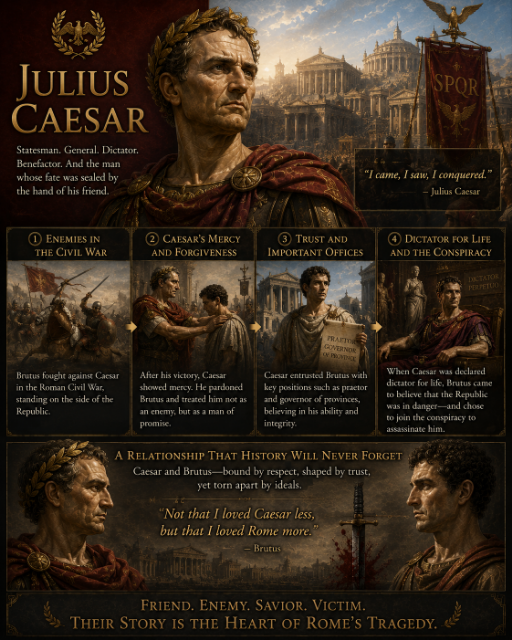
One of the most prominent statesmen and military commanders of ancient Rome, Julius Caesar was also Brutus’s benefactor.
Although they fought on opposing sides during the civil war, the victorious Caesar pardoned Brutus and later entrusted him with important political offices, including praetor and provincial governor.
However, when Caesar became dictator for life, Brutus chose to join the assassination conspiracy in an attempt to defend the Roman Republic.
Their relationship has become one of history’s most famous examples of the conflict between personal loyalty and political conviction.
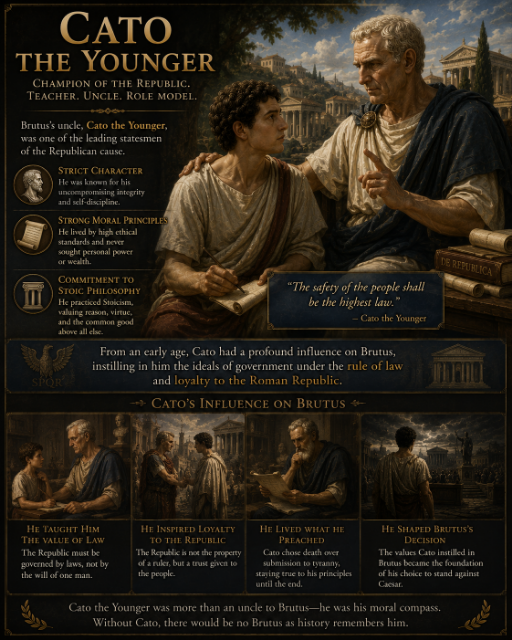
Cato the Younger
Brutus’s uncle, Cato the Younger, was one of the leading statesmen of the Republican cause.
He was renowned for his strict character, strong moral principles, and commitment to Stoic philosophy.
From an early age, Cato had a profound influence on Brutus, instilling in him the ideals of government under the rule of law and loyalty to the Roman Republic.
Cato’s influence is essential to understanding why Brutus later became so determined to defend the Republic.
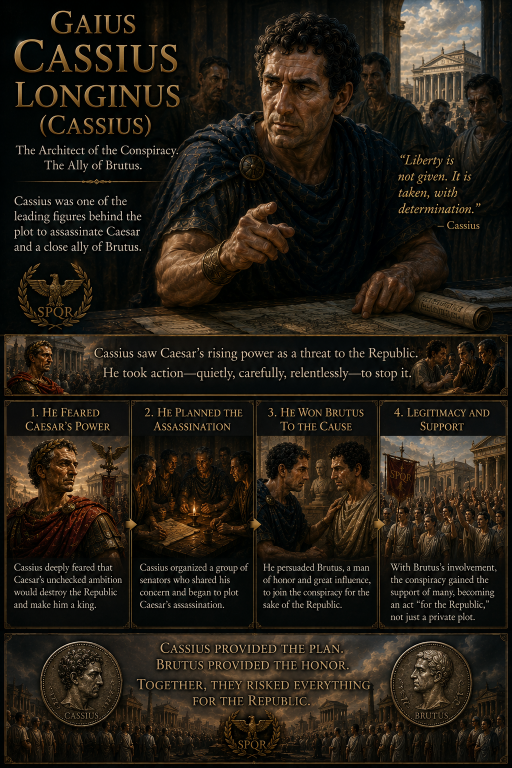
Gaius Cassius Longinus (Cassius)
Cassius was one of the leading figures behind the plot to assassinate Caesar and a close ally of Brutus.
Deeply alarmed by Caesar’s growing power, Cassius played a central role in organizing the assassination conspiracy.
He then persuaded Brutus, who was highly respected by many Roman citizens and senators, to join the plot.
Brutus’s participation gave the conspiracy greater legitimacy, allowing it to be presented not merely as a plot by Caesar’s political enemies, but as an attempt to defend the Roman Republic.
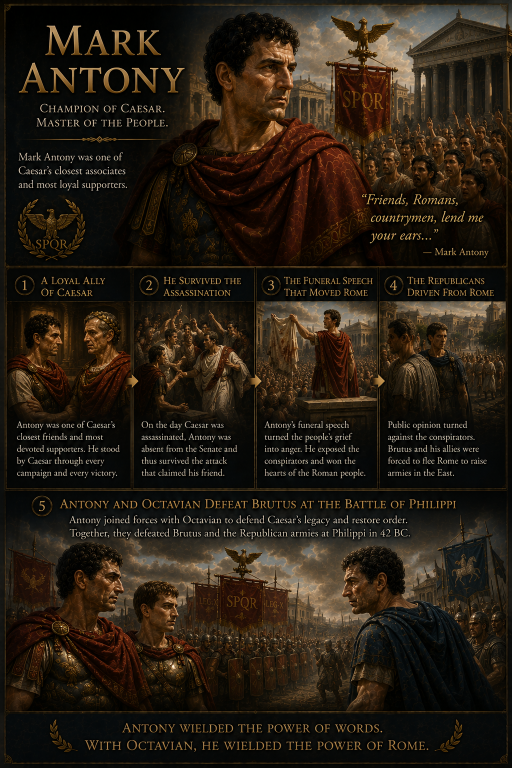
Mark Antony was one of Caesar’s closest associates and most loyal supporters.
He survived the day of Caesar’s assassination and later delivered a powerful funeral speech that stirred the emotions of the Roman people.
As a result, public opinion turned against the Republican conspirators, forcing Brutus and his allies to flee Rome.
Antony later joined forces with Octavian to fight the Republican armies, ultimately defeating Brutus at the Battle of Philippi.
Octavian (Augustus)
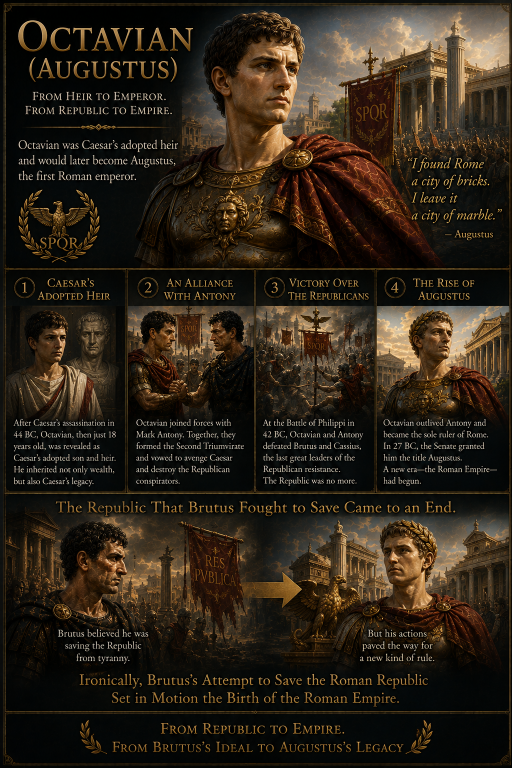
Octavian was Caesar’s adopted heir and would later become Augustus, the first Roman emperor.
Although he was still a young man at the time of Caesar’s assassination, he joined forces with Mark Antony to defeat the Republican faction and eventually emerged as the sole ruler of Rome.
The Republic that Brutus had fought to preserve ultimately came to an end during Octavian’s rise to power.
Ironically, Brutus’s attempt to save the Roman Republic ultimately helped set in motion the events that paved the way for the birth of the Roman Empire.
Understanding Brutus Through His Relationships
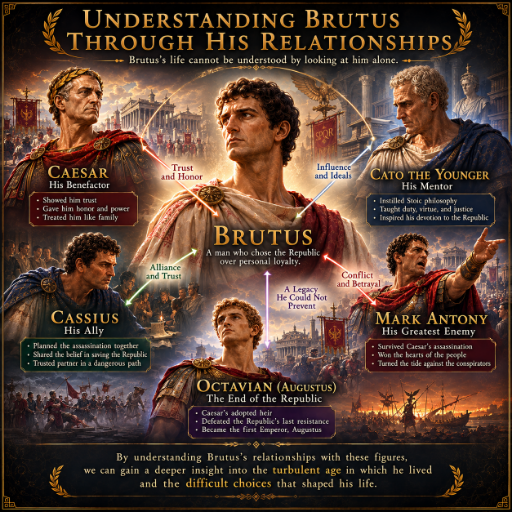
Brutus’s life cannot be understood by looking at him alone.
There was Caesar, his benefactor; Cato the Younger, his philosophical mentor; Cassius, his ally in the conspiracy; Mark Antony, who became his greatest enemy; and Octavian, who ultimately brought the Roman Republic to an end.
By understanding Brutus’s relationships with these figures, we can gain a deeper insight into the turbulent age in which he lived and the difficult choices that shaped his life.
For Those Who Want to Learn More About Caesar
This article explores the life of Brutus in detail.
Why did he change the course of history?
What reforms did he carry out, and why is he still remembered today as both a hero and a dictator?
If you would like to learn more about Caesar, read the article below.
👉 Julius Caesar — The Man Who Changed History

Become Part of the Chronicle
If this article inspired you, consider supporting the project.
Become a character in the Chronicle.
Receive your own custom card and stand alongside queens, warriors, inventors, rebels, and legends from history.
Your support helps keep these stories alive and allows me to create more articles, illustrations, and historical cards.
Join the Chronicle and leave your mark on history.

Comment