
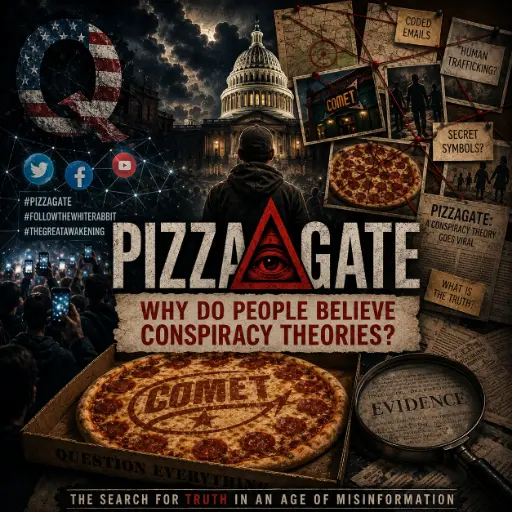
Introduction
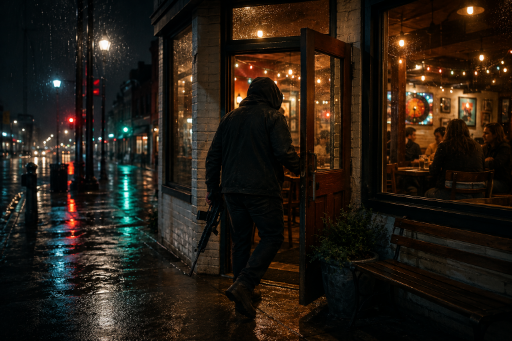
On December 4, 2016, a man carrying a rifle entered a small pizza restaurant in Washington, D.C.
His goal was not to commit a robbery. Pizzagate — one of the largest conspiracy theories created by the internet.
On December 4, 2016, a man entered a small pizza restaurant in Washington, D.C.
He believed:
“Children who had been kidnapped were being held captive in the basement of this restaurant. I have to rescue them.”
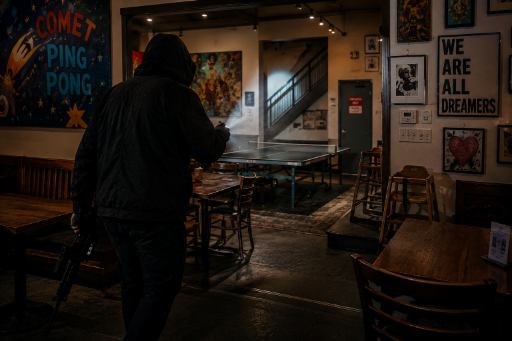
However, a search of the restaurant found no children.
In fact, Welch searched the premises but found neither children nor any secret facility.
What he believed was a conspiracy theory known as “Pizzagate.”
The incident has become a symbolic example of how a single false rumor can spread widely through the internet and ultimately develop into a real-world act of violence.[2][5]
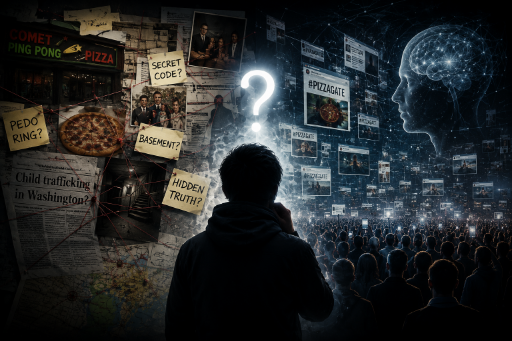
However, simply dismissing this event as “just a conspiracy theory” does not allow us to understand the human beings behind it.
Why did so many people believe this story?
And why do humans try to uncover “hidden truths” from among countless pieces of information?
In this article, we will trace the Pizzagate incident chronologically while exploring the background behind it and the psychology of the people who came to believe it.

The 2016 U.S. Presidential Election
In 2016, the United States was in the midst of one of the most fiercely contested presidential elections in recent years.
Democratic candidate Hillary Clinton and Republican candidate Donald Trump were locked in a bitter race, deeply dividing the American public.
Amid this intense political climate, an event occurred that would shake the election campaign.
John Podesta, the chairman of Hillary Clinton’s presidential campaign, had his email account hacked, resulting in the release of a massive trove of emails.
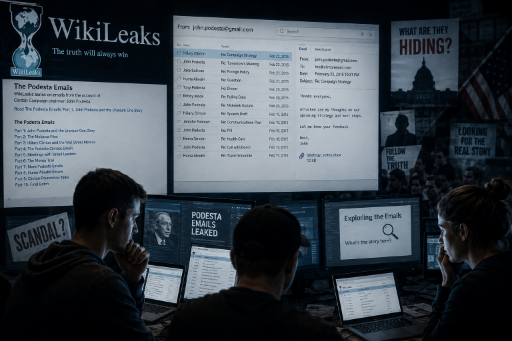
Later, WikiLeaks published a large collection of Podesta’s emails. [1]
The correspondence between politicians became publicly accessible, and many people began reading through the messages.
At first, many were looking for political scandals.
However, some internet users began to notice something else.
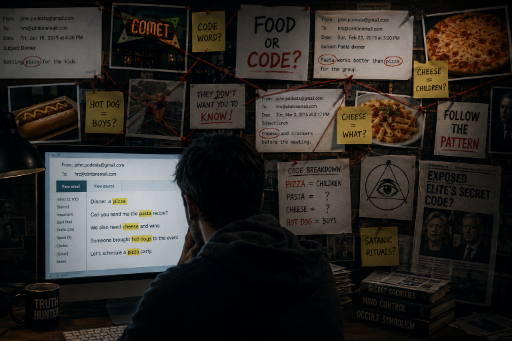
The emails contained repeated references to words related to food, such as:
- Pizza
- Pasta
- Cheese
- Hot Dog
Of course, these could simply have been references to food.
However, some people began to wonder:
“Could this be about something other than an ordinary discussion about food?”
They began to suspect that the words might have a hidden meaning.
Chapter 2: Is “Pizza” a Code? — The Birth of a Conspiracy Theory

After John Podesta’s emails were released, people around the world began reading through their contents.
However, no series of definitive political scandals emerged from the emails.
Instead, some internet users began analyzing the messages from a different perspective.
“What if we don’t read these as ordinary messages, but as coded communications? Could their meaning change?”
This idea became the starting point for what would later be known as the Pizzagate narrative.[2]
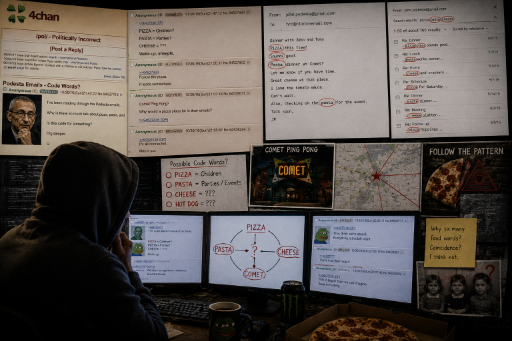
Speculation Spread on 4chan
At the time, users on the political board of the anonymous forum 4chan discussed the released emails on a daily basis.
They focused on words such as “Pizza” and “Pasta,” which appeared repeatedly throughout the emails.
“Why are there so many references to food in emails between politicians?”
From this question, one user posted a hypothesis:
“What if these words are not about food, but are codes with another meaning?”
The hypothesis spread rapidly, and many people began reading the emails line by line as if they were trying to decipher a secret code.
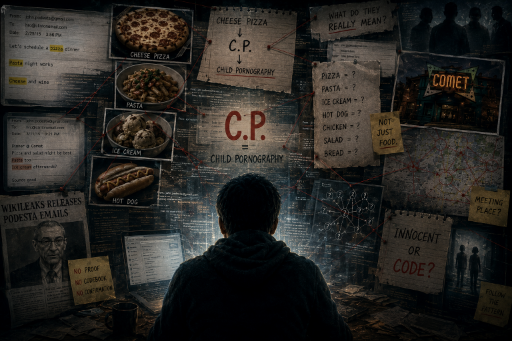
“CP” as an Abbreviation
One term that attracted particular attention during these discussions was “Cheese Pizza.”
On the internet, “CP” had long been known as an abbreviation that could refer to child pornography.
This led to the following association:
Cheese Pizza
↓
C.P.
↓
Child Pornography
From there, further speculation emerged that words such as:
- Pizza
- Pasta
- Ice Cream
- Hot Dog
might also have hidden meanings.
However, there is no verified public evidence supporting these supposed connections, nor is there any officially recognized codebook linking these food-related terms to such meanings.
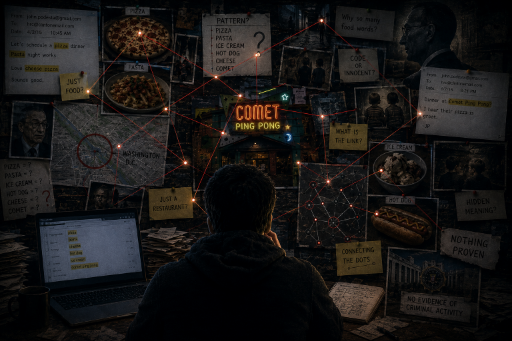
“The Dots” Begin to Form a Line
People do not usually build a grand narrative from a single coincidence.
However, when multiple coincidences appear to overlap, we tend to connect them and interpret them as part of the same story.
The emails also contained the name “Comet Ping Pong,” a pizza restaurant in Washington, D.C.
On its own, of course, this was simply the name of a restaurant.
But for those who had already accepted the premise that “pizza” was a code, the restaurant began to take on a special significance.
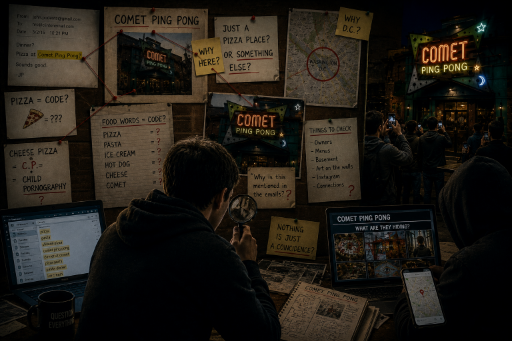
“Why does the name of this restaurant appear in the emails?”
“Could it really be just an ordinary pizza restaurant?”
And so, people began investigating the restaurant itself.
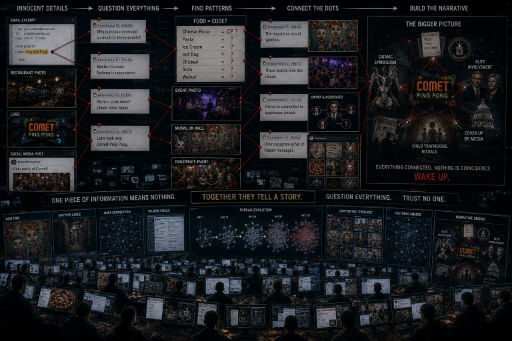
“Collective Investigation” on the Internet
Before long, large numbers of internet users began investigating the restaurant simultaneously.
- The restaurant’s official website
- Google Maps
- Social media posts
- The owner’s social connections
- Past events
- Artwork displayed on the walls
- Photos from events for children
Every piece of information they could find was collected and posted on online forums.
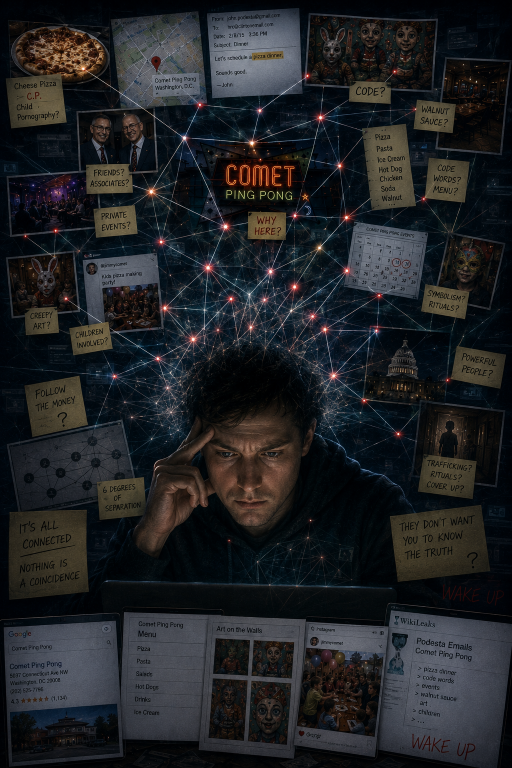
Each piece of information, taken on its own, had no particular significance.
But when viewed through the assumption that “a criminal organization exists,” everything began to look like evidence.
One person would post a photograph, and another would add a new interpretation.
Someone else would then search for information that appeared to support that interpretation.
In this way, the hypothesis gradually transformed into a vast and elaborate narrative.
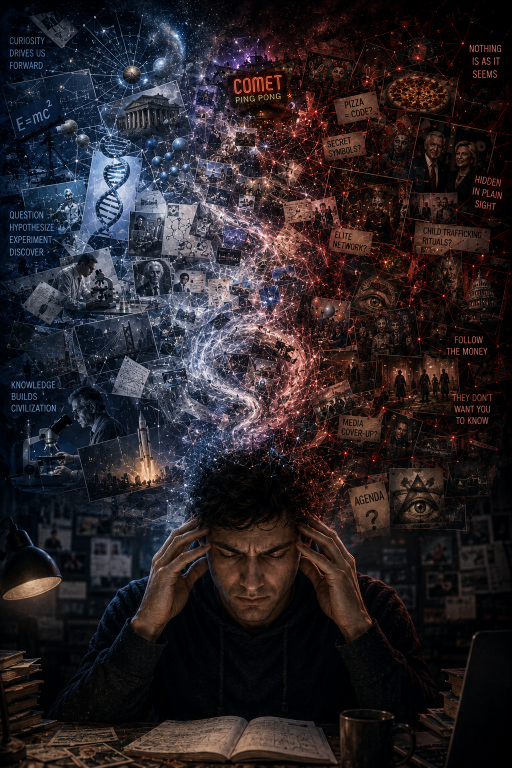
Humans Are Creatures That Search for Meaning
At this stage, there had been no police raids and no direct evidence supporting claims of child trafficking.
Even so, many people became convinced that “something was being hidden.”
This was not unique to Pizzagate.
The human brain has a tendency to find patterns and meaning even in unrelated pieces of information.
That ability has helped humanity build civilizations and advance science.
But when we connect the dots before sufficient evidence exists, we can end up believing a story that does not actually exist as reality.
The Pizzagate case was a striking example of where that boundary can lie.
Chapter 3: Why Did “Comet Ping Pong” Become a Target?
As the theory that “pizza might be a code” began to spread online, people started asking another question:
“Then what does the pizza refer to?”
The answer that emerged was a pizza restaurant in Washington, D.C., called Comet Ping Pong.
From that point on, a single restaurant would become the focus of attention from people around the world.
An Ordinary Pizza Restaurant
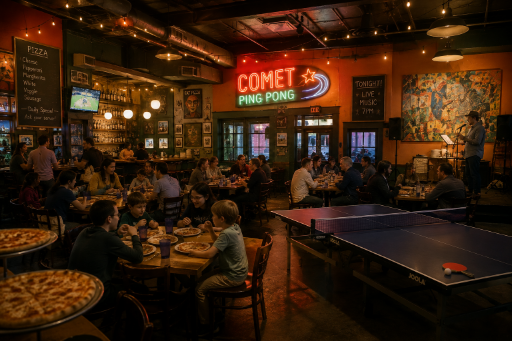
Comet Ping Pong was a well-known local pizza restaurant.
The restaurant had ping-pong tables and hosted live events and activities for children, making it a popular destination for families.
Politicians and public figures also visited the restaurant, but given its location in Washington, D.C., this was hardly unusual.
At first, there was little reason to suspect the restaurant.
However, a different narrative began to emerge online.
The Restaurant’s Name in the Emails
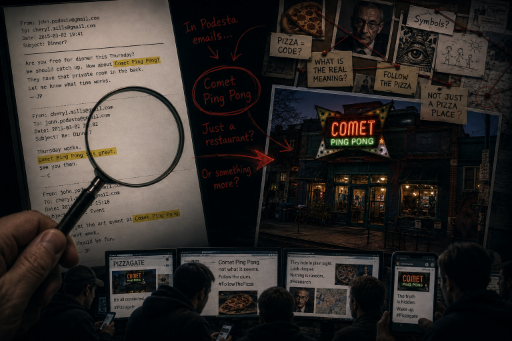
The name “Comet Ping Pong” appeared several times in the released Podesta emails. [1]
The messages referred to plans to dine at the restaurant and to events held there.
Under normal circumstances, these would simply be understood as casual exchanges between friends.
But for those who approached the emails with the assumption that “pizza” was a code, they took on a different meaning.
“If pizza is a code, could this restaurant be more than just an ordinary restaurant?”
This idea pushed Comet Ping Pong to the center of the conspiracy theory.

The Owner Comes Under Suspicion
Before long, attention shifted from the restaurant itself to its owner.
The owner, James Alefantis, was a well-known figure in Washington, D.C.’s social circles and had connections with politicians and artists.
Supporters began compiling lists of his acquaintances and posting information on online forums:
“I know this person too.”
“He has been photographed with this politician.”
Meanwhile, in Washington, D.C., it was hardly unusual for restaurant owners to have connections with people in politics, and social relationships alone could not establish evidence of a crime.
However, for those who already believed that a crime was taking place, these connections began to look like evidence of an organized network.
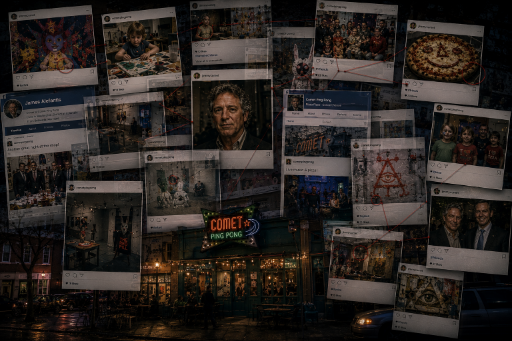
SNS Posts Begin to Be Treated as “Evidence”
Next, attention turned to the social media accounts of the restaurant’s owner and associates.
Instagram and Facebook contained numerous posts featuring:
- Modern art
- Children’s events
- Photos with friends
- Everyday activities
Some of the posts included contemporary artworks that appeared disturbing to certain viewers, as well as photographs that could be misleading when taken out of context.
Supporters of the conspiracy theory began interpreting these posts as “codes” or “evidence” of criminal activity.
However, many of the posts were circulated without their original context and did not constitute direct evidence of any crime.
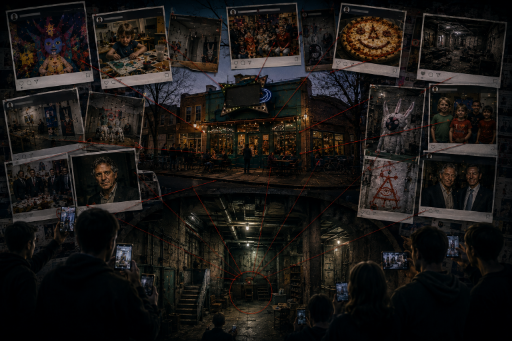
“The Basement” Rumor
One of the most widely circulated claims was the idea that:
“Children were being held captive in the restaurant’s basement.”
However, there was a fundamental problem with this claim.
Comet Ping Pong did not have the secret underground facility described in the conspiracy theory.
The subsequent investigation confirmed the circumstances surrounding the incident, including Welch’s search of the restaurant after he entered it armed.[4][5]
Even so, the claim that the restaurant had a basement was repeatedly circulated online, and many people came to accept it as though it were an established fact.
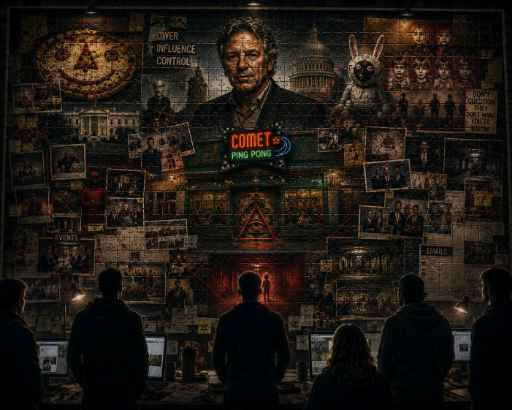
“From Gathering Evidence” to “Creating a Narrative”
By this point, new pieces of “evidence” were being posted online almost every day.
A single photograph.
A single email.
A single social media post.
Information that meant little on its own was gradually connected under the assumption that:
“They all point to one vast criminal organization.”
Then came the growing conviction:
“If this much evidence has been collected, it must be true.”
That belief drew even more people into the narrative.
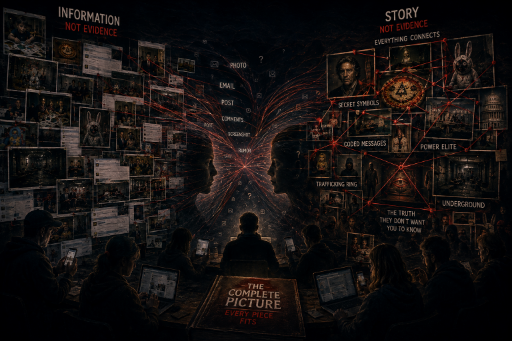
Information Becomes a “Narrative” Rather Than “Evidence”
What matters here is not the information itself.
What matters is how people assign meaning to that information.
The same photograph may be seen by one person as “an ordinary moment,” while another may interpret it as “a hidden message.”
More information does not necessarily bring us closer to the truth.
Sometimes, an increase in information can instead create an increasingly elaborate narrative.
That was precisely what happened in the Pizzagate case.
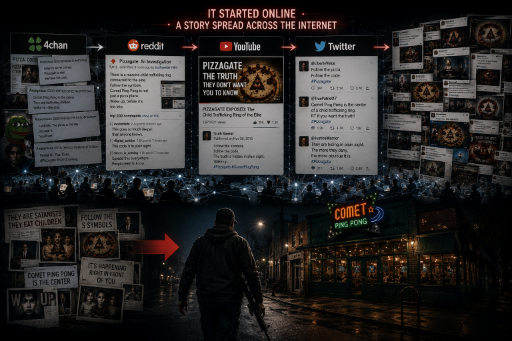
However, this story still existed only within the online world.
It eventually spread from anonymous forums such as 4chan to platforms like Reddit, YouTube, and Twitter, and Pizzagate became widely known across the internet.[2][3]
Then, one man who believed the story was real would take a rifle and head to the pizza restaurant.
Chapter 4: The Internet Began Searching for the “Truth”
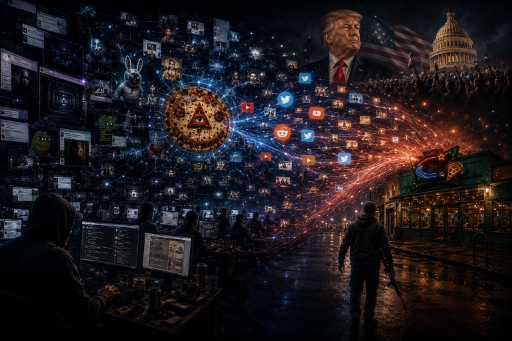
November 2016.
After the U.S. presidential election ended with Donald Trump’s victory, the Pizzagate story did not disappear. Instead, it gained even more momentum.
At first, the story was discussed only within limited corners of the internet, such as anonymous forums.
But the discussion eventually spread across the internet as a whole.
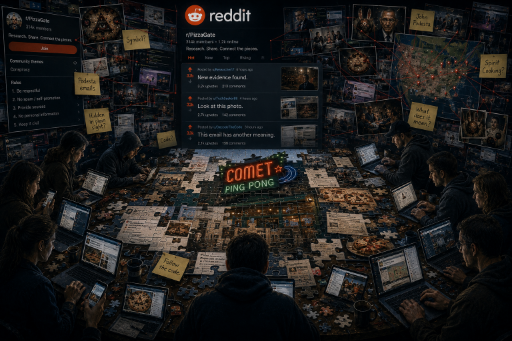
Next, Reddit, a news and information-sharing website, played a major role in spreading the story.
A community dedicated to Pizzagate was created on Reddit, where users began bringing information together. [3]
Every day, posts appeared such as:
“I found new evidence.”
“Look at this photograph.”
“This email has another meaning.”
It was as though large numbers of people were gathering information together in an attempt to complete one enormous jigsaw puzzle.
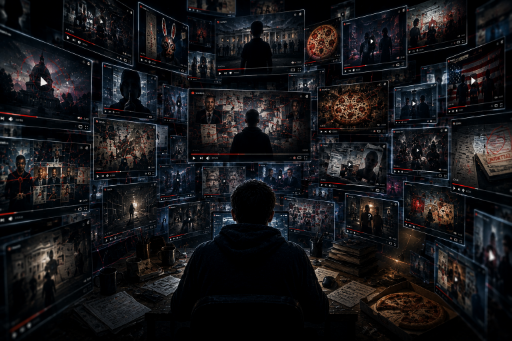
YouTube Creates “Documentaries”
YouTube also saw the publication of numerous videos.
Titles such as:
“The Full Story of Pizzagate”
“The Hidden Truth”
“What the Media Won’t Tell You”
appeared one after another, and some of these videos attracted very large numbers of views.
Video can create a powerful sense of persuasion in a way that written text does not.
When still images are presented alongside a calm narration, the result can easily give the impression of an investigative report.
With the addition of background music and visual effects, these videos could come to be perceived as cinematic stories rather than unverified claims.
The Explosive Spread Through Twitter and Facebook
Social media also accelerated the phenomenon.
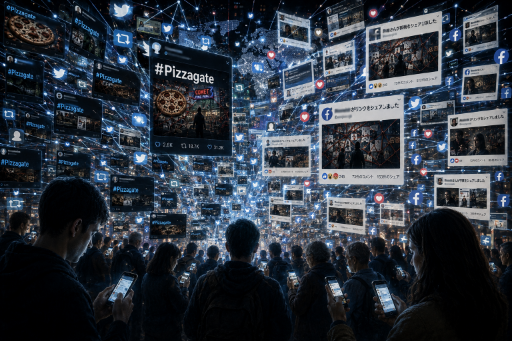
On Twitter, the hashtag “#Pizzagate” spread rapidly, and many users shared related information. [2]
On Facebook, posts were shared among friends and family, allowing the story to reach people who had previously shown little interest in conspiracy theories.
As a result, Pizzagate became known not only within certain anonymous online communities, but also among ordinary social media users.

The Frenzy of “Investigating Together”
By this point, many people had begun to see themselves as “investigators.”
Some searched the area around the restaurant on Google Maps.
Others looked for building plans.
Some went back through years of old social media posts.
Others analyzed the emails line by line.
The hope that information they could not find alone might be uncovered if enough people searched simultaneously drew them deeper into the investigation.
This was a phenomenon unique to the internet age.
People from all over the world, most of them complete strangers to one another, were trying to solve the same mystery.
Social Media Accelerates the Frenzy
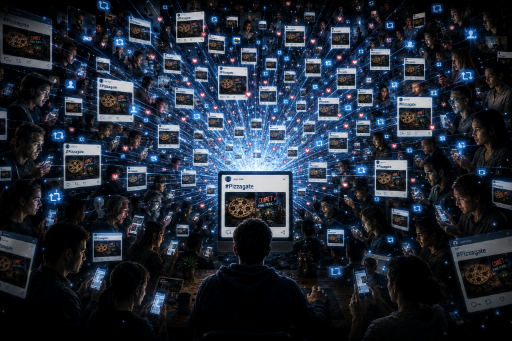
The very structure of social media also played a major role in the spread of Pizzagate.
On social media, information that users showed interest in could appear repeatedly, increasing their exposure to the same narrative.
Once someone encountered Pizzagate-related content, the same story would appear again and again through other posts, videos, comments, and discussions.
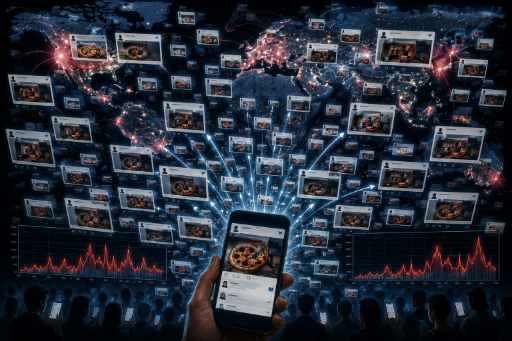
In November 2016, the hashtag “#Pizzagate” appeared on Twitter, after which large numbers of related posts began to be shared. [2]
According to reports at the time, Pizzagate-related posts were being tweeted and retweeted hundreds or even thousands of times per day over a period of several weeks. [2]
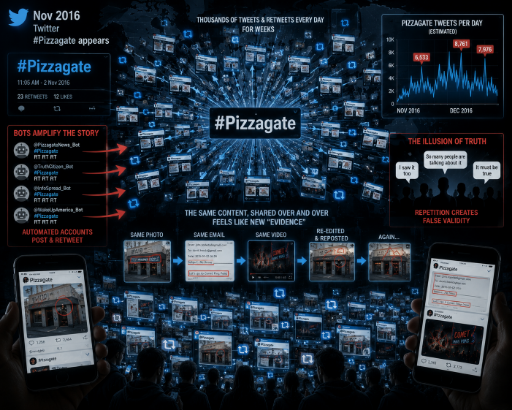
Some posts were also reported to involve automated accounts believed to be bots, which further amplified the spread of the information. [2]
On social media, repeatedly sharing the same information can make a rumor appear to be something that “many people already know.”
Furthermore, when the same photographs, emails, and videos are repeatedly quoted and re-edited, they can create the impression that a stream of “new evidence” is continually emerging, even when it is actually the same information being recycled.
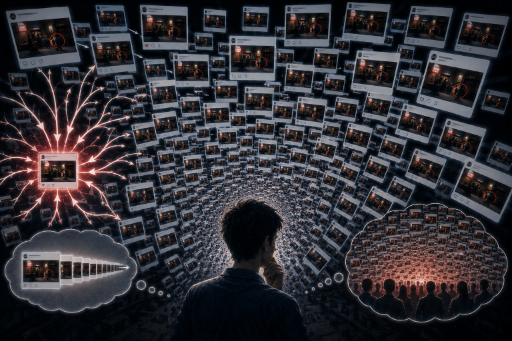
As a result, users became more likely to think:
“If there is this much information out there, it must be true.”
In reality, the same information was often being repeatedly quoted and re-edited.
A single piece of unverified information might simply have been copied 100 times.
Yet on the screen, it could appear as though an enormous amount of evidence existed.
In this way, the sheer volume of information gradually came to be perceived as a sign of its credibility.
Distrust in the Media
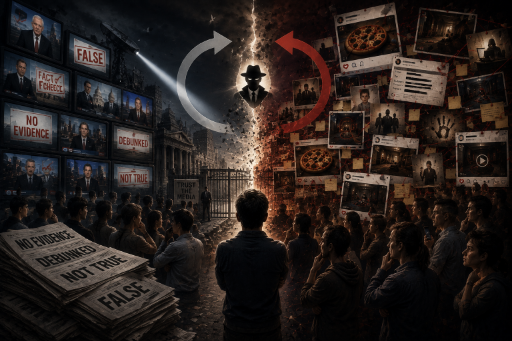
By this point, many people had also grown distrustful of the mainstream media.
“The television networks don’t report the truth.”
“The newspapers protect those in power.”
For people who already held these views, the more the media denied the Pizzagate claims, the stronger their suspicion could become:
“Maybe they really are hiding something.”
In other words, a structure had emerged in which the denial of the conspiracy itself could be interpreted as evidence of the conspiracy, making the claims increasingly resistant to disproof. [2][3]
The Sense of Mission to “Expose the Truth”
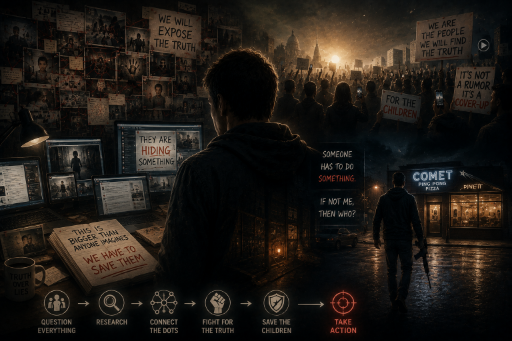
In this way, many people began to see themselves not simply as internet users, but as:
“Citizen investigators determined to uncover the hidden truth.”
To them, Pizzagate was no longer just a rumor.
It was a righteous mission to save children.
And there was one man who came to believe in that sense of mission more strongly than anyone else.
He believed that “someone had to take action.”

And on December 4, 2016, he took a rifle and headed to a pizza restaurant.
People Act According to What They Believe
We do not always respond to reality itself.
We respond to what we believe to be reality.
If someone genuinely believed that children were being held captive in front of them, many people would be willing to risk danger to try to rescue them.
That is why the core issue is not simply that someone took action, but what they believed was the basis for that reality.
The Pizzagate incident demonstrated how information can shape a person’s beliefs, and how those beliefs can ultimately turn into real-world action.
Chapter 5: “Saving the Children” — Pizzagate Becomes Reality
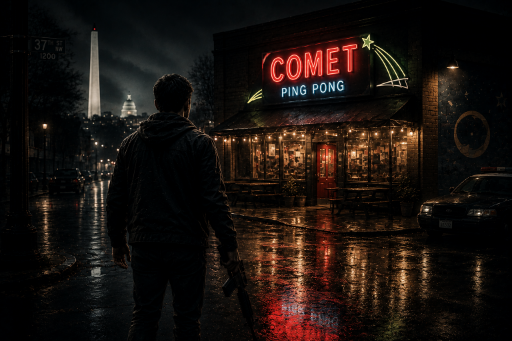
December 4, 2016.
Pizzagate was no longer just an online rumor.
It had become a real-world incident.
That day, a man carrying a rifle headed to the Washington, D.C., pizza restaurant Comet Ping Pong.

“Someone Had to Take Action”
The man’s name was Edgar Maddison Welch.
He was 28 years old at the time.
He was a father of two living in North Carolina.

For several weeks, he continued reading information about Pizzagate online.
Posts on online forums.
YouTube videos.
“Evidence” shared on social media.
As he continued consuming this material, he eventually came to a conclusion.

“The Children Are Really Being Held Captive.”
And another thought began to take hold.
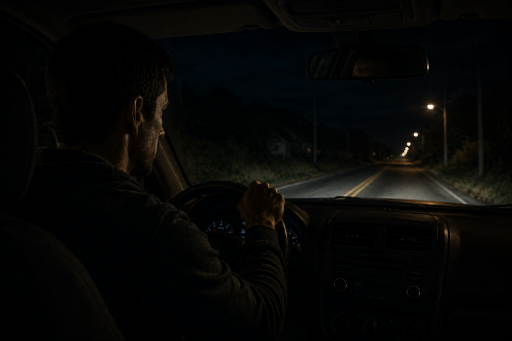
“If it’s true, I have to save them as soon as possible.”
He later gave statements to the effect that he wanted to see for himself whether the claims were true.
However, that attempt to “find out for himself” took a dangerous form: he drove to the restaurant carrying a rifle.[2][4]
Entering the Restaurant
Around 3:00 p.m.
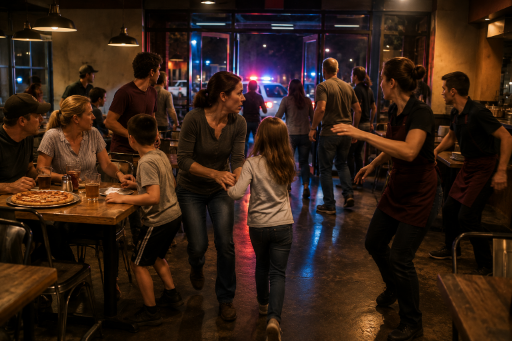
Welch entered the restaurant carrying a rifle and a handgun.[4][10]
At the time, the restaurant was occupied not only by employees but also by customers.[10]
Families were there as well, with children playing ping-pong while their parents enjoyed pizza and beer.
The sudden appearance of an armed man threw the restaurant into chaos.
The employees evacuated the customers and called the police.[4][5]

“Take Me to the Basement”
Welch reportedly asked an employee:
“Where is the basement?”
He believed, based on what he had read online, that children were being held captive underground.[2][4]
But the employee’s answer was unexpected:
“There is no basement.”
He did not believe them.

“Maybe They’re Hiding Something.”
That was what he began to suspect, and he started searching the restaurant himself.

A Single Gunshot
While searching the restaurant, Welch found a locked door.
He wondered whether it might lead to a secret room connected to a hidden basement.
He then fired his weapon at a locked area inside the restaurant.
Fortunately, no one was injured in the shooting.
However, the incident could easily have resulted in multiple deaths.

The “Evidence” He Kept Searching For
Beyond the door were a kitchen and storage areas.

There were no children being held captive.
There was no secret facility.
There was no passage leading to a basement.
Welch walked through the restaurant, continuing to search for the “evidence” he believed in.

The Moment He Faced Reality
Eventually, the police arrived and surrounded the restaurant.
Welch surrendered without resistance.
He later acknowledged that he had found nothing inside the restaurant.[2][4]
He also made statements to the effect that the information he had encountered was not necessarily “100 percent accurate.”
At trial, he was found guilty and sentenced to prison.[5]
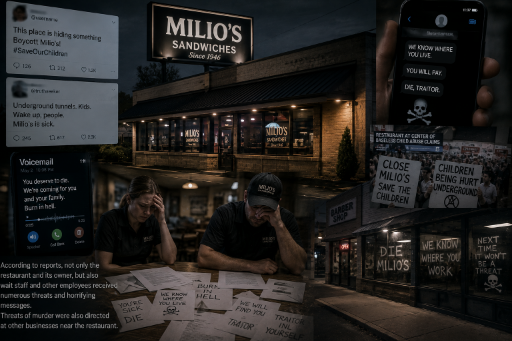
No one lost their life in the incident.
However, the harm was far from insignificant.
The restaurant’s employees and owner continued to receive threats and harassment through social media and phone calls.[6]
According to reports, numerous threats and disturbing messages were sent not only to the restaurant and its owner, but also to waitstaff and other employees.[6]
Other businesses in the surrounding area were also subjected to death threats and harassment.[6]
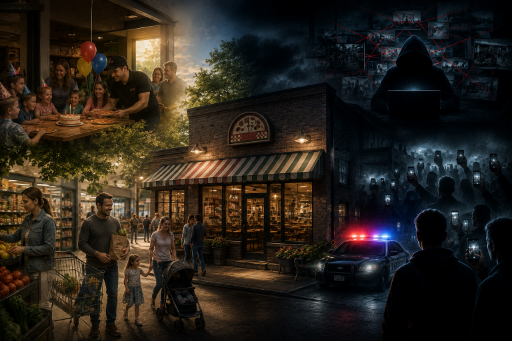
A place where local people had once worked, eaten, and shopped normally was suddenly transformed into a dangerous environment by an internet conspiracy theory.
A neighborhood pizza restaurant where children’s birthday parties were held came to be described online as the “headquarters of a criminal organization.”

“Believing” vs. “Proving”
Welch believed that he was doing the right thing.
If children had actually been held captive, many people might have praised his courage.
But in reality, there was no evidence to support the premise on which his actions were based.
This reveals one of the greatest traps that human beings can fall into.
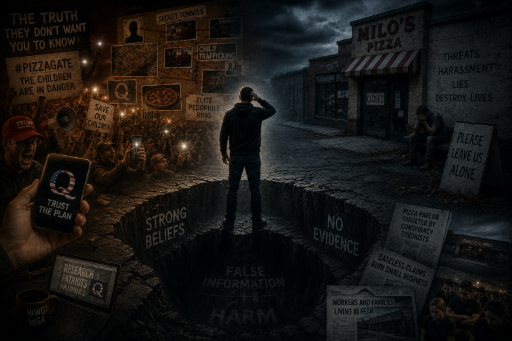
“Strong Belief” Does Not Guarantee “Fact”
No matter how sincere the motive, if the information at its starting point is false, the resulting actions can end up harming others.
The Pizzagate incident left a powerful impression on the world as a stark example of this danger.
But the story did not end there.
If anything, the events surrounding the incident allowed “Pizzagate” to survive in a new form.
Chapter 6: Pizzagate Did Not End — Its Legacy in QAnon
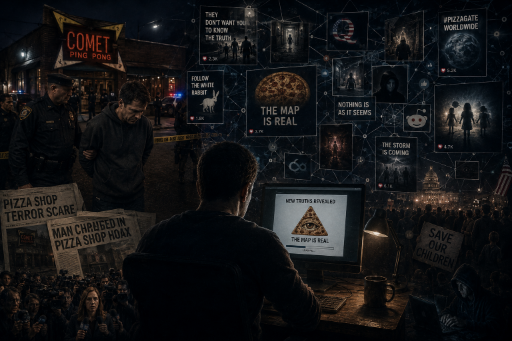
Edgar Maddison Welch’s arrest made it seem as though the Pizzagate incident had come to an end.
“There were no children.”
“There was no basement.”
“Police found no evidence of a crime.”
Many people assumed that the rumor would disappear.
But the reality was different.
Rather than ending, Pizzagate evolved into a new form and continued to live on.
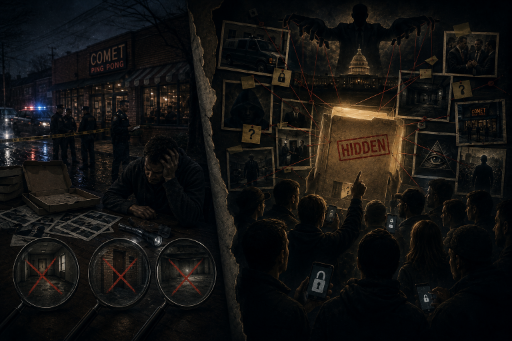
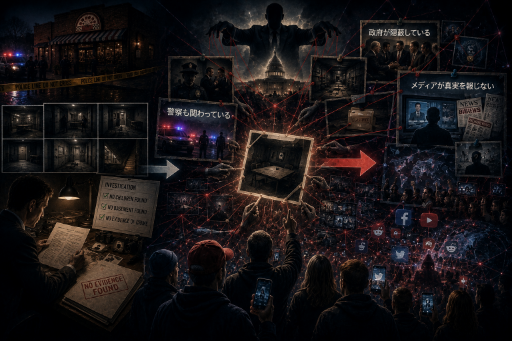
“The Evidence Wasn’t Missing — It Was Hidden”
Many people who believed in Pizzagate did not change their minds after the incident.
They interpreted the fact that “nothing was found” as evidence that “the evidence had been hidden.”
This is one of the characteristics commonly associated with conspiracy theories.
Normally, people revise their beliefs when new evidence comes to light.
But with conspiracy theories, the opposite can sometimes happen.
The very evidence that contradicts the theory can be incorporated into the conspiracy as further proof of its existence.
“The police are involved.”
“The government is covering it up.”
“The media are hiding the truth.”
In this way, the narrative continued to grow and expand.
The Mysterious Poster “Q”
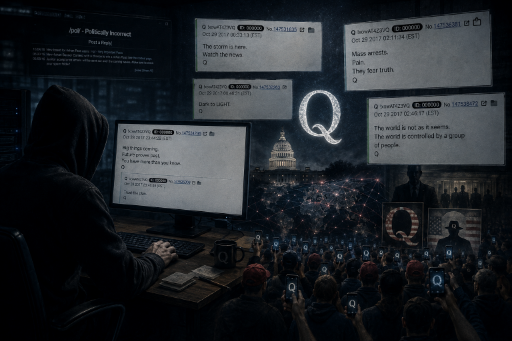
October 2017.
An anonymous poster appeared on the forum 4chan, presenting himself as someone with a high level of authority within the U.S. government.
The name he used was “Q.”
Q began posting cryptic, short messages such as:
“A large number of arrests will take place soon.”
“There is a powerful force controlling the world.”
“The truth will eventually be revealed.”
These posts later became known as “Q drops.”
From Pizzagate to QAnon
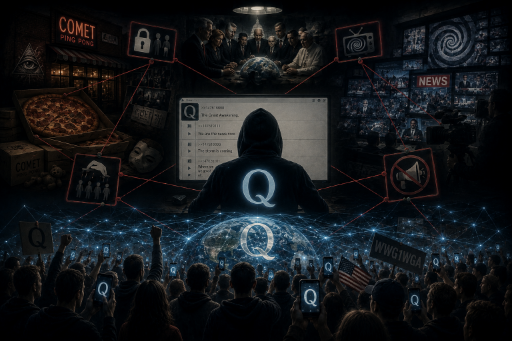
The narrative promoted by Q shared many elements with Pizzagate.[7][8]
For example:
- Powerful figures were secretly committing crimes.
- The media were hiding those crimes.
- Ordinary people were being deceived.
- Those who knew the truth were fighting back.
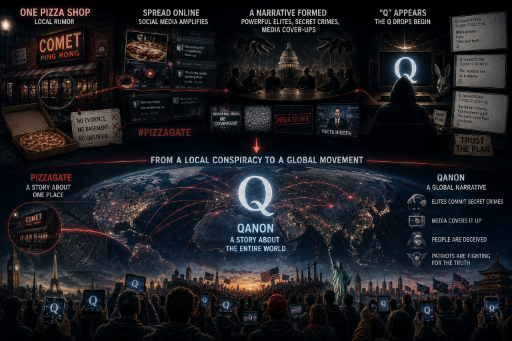
The Setting Expanded from a Single Pizza Restaurant to a Global Scale.
Of course, QAnon did not emerge solely from Pizzagate.[7][8]
However, the narratives that had spread through Pizzagate—such as “powerful figures are secretly committing crimes” and “the media are covering up the truth”—were carried forward into QAnon.[7][8]
If Pizzagate was a story centered on “one restaurant,” QAnon developed into a narrative that placed “the entire world” at its center.[7][10]
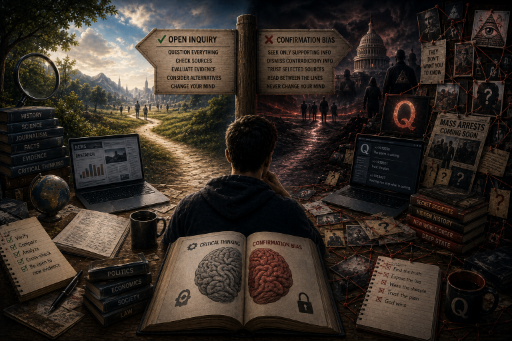
The Pitfall of “Do Your Own Research”
QAnon has a characteristic phrase:
“Do Your Own Research.”
At first glance, this may seem like a perfectly healthy approach.
Rather than blindly accepting what others say, gathering information and examining it for yourself is genuinely important.
However, the real question is which information you collect and how you evaluate it.
If you begin your research with the assumption that “a global conspiracy exists,” you are more likely to seek out information that supports that conclusion and interpret it in ways that fit your existing beliefs.
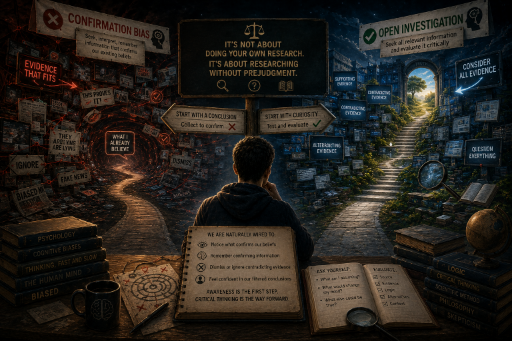
This phenomenon is known in psychology as “confirmation bias.”[9]
In a 1998 review article, psychologist Raymond S. Nickerson described confirmation bias as the tendency to seek out or interpret evidence in ways that are consistent with one’s existing beliefs or hypotheses.
He reviewed research demonstrating that this phenomenon has been observed across a wide range of situations.[9]
In other words, the problem is not “doing your own research” itself.
The problem arises when you decide on a conclusion first and then begin gathering information in order to prove it.
If you genuinely want to know the truth, you must consider not only information that supports your hypothesis, but also information that could potentially disprove it.
People tend to seek out information that confirms what they already believe while overlooking or dismissing evidence that contradicts it.
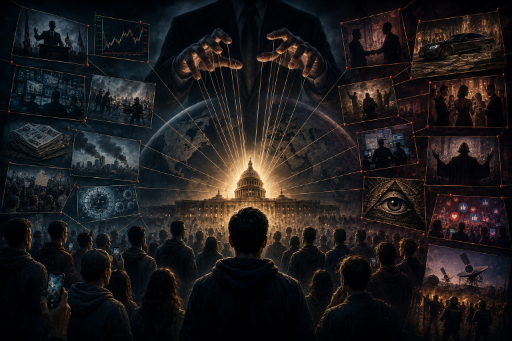
Why Did So Many People Believe It?
The important question here is not, “Why were people deceived?”
Rather, it is:
“Why was this story so compelling to so many people?”
The world is filled with events that are difficult to explain.
- Politics
- Economics
- War
- Crime
All of these factors are deeply interconnected and often extremely complex.
Yet the narrative that “everything is secretly controlled by a single organization” offers a simple storyline that appears to explain this complicated reality.
Human beings tend to seek coherent explanations and narratives when faced with complex and uncertain events.
That is precisely why stories like this can be so persuasive.
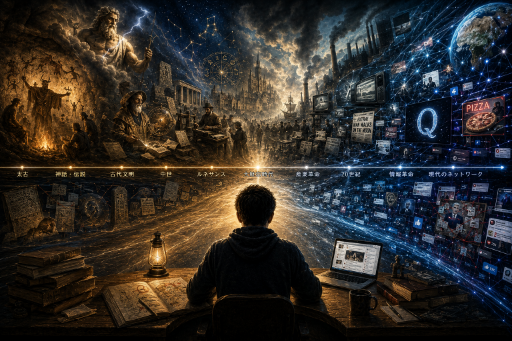
A New Mythology for the Internet Age
In the past, people sought to understand the world through myths and legends.
Thunder was the wrath of the gods.
Plagues were the work of evil spirits.
The movement of the stars was seen as a sign of what the future held.
Today, science has explained many of the mysteries that once seemed beyond human understanding.
Yet the appeal of stories claiming that “hidden truths still exist behind the world we see” has never disappeared.
The internet has made it easier than ever for people around the world to share, reinforce, and expand such narratives.
The Pizzagate incident can be seen as a powerful example of this phenomenon.

Pizzagate was not simply a story that began at a single pizza restaurant.
It was also the result of deeply rooted human desires:
“To know.”
“To find meaning.”
“To understand the world.”
Conclusion: Why Do People Believe Stories?
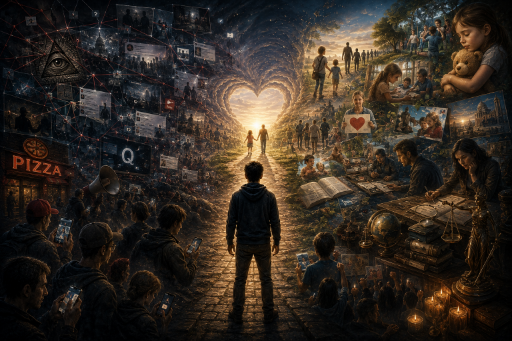
Pizzagate was not simply an incident that took place at a single pizza restaurant.
It was an event that unfolded within the human mind.
Not everyone began by wanting to believe a lie.
Many people genuinely wanted to know the truth.
“I want to save the children.”
“I want to expose crimes committed by those in power.”
Those desires were not wrong in themselves.
The problem was that those desires led to conclusions being formed before the facts were established.

We Are Creatures That Connect the Dots
When we look up at the night sky, we draw lines between the stars and create constellations.
The stars themselves are not actually connected by any lines.
Yet we see Orion.
We see the Big Dipper.
And we create stories around them.
This ability was essential to human evolution.
We see footprints and think:
“There may be prey nearby.”
We see smoke and think:
“There may be a village over there.”
We see clouds and think:
“Rain is coming.”
The ability to find meaning in seemingly unrelated information has helped humanity survive.
But that same remarkable ability can sometimes lead us to draw lines that do not actually exist.
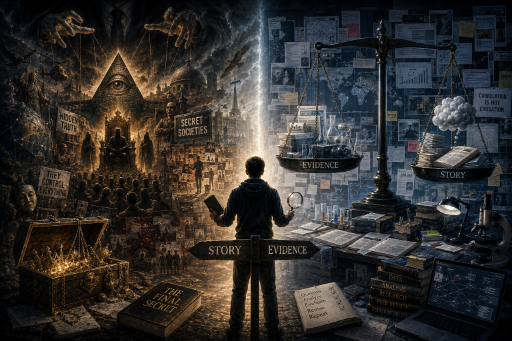
“Evidence” and “Narrative” Are Not the Same
Stories are compelling.
Good and evil.
Heroes and villains.
Hidden truths.
Secret societies.
Organizations that control the world.
These kinds of narratives can make a complicated reality easier to understand.
That is precisely why they can feel reassuring.
But a story being easy to understand does not make it true.
Evidence does not exist to support a predetermined narrative.
Rather, a narrative must be revised whenever the evidence demands it.
Did the Internet Change Human Nature?
When we look at the Pizzagate incident, some people might conclude:
“Social media is to blame.”
“The internet is to blame.”
But is that really the case?
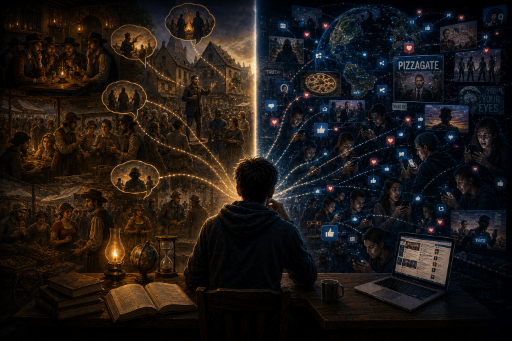
If the same events had happened 500 years ago, rumors might still have spread—
in town squares,
in taverns,
and in marketplaces.
Rather than changing human nature itself, the internet may have simply amplified traits that humans already possessed on an unprecedented scale.
The Pursuit of Truth
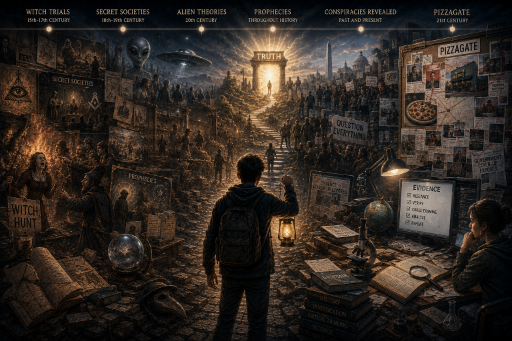
Throughout history, humanity has repeatedly searched for “hidden truths.”
Witch hunts.
Secret societies.
Aliens.
Prophecies.
And Pizzagate.
Some hidden truths have, in fact, existed.
History is filled with countless examples of powerful people lying, concealing wrongdoing, and engaging in conspiracies.
That is why people question what they are told.
There is nothing inherently wrong with questioning.
In fact, it is an essential part of a healthy society.
At the same time, questioning something is not the same as becoming convinced of it.
If we genuinely seek the truth, we must listen not only to information that supports our beliefs, but also to evidence that could disprove them.
The people who truly want to know the truth are those who remain willing to consider that they might be wrong.
Another Lesson Left by Humanity
The Pizzagate incident is not simply a story about how “conspiracy theories are dangerous.”
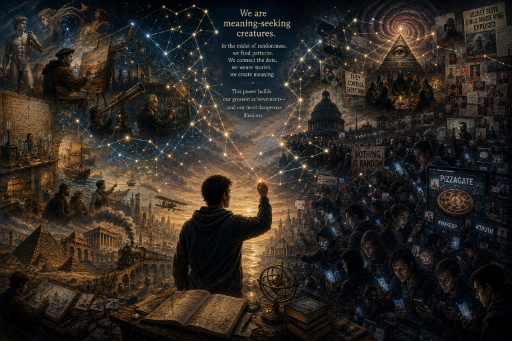
It is part of a much more universal story: human beings are creatures who seek meaning.
We find destiny in coincidence.
We connect countless dots and turn them into a single story.
That ability has given rise to science, inspired art, and helped build civilizations.
But the same ability can sometimes make stories that do not actually exist appear real.
The One Question Pizzagate Leaves Us With
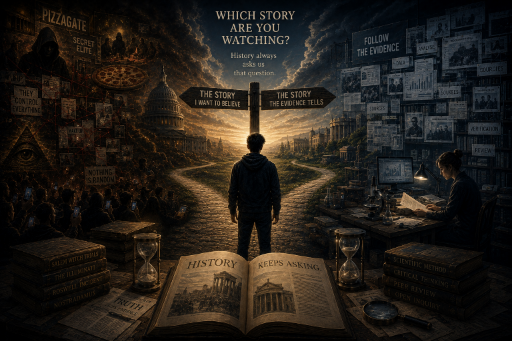
Are you seeing the story you want to believe?
Or are you seeing the story told by the evidence?
History has always asked us that question.

Become Part of the Chronicle
If this article inspired you, consider supporting the project.
Become a character in the Chronicle.
Receive your own custom card and stand alongside queens, warriors, inventors, rebels, and legends from history.
Your support helps keep these stories alive and allows me to create more articles, illustrations, and historical cards.
Join the Chronicle and leave your mark on history.
References & Primary Sources
[1] WikiLeaks, The Podesta Emails — Comet Pizza / Comet Ping Pong
https://wikileaks.org/podesta-emails/?q=Comet+Ping+Pong
[2] Washington Post, “Pizzagate: From rumor, to hashtag, to gunfire in D.C.”, December 6, 2016.
https://www.washingtonpost.com/local/pizzagate-from-rumor-to-hashtag-to-gunfire-in-dc/2016/12/06/4c7def50-bbd4-11e6-94ac-3d324840106c_story.html
[3] Washington Post, “Fearing yet another witch hunt, Reddit bans ‘Pizzagate’”, November 24, 2016.
https://www.washingtonpost.com/news/the-intersect/wp/2016/11/23/fearing-yet-another-witch-hunt-reddit-bans-pizzagate/
[4] U.S. Department of Justice, “North Carolina Man Pleads Guilty to Charges In Armed Assault at Northwest Washington Pizza Restaurant”, March 24, 2017.
https://www.justice.gov/usao-dc/pr/north-carolina-man-pleads-guilty-charges-armed-assault-northwest-washington-pizza
[5] U.S. Department of Justice, “North Carolina Man Sentenced to Four-Year Prison Term For Armed Assault at Northwest Washington Pizza Restaurant”, June 22, 2017.
https://www.justice.gov/usao-dc/pr/north-carolina-man-sentenced-four-year-prison-term-armed-assault-northwest-washington-pizza-restaurant
[6] Washington Post, “‘We’re going to put a bullet in your head’: #PizzaGate threats terrorize D.C. shop owners”, December 6, 2016.
https://www.washingtonpost.com/local/were-going-to-put-a-bullet-in-your-head-pizzagate-threats-terrorize-dc-shop-owners/2016/12/05/39469a82-bb2e-11e6-94ac-3d324840106c_story.html
[7] Anti-Defamation League, “QAnon”, September 24, 2020.
https://www.adl.org/resources/backgrounder/qanon
[8] U.S. House of Representatives, testimony on QAnon and other conspiracy theories, 2020.
https://www.congress.gov/116/meeting/house/111041/witnesses/HHRG-116-Wstate-GinsbergM-20200924.pdf
[9] Nickerson, R. S. (1998). “Confirmation Bias: A Ubiquitous Phenomenon in Many Guises.” Review of General Psychology, 2(2), 175–220.
https://doi.org/10.1037/1089-2680.2.2.175
[10] Washington Post, “How Pizzagate fueled QAnon conspiracy theories and the attack on the Capitol”, February 16, 2021.
https://www.washingtonpost.com/dc-md-va/2021/02/16/pizzagate-qanon-capitol-attack/


Comment