
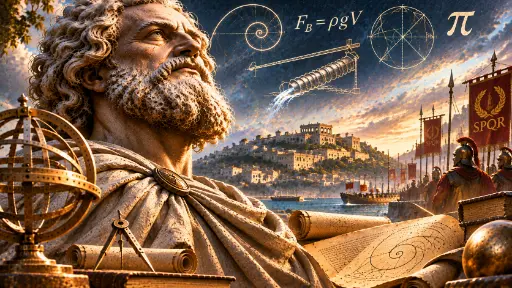
The genius of ancient Greece whose ideas changed science and even influenced the course of war.
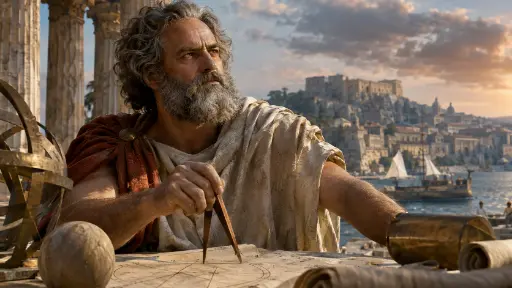
1. The Genius Born in Syracuse

Around 287 BCE, a boy was born in the city of Syracuse on the island of Sicily. His name was Archimedes.
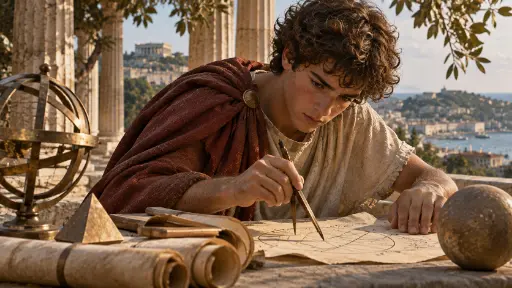
Almost nothing is known about his childhood.
However, as he grew older, he developed a deep fascination with numbers, shapes, and the mysteries of the natural world.
He would eventually become one of the greatest mathematicians of the ancient world.
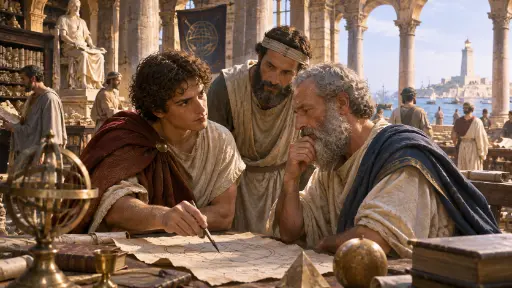
At the time, Alexandria in Egypt was a major center of learning.
Archimedes is believed to have had connections with scholars there, where he expanded his knowledge of mathematics.
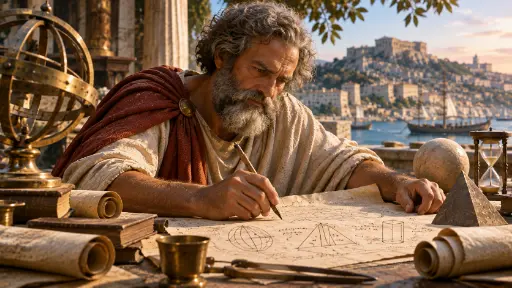
Throughout his life, he continued his research and left a lasting mark on mathematics and physics.
2. Unlocking the Secrets of the World
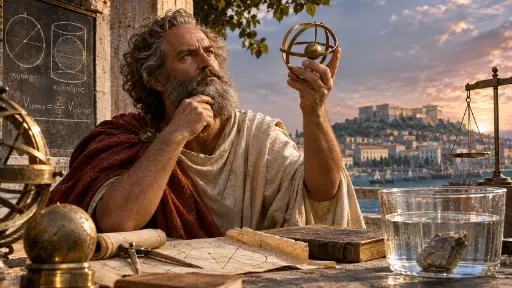
Archimedes’ greatness was not simply that he could solve difficult mathematical problems.
It was his ability to use mathematics to explain how the natural world worked.
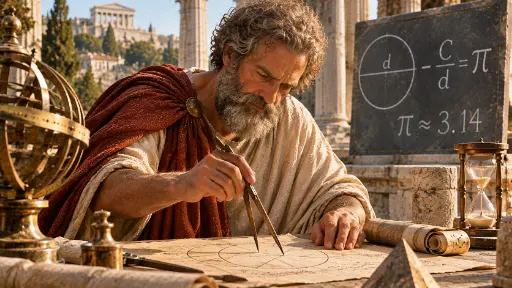
He calculated the value of pi with remarkable accuracy.
Pi is the number that describes the relationship between a circle’s circumference and its diameter.
Today, we commonly use the approximation 3.14, but Archimedes found a remarkably accurate estimate using the mathematical methods available in his time.
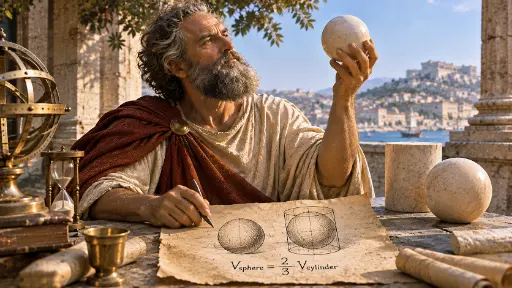
He also proved that the volume of a sphere is two-thirds the volume of the cylinder that perfectly surrounds it.
He was so proud of this discovery that, according to a later account, he wanted a sphere and cylinder engraved on his tomb.
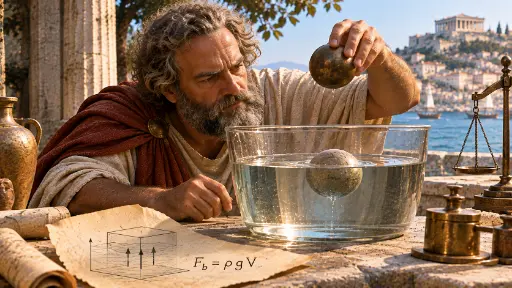
He also studied why objects float in water.
His work led to what is now known as the Archimedes’ principle, which explains the upward force acting on an object immersed in a fluid.
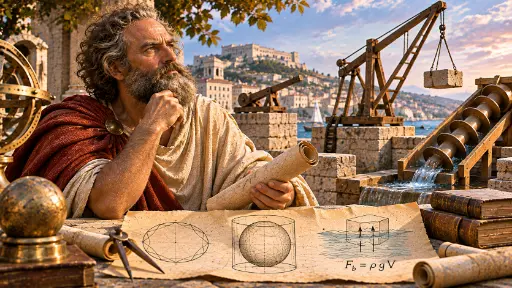
His discoveries helped advance not only mathematics but also physics and engineering.
3. The Inventor Who Served a King
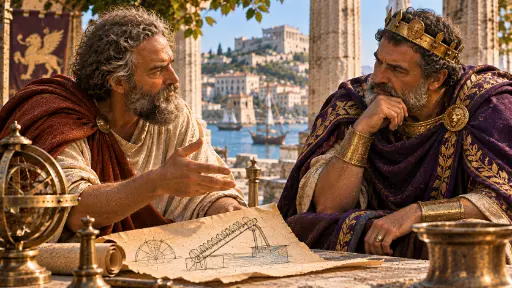
Archimedes was also connected to King Hieron II of Syracuse.
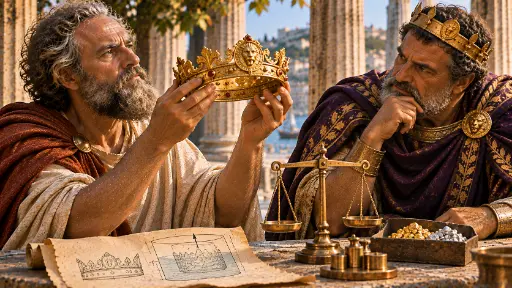
One famous story tells how the king asked him to determine whether a golden crown was made entirely of gold.
The king suspected that a craftsman had secretly replaced some of the gold with silver, but he wanted to find out without damaging the crown.

According to the story, Archimedes finally discovered the solution while taking a bath.
Excited by his idea, he supposedly ran through the streets shouting, “Eureka!” — “I have found it!”
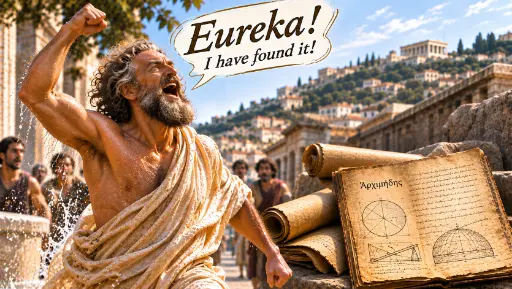
However, this story was recorded centuries after his death, and there is no confirmation of the incident in Archimedes’ own writings.
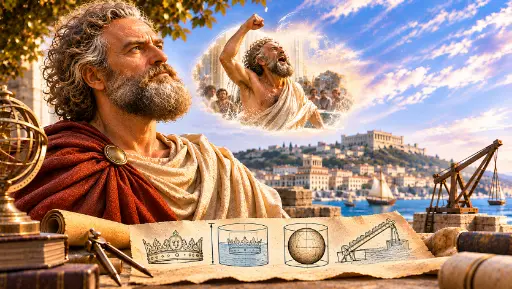
Even so, it has become a lasting symbol of his ability to apply mathematical thinking to real-world problems.
4. The Battle Against Rome
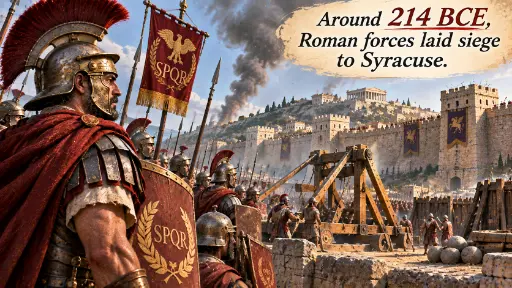
Around 214 BCE, Roman forces laid siege to Syracuse.
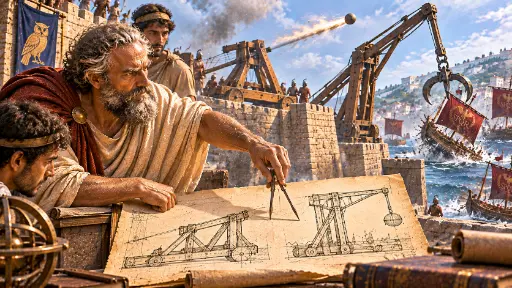
Archimedes reportedly helped defend his city by designing powerful military machines.
His inventions included catapults and mechanical devices capable of attacking approaching enemy ships.
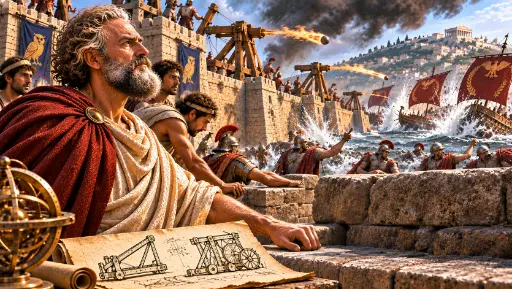
These machines caused serious difficulties for the Roman army.
The mathematician who had once studied the mysteries of the natural world was now using his knowledge to protect his homeland.
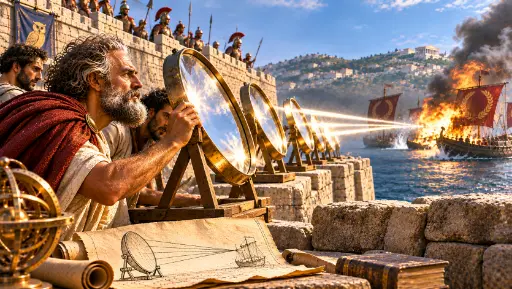
Another famous story claims that Archimedes used enormous mirrors to concentrate sunlight and set Roman ships on fire.
However, this is a later legend, and there is no reliable evidence that such a weapon was actually used.
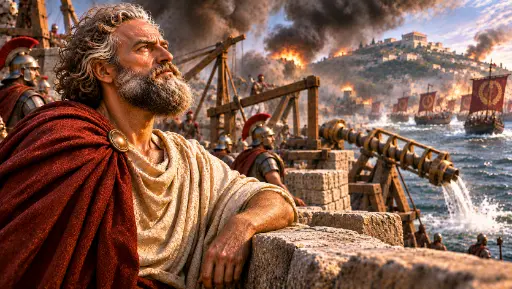
Despite his remarkable inventions, even Archimedes could not defend the city forever.
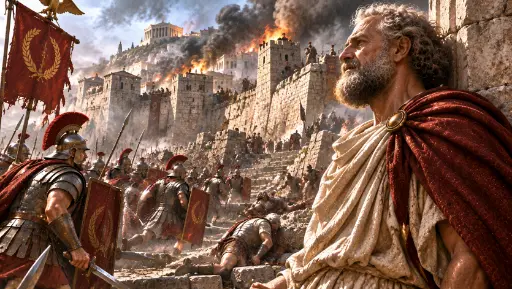
In 212 BCE, after a long siege, Syracuse finally fell to the Romans.
5. The Final Words in the Sand
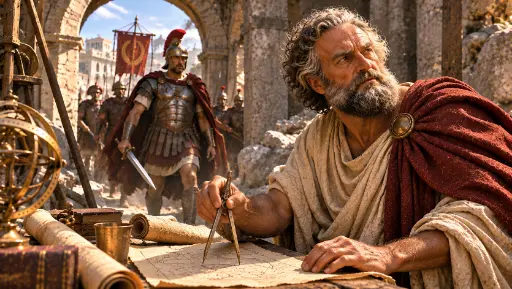
When Roman soldiers entered the city, Archimedes was around seventy-five years old.
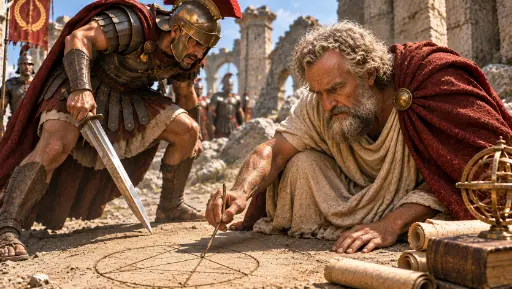
Several accounts describe the circumstances of his death.
One of the most famous tells of a Roman soldier approaching him while he was drawing geometric figures in the sand.
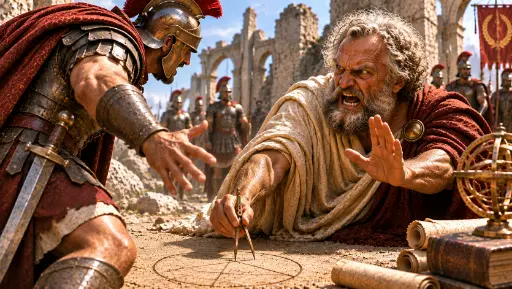
The soldier ordered him to come along, but Archimedes did not want to abandon his work. According to the story, he replied:
“Do not disturb my circles.”
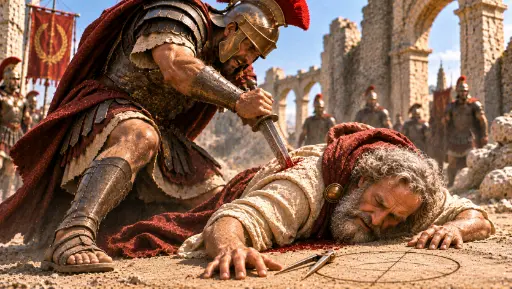
The soldier then killed him.
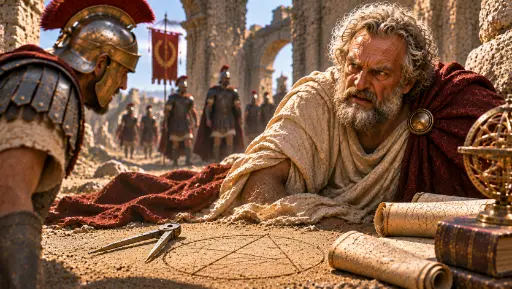
However, we cannot know whether these were truly his final words.
Ancient writers preserved different versions of his death, and the exact circumstances remain uncertain.
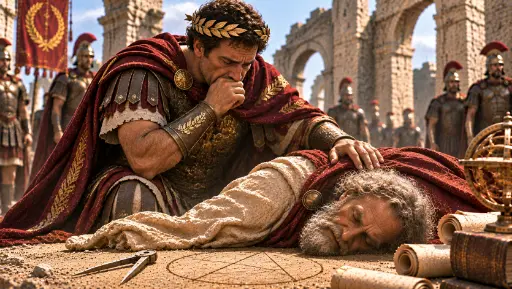
The Roman general Marcellus was reportedly saddened by his death and regretted losing such an extraordinary mind.
6. A Legacy That Outlived Him
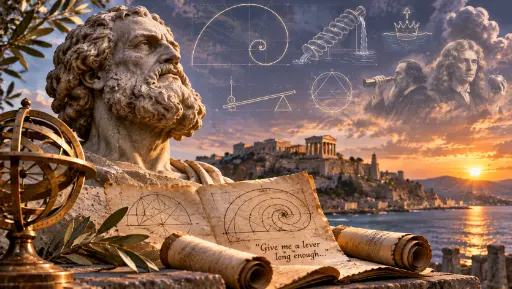
Archimedes’ death did not bring an end to his influence.

His research continued to shape mathematics and physics, inspiring scholars for centuries.
His ideas were studied, preserved, and passed down through generations.
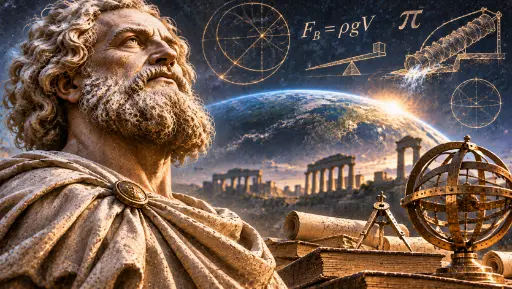
He was neither a king nor a general.
Yet through mathematics, he changed the way humanity understood the world.

He showed that the mysteries of nature could be explored through reason, observation, and mathematics.
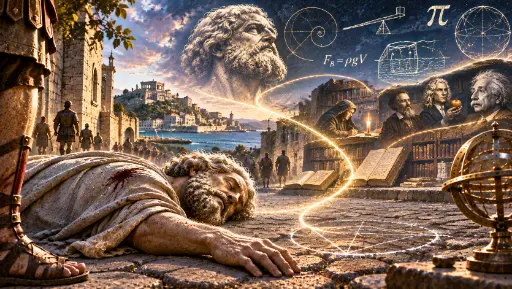
His life ended in the streets of Syracuse, but his ideas survived.

More than two thousand years later, the knowledge he left behind continues to influence science and engineering.
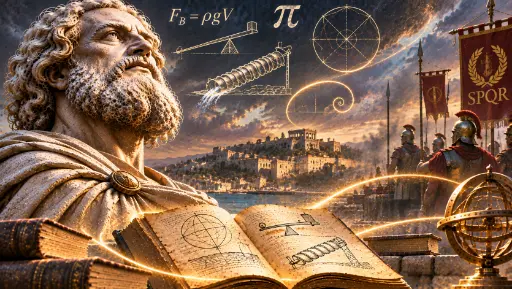
Archimedes may have lost his life when Rome conquered his city, but the wisdom he discovered has never been conquered.
Author:Fuji

Human history is truly complex, isn’t it?
There are countless websites introducing historical figures and events, but many of them are just plain explanations—not exactly exciting to read.
On the other hand, reading books takes a lot of time and effort.
That’s where I come in.
Through “stories that are more engaging than explanations and shorter than books,” I aim to bring the world’s history and humanity’s records to you in a more accessible and interesting way.
If my stories inspire you to love history a little more, I’d be absolutely thrilled!

Become Part of the Chronicle
If this article inspired you, consider supporting the project.
Become a character in the Chronicle.
Receive your own custom card and stand alongside queens, warriors, inventors, rebels, and legends from history.
Your support helps keep these stories alive and allows me to create more articles, illustrations, and historical cards.
Join the Chronicle and leave your mark on history.

Comment