

Mata Hari ― Was Mata Hari Really a Traitor?
“She was a villain who sent tens of thousands of soldiers to their deaths.”
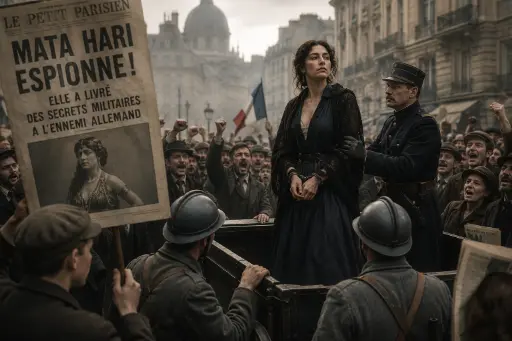
1917. In the midst of the First World War, the French government presented a single woman to the nation.
“This woman is the spy who leaked military secrets to Germany.”
Newspapers branded her “a femme fatale” and “a dangerous female spy,” while crowds erupted in cheers.
“Shoot her!”
“Don’t spare the traitor!”
Before long, she was sentenced to death by firing squad, and her name became known throughout the world.
That woman was— 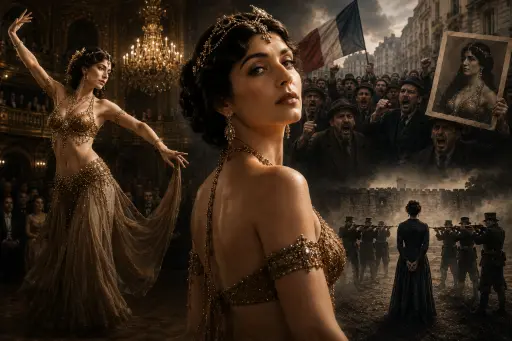 Mata Hari.
Even today, she is remembered as the world’s most famous female spy.
But did she really send tens of thousands of soldiers to their deaths?
Or was she merely the villain a nation at war created to conceal its own failures?
Today, we’ll follow the extraordinary life of a woman who fell from being a celebrated dancer to becoming the legendary spy known around the world.
A Wealthy Young Girl
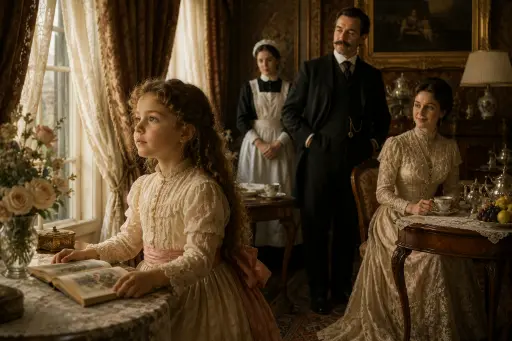 August 7, 1876.
In the northern Dutch city of Leeuwarden, a baby girl was born.
Her name was Margaretha Geertruida Zelle.
One day, the world would know her as Mata Hari.
But at this time, she was just an ordinary little girl.
Or rather, she lived a life that was far from ordinary.
Her father, Adam Zelle, was a successful businessman.
He owned a hat shop and had also made profitable investments in real estate and the oil industry.
The family employed servants, she wore beautiful clothes, and she wanted for nothing.
Young Margaretha grew up believing that a life of wealth was simply the way life was meant to be.
But that seemingly ordinary reality came to an abrupt end.
How Easily Happiness Can Be Shattered
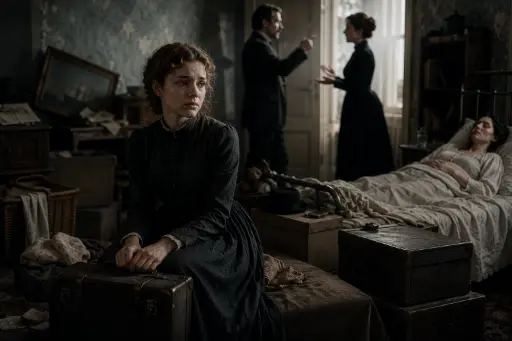 At the age of thirteen, everything changed.
Her father’s business collapsed, and the family went bankrupt.
The wealthy life they had once known disappeared almost overnight.
Soon afterward, her parents divorced.
Then, when she was fifteen, her mother—the person she had relied on most—died of illness.
By then, her father had already remarried, leaving Margaretha to move from one relative’s home to another.
In just a few short years, the girl who had once lived in luxury lost both her family and her fortune.
Life sometimes brings hardships that no amount of effort can prevent.
No one chooses the family they are born into, whether a parent’s business will fail, or whether a loved one will fall ill.
Margaretha learned that painful truth all too well while she was still a teenager.
Never Poor Again
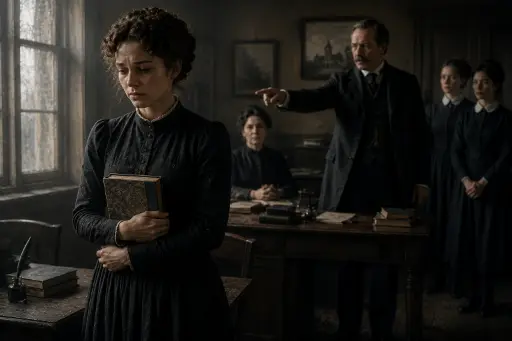 Afterward, she enrolled in a teacher training college, hoping to become a kindergarten teacher.
At a time when women had very few opportunities to support themselves, teaching was one of the few stable professions available.
But that dream did not last long.
Rumors spread that she had been involved in an inappropriate relationship with the school’s headmaster, and she was expelled.
What actually happened remains unclear to this day.
Some believe the rumors were true.
Others argue that the headmaster sacrificed the young student to protect his own reputation.
Only one thing is certain.
Once again, Margaretha lost the life she had been trying to build.
Her dream of becoming a teacher was gone.
She had no work experience. No formal education.
And no family left to rely on.
But how could a young woman rebuild her life in those days? For women of that era, the options were painfully limited.
 The answer was a practical one.
Marry a wealthy man.
Today, women have countless opportunities to build careers and support themselves through their own abilities.
But in late nineteenth-century Europe, marriage was, for many women, the single most important decision of their lives.
Margaretha made her choice.
“I want my life back.”
It wasn’t simply because she longed for the luxury she had known as a child.
After losing her family, her future, and her livelihood, marriage had become more than a dream.
It was her only chance to survive.
Chapter 2: The Marriage That Was Supposed to Bring Happiness Destroyed Everything
 “This is my chance to start over.”
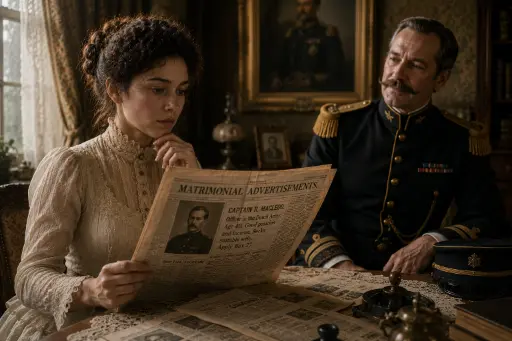
In 1895, at the age of nineteen, Margaretha answered a marriage advertisement in a newspaper.
The man behind the ad was Captain Rudolf MacLeod, an officer in the Dutch Army.
He was twenty-one years older than she was and enjoyed a stable military career with a comfortable income.
Just one hundred days after they first met, they were married.
 Today, that might seem like a whirlwind romance.
But in Europe at the end of the nineteenth century, such marriages were far from unusual.
More importantly, Margaretha had no time to hesitate.
She had lost her wealth, her family, and her future.
To her, this marriage was the only chance to rebuild her life.
And so, she found herself living in comfort once again.
The life she had once enjoyed as a little girl—the life she thought she had lost forever—had finally returned.
But… She had no way of knowing.
The greatest tragedy of her life was only just beginning.
A New Life in the Tropics
 After their marriage, the couple moved to the Dutch East Indies—present-day Indonesia—where her husband had been stationed.
It was a world unlike anything she had ever known in Europe.
The tropical heat never seemed to end.
Bustling markets filled with brilliant colors.
The rich aroma of exotic spices.
Streets where Islamic and Hindu traditions existed side by side.
And graceful traditional dances performed by the local people.
Margaretha was captivated by this unfamiliar world.
She didn’t know it yet…
She had no way of knowing that these experiences would one day transform her into the woman who would captivate all of Europe—Mata Hari.
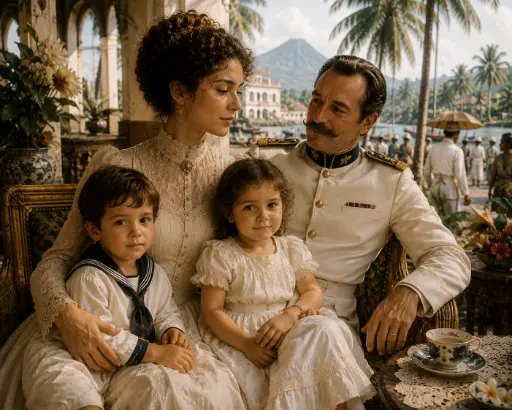 In time, the couple welcomed two children into the world—a son, Norman, and a daughter, Jeanne.
From the outside, they seemed to have the perfect family.
A wealthy husband.
Two beautiful children.
A life beneath the tropical sun.
It was the kind of life that others could only envy.
But the happiest-looking families often hide the deepest cracks behind closed doors.
 Rudolf was a military officer.
In the army, orders are absolute.
Subordinates are expected to obey without question.
But some men carry that same mindset into their homes.
Rudolf was one of them.
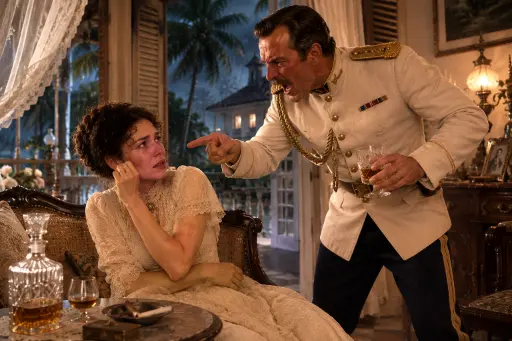
He drank heavily.
He shouted.
At times, he even became physically abusive toward his wife.
He also pursued relationships with other women.
Little by little, the man Margaretha had never truly seen before marriage began to reveal his true nature.
Naturally, she fought back.
Their arguments grew increasingly bitter, and before long, their home was filled less with laughter than with angry voices.
They had decided to marry after knowing each other for only one hundred days.
There had never been enough time to truly understand one another.
Love can begin in a moment.
But a marriage cannot survive on passion alone.
As time passes, differences in values only grow more impossible to ignore.
The Tragedy That Took Their Son
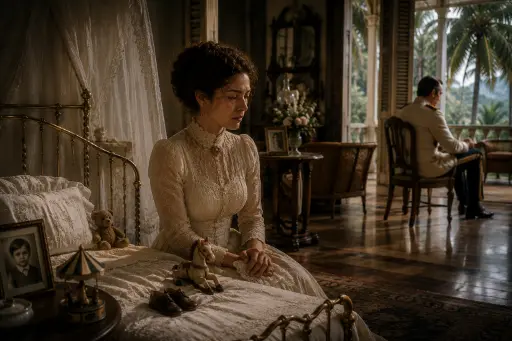 Then, one day, the family was struck by an unimaginable tragedy.
Their young son, Norman, suddenly became gravely ill.
Despite every effort to save him, he died at just two years old.
At the time, rumors spread rapidly.
Some claimed that a servant had poisoned him.
Others believed one of Rudolf’s lovers had sought revenge by poisoning the child.
Today, however, some historians suggest that a congenital illness or complications related to syphilis may have been responsible.
The truth has never been conclusively established.
But one fact is beyond dispute.
Margaretha lost the son she loved more than anything.
It is impossible to measure the grief of a parent forced to bury a child.
That pain is the same in every era.
The tragedy drove a final wedge into a marriage that had already begun to fall apart.
They blamed each other.
They grew to resent each other.
And in time, they could no longer forgive one another.
The two people who had once married for love had become little more than strangers living under the same roof.
What Remained
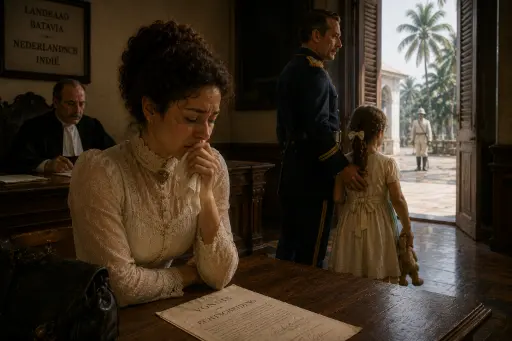 In 1902, their marriage came to an end.
Margaretha desperately wanted to keep custody of her daughter.
But society was very different then.
A woman without an income was widely believed to be incapable of raising a child on her own.
Custody was awarded to her husband.
She had already lost her son.
Now, she lost her daughter as well.
And with that, the family she had fought so hard to build was gone.
What, then, did she have left?
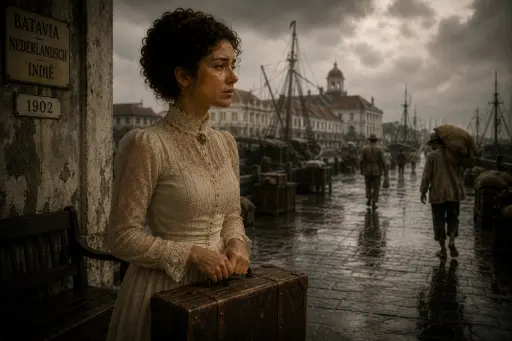 She had no family.
No job.
No money.
The comfortable married life she had once dreamed of had brought her none of the happiness she had hoped for.
And yet, life goes on.
No matter how long you grieve, hunger eventually returns.
And if you don’t work, you cannot survive.
With nowhere else to turn, Margaretha returned to her homeland, the Netherlands.
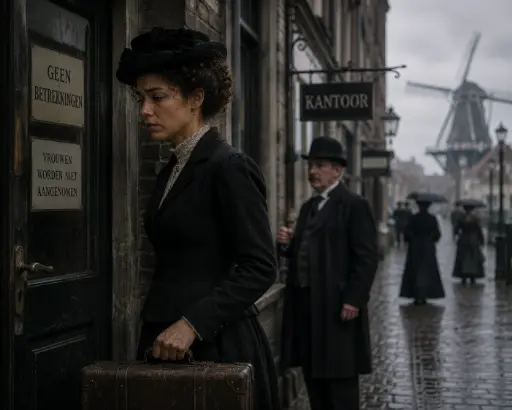 But society showed little compassion for a divorced woman.
Her dream of becoming a teacher had long since vanished.
She had no work experience.
No special qualifications.
No matter where she looked for work, the answer was always the same.
“No.”
And then, she made a decision.
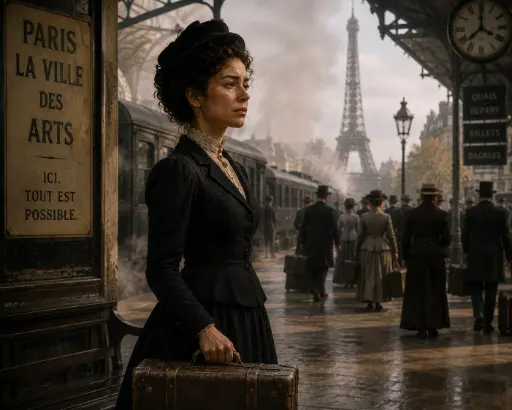 “I’ll go to Paris.”
At the dawn of the twentieth century, Paris was the cultural and artistic capital of the world.
It was a city where talent could open doors, regardless of your background or your past.
Margaretha made up her mind to start her life over.
But she had no idea… that the new name she would take in Paris would still be known around the world more than a century later.
That name was—
Mata Hari.
Chapter 3: Mata Hari — The Legendary Dancer Who Captivated Paris
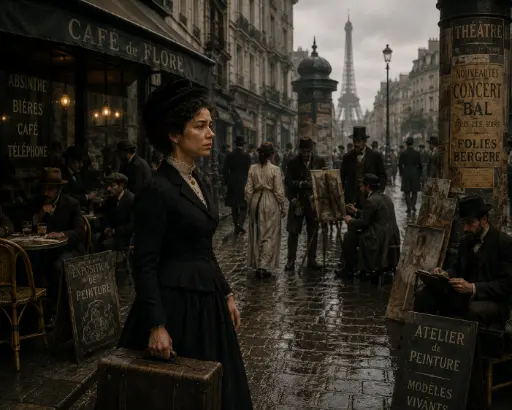
A City Where No One Knew Her Past
In 1903, following her divorce, Margaretha arrived in Paris alone.
At the time, Paris was a city where artists from around the world gathered.
Painters.
Writers.
Musicians.
And dancers.
It was a place where, if you had talent, neither your social status nor your past mattered.
Drawn by that dream, countless young people came to Paris in search of a new life.
Of course, only a fortunate few ever found success.
Most saw their dreams slip away and quietly disappeared from the city.
At first, Margaretha was no different.
She couldn’t find work. 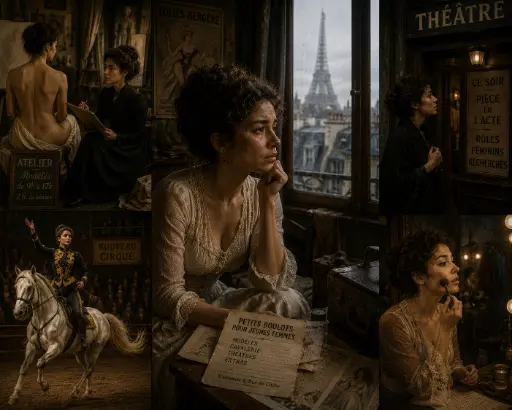 She worked as a model.
She performed in horseback riding shows.
She appeared in small theaters.
To make ends meet, she accepted whatever work she could find.
But she had one advantage that no other woman possessed.
It was…
Her years in the Dutch East Indies.

The Mystique of the East
Today, international travel is nothing unusual.
But at the beginning of the twentieth century, Europe was a very different world.
For most people, Asia was a land of mystery.
They imagined the East as…
A land of ancient secrets.
A place where mysterious rituals were performed.
A paradise filled with beautiful dancers.
Of course, much of it was fantasy rather than reality.
But people are often drawn more to dreams than to facts.
Margaretha understood that.
“I’ll turn the East I’ve seen into a story… and sell it.”
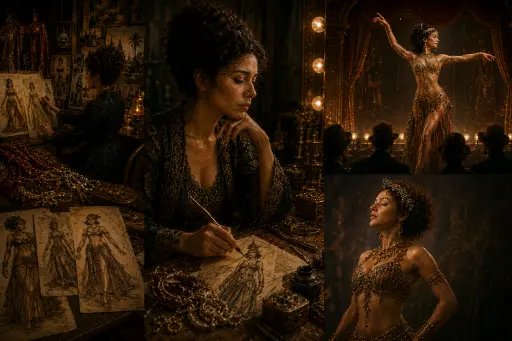 Inspired by the dances and costumes she had seen in the Dutch East Indies, she created a stage persona unlike any other.
Then, she abandoned her real name.
The name she chose was Mata Hari.
In Malay and Indonesian, it means “the sun.”
On that day, Margaretha Zelle disappeared.
And a new woman was born—
Mata Hari.
It didn’t have to be real.
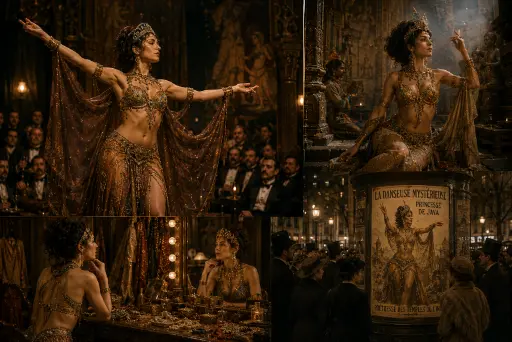 She reinvented herself as a princess from Java… …and a temple priestess from India devoted to the gods.
Of course, none of it was true.
She had been born in the Netherlands.
But in Europe at the dawn of the twentieth century, there was almost no way for anyone to verify her story.
People were looking for romance, not the truth.
 The theater lights dimmed.
Soft music began to play.
Slowly, a lone woman stepped onto the stage.
Adorned with jewels…
Draped in flowing veils…
She performed an exotic dance from a distant land.
And as the performance unfolded…
One by one…
The layers of her costume fell away.
It was unlike anything audiences had ever seen.
But it wasn’t mere nudity.
It was mystery. Sensuality.
An atmosphere that felt almost like a sacred ritual.
Together, they cast a spell over the audience.
People watched in breathless silence. 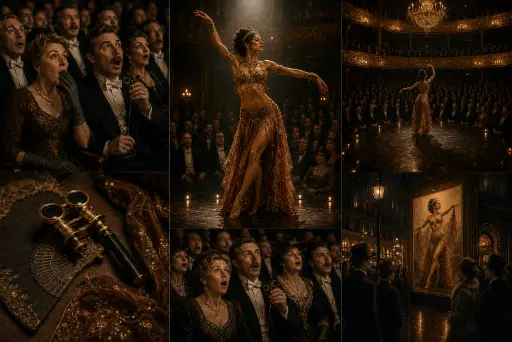 “I’ve never seen anything like this.”
“She really is an Eastern princess.”
The rumors spread across Europe with astonishing speed.
The Woman Who Captivated Men Around the World
 By 1905, Mata Hari had become the sensation of the age.
And not just in Paris.
Berlin.
Vienna.
Madrid.
Rome.
She performed across Europe, and her fame quickly crossed national borders.
The theaters were filled with aristocrats…
Diplomats…
Military officers…
And wealthy industrialists.
Her fame extended far beyond the stage.
 Wealthy men invited her to lavish dinners…
Presented her with priceless jewels…
And asked her to become their mistress.
Sometimes, she refused.
Sometimes, she accepted.
In doing so, she built a network that reached into the highest circles of European society.
At the time, she was the woman everyone envied.
Beauty.
Fame.
Wealth.
Once again, she had reclaimed the life of luxury she had lost as a child.
But— History has taught us the same lesson time and time again.
Fame never lasts forever.
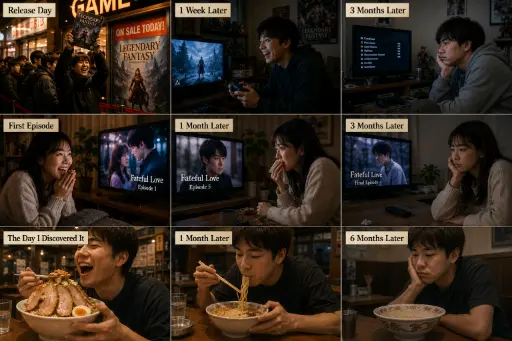
People always grow tired of what they once admired.
Haven’t you experienced it yourself?
A game you couldn’t wait to buy on release day.
A TV series you were completely hooked on.
A meal you thought you’d never grow tired of.
Yet with time…
The excitement fades.
That’s simply human nature.
We adapt.
And Mata Hari was no exception.
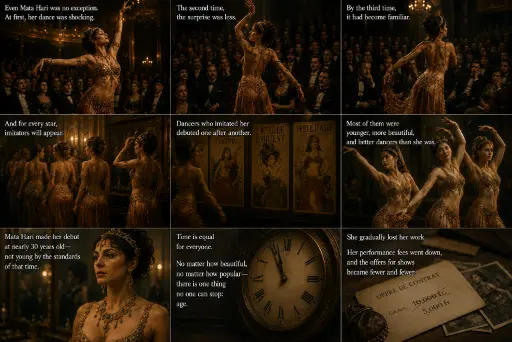 Even Mata Hari was no exception.
At first, her dance was shocking.
The second time, the surprise was less.
By the third time, it had become familiar.
And for every star, imitators will appear.
Dancers who imitated her debuted one after another.
Most of them were younger, more beautiful, and better dancers than she was.
Mata Hari made her debut at nearly 30 years old ― not young by the standards of that time.
Time is equal for everyone.
No matter how beautiful, no matter how popular ― there is the one thing no one can stop: age.
She gradually lost her work.
Her performance fees went down, and the offers for shows became fewer and fewer.
As her popularity declined, so did her income.
But once a person has known luxury, it is not easy to lower one’s standard of living.
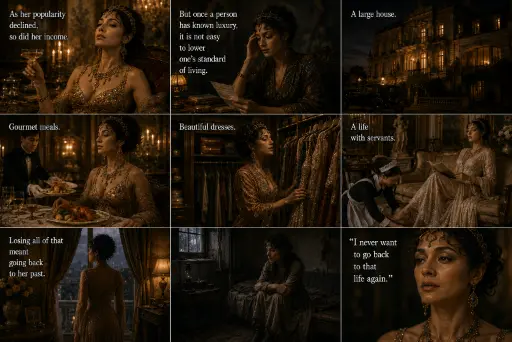 A large house.
Gourmet meals.
Beautiful dresses.
A life with servants.
Losing all of that meant going back to her past.
“I never want to go back to that life again.”
Those feelings had never changed—not since she was a little girl who had lost both her family and her fortune.
To protect that life, she began to look at dangerous choices
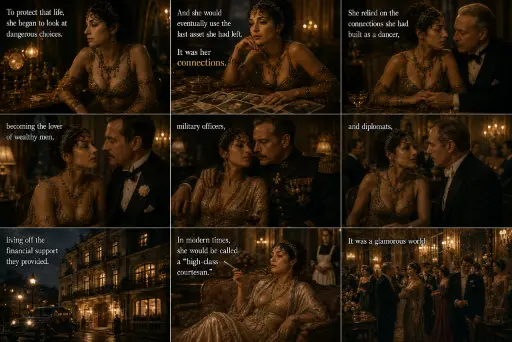 And she would eventually use the last asset she had left.
It was her connections.
She relied on the connections she had built as a dancer, becoming the lover of wealthy men, military officers, and diplomats, living off the financial support they provided.
In modern times, she would be called a “high-class courtesan.“
It was a glamorous world.
But that glamour was as fragile as a castle of sand.
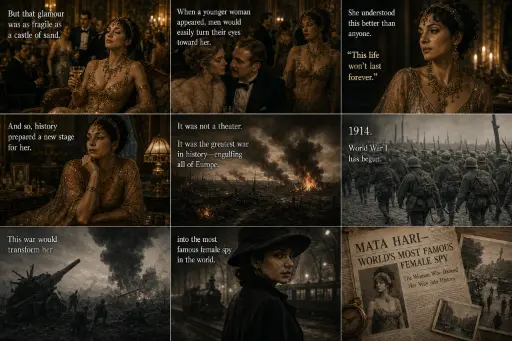 When a younger woman appeared, men would easily turn their eyes toward her.
She understood this better than anyone.
“This life won’t last forever.”
And so, history prepared a new stage for her.
It was not a theater.
It was the greatest war in history—engulfing all of Europe.
1914.
World War Ⅰ has begun.
This war would transform her into the most famous female spy in the world.
Chapter 4: H-21 — The Day War Turned Her into a Spy

War changes everything.
1914.
A war erupted that would shake all of Europe.
WORLD WAR Ⅰ.
Over the course of about four years, it claimed more than 17 million lives, becoming the first total war in human history.
Gunfire was not confined to the battlefield.
Borders were sealed.
People began to distrust one another.
A person who had been your friend yesterday could become an “enemy” today.
It was an extraordinary age of fear and suspicion.
And this war would forever change the life of one dancer.
MATA HARI.
Why her?
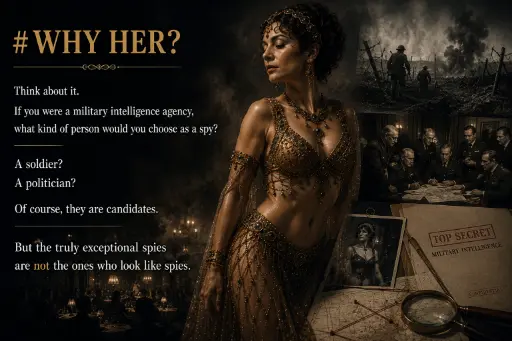 Think about it.
If you were a military intelligence agency, what kind of person would you choose as a spy?
A soldier?
A politician?
Of course, they are candidates.
But the truly exceptional spies are not the ones who look like spies.
Mata Hari possessed every one of those qualities.
 First, she was Dutch.
At the time, the Netherlands was a neutral country.
It was aligned with neither Germany nor France.
As a result, she was able to travel relatively freely between many of the warring nations.
She was also multilingual, speaking Dutch, French, German, English, and Malay.
To an intelligence agency, she was a priceless asset.
Language is the most powerful weapon for crossing borders.
More importantly than anything else, she had connections.
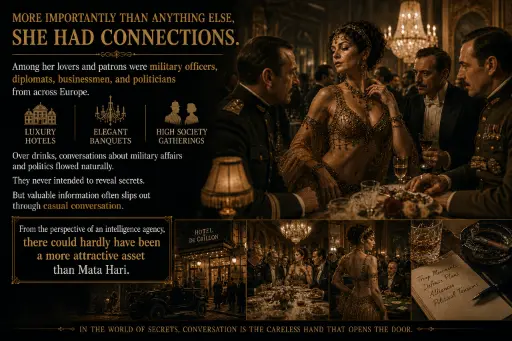 Among her lovers and patrons were military officers, diplomats, businessmen, and politicians from across Europe.
Luxury hotels.
Elegant banquets.
High society gatherings.
Over drinks, conversations about military affairs and politics flowed naturally.
They never intended to reveal secrets.
But valuable information often slips out through casual conversation.
From the perspective of an intelligence agency, there could hardly have been a more attractive asset than Mata Hari.
The Germans’ Offer
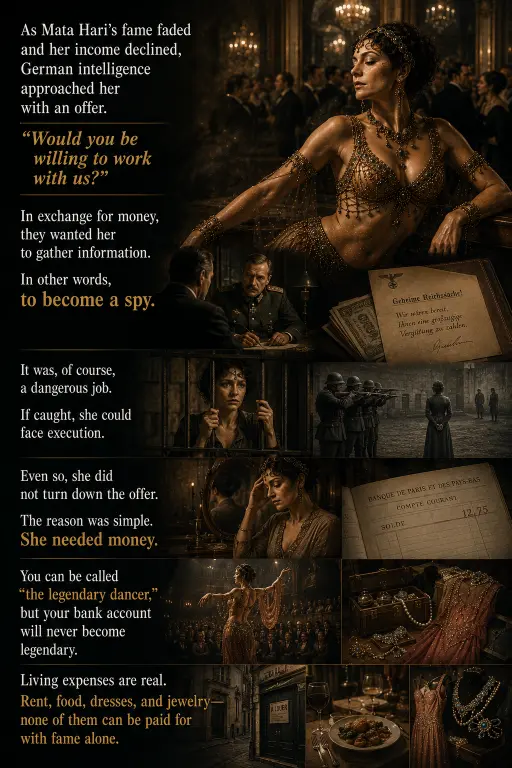 As Mata Hari’s fame faded and her income declined, German intelligence approached her with an offer.
“Would you be willing to work with us?”
In exchange for money, they wanted her to gather information.
In other words, to become a spy.
It was, of course, a dangerous job.
If caught, she could face execution.
Even so, she did not turn down the offer.
The reason was simple.
She needed money.
You can be called “the legendary dancer,” but your bank account will never become legendary.
Living expenses are real.
Rent, food, dresses, and jewelry— none of them can be paid for with fame alone.
The German intelligence service gave her the codename “H-21.”
 With that, Mata Hari began her career as an agent for Germany.
But the story doesn’t end here.
The Man She Loved
 Around this time, there was someone Mata Hari truly loved.
His name was Vadim Maslov.
He was a young Russian military aviator.
He was more than twenty years younger than Mata Hari.
Yet despite the age difference, the two were said to have been deeply in love.
But war shows no mercy, even to those in love.
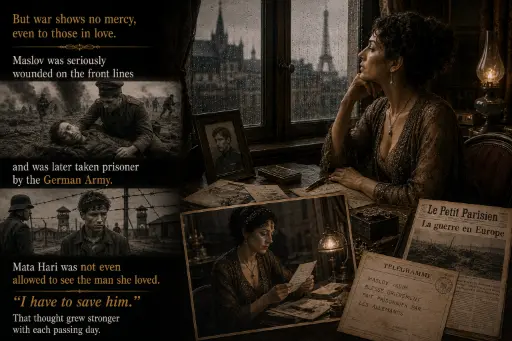 Maslov was seriously wounded on the front lines and was later taken prisoner by the German Army.
Mata Hari was not even allowed to see the man she loved.
“I have to save him.”
That thought grew stronger with each passing day.
The French Army’s Offer
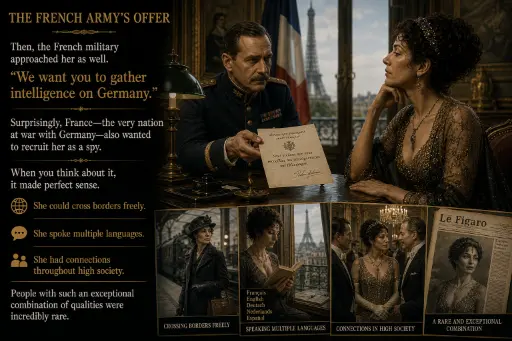 Then, the French military approached her as well.
“We want you to gather intelligence on Germany.”
Surprisingly, France—the very nation at war with Germany—also wanted to recruit her as a spy.
When you think about it, it made perfect sense.
She could cross borders freely.
She spoke multiple languages.
She had connections throughout high society.
People with such an exceptional combination of qualities were incredibly rare.
Then, the French military is said to have made her an extraordinary offer.
“If you succeed in your mission, we’ll help reunite you with your lover.”
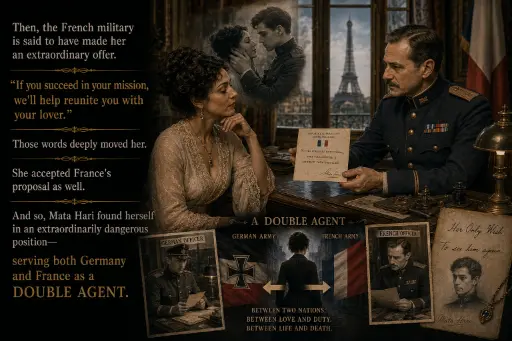 Those words deeply moved her.
She accepted France’s proposal as well.
And so, Mata Hari found herself in an extraordinarily dangerous position— serving both Germany and France as a double agent.
Was She Really an Exceptional Spy?
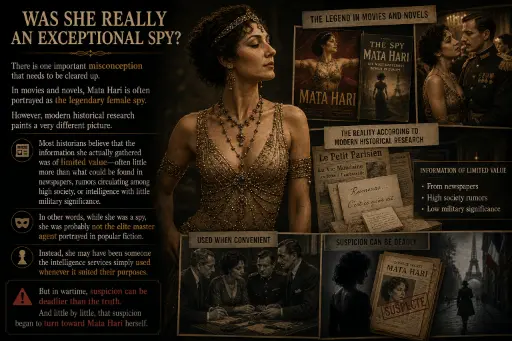 There is one important misconception that needs to be cleared up.
In movies and novels, Mata Hari is often portrayed as the legendary female spy.
However, modern historical research paints a very different picture.
Most historians believe that the information she actually gathered was of limited value—often little more than what could be found in newspapers, rumors circulating among high society, or intelligence with little military significance.
In other words, while she was a spy, she was probably not the elite master agent portrayed in popular fiction.
Instead, she may have been someone the intelligence services simply used whenever it suited their purposes.
But in wartime, suspicion can be deadlier than the truth.
And little by little, that suspicion began to turn toward Mata Hari herself.
H-21
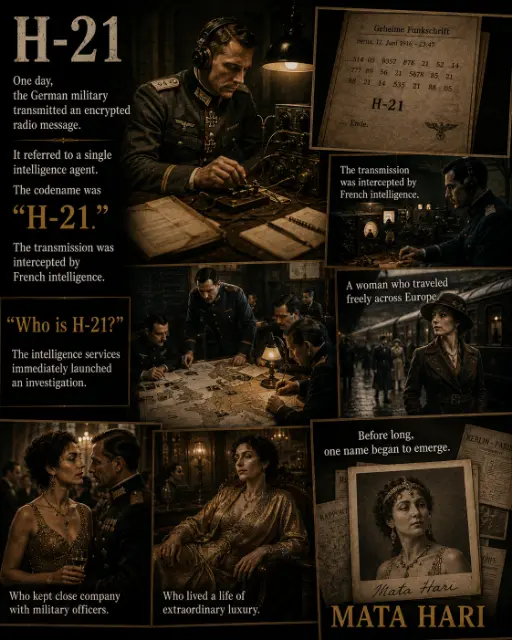 One day, the German military transmitted an encrypted radio message.
It referred to a single intelligence agent.
The codename was “H-21.”
The transmission was intercepted by French intelligence.
“Who is H-21?”
The intelligence services immediately launched an investigation.
A woman who traveled freely across Europe.
Who kept close company with military officers.
Who lived a life of extraordinary luxury.
Before long, one name began to emerge.
Mata Hari.
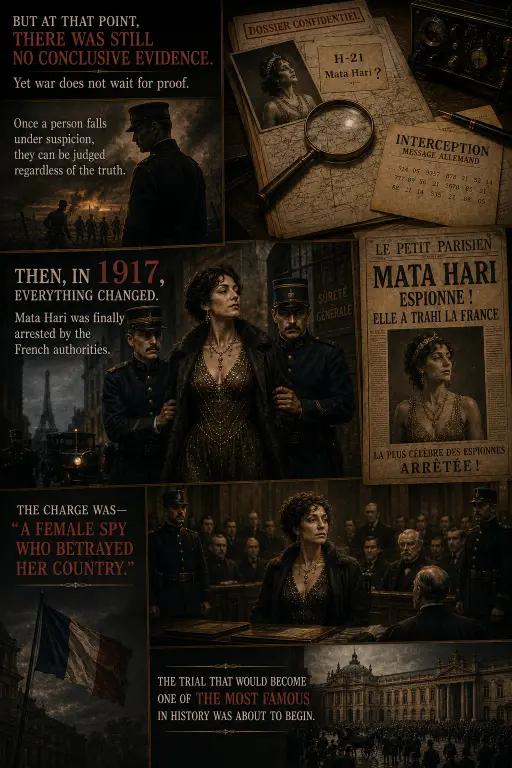 But at that point, there was still no conclusive evidence.
Yet war does not wait for proof.
Once a person falls under suspicion, they can be judged regardless of the truth.
Then, in 1917, everything changed.
Mata Hari was finally arrested by the French authorities.
The charge was— “A female spy who betrayed her country.”
The trial that would become one of the most famous in history was about to begin.
Chapter 5: The Executed Woman — Was She Really a Villain?
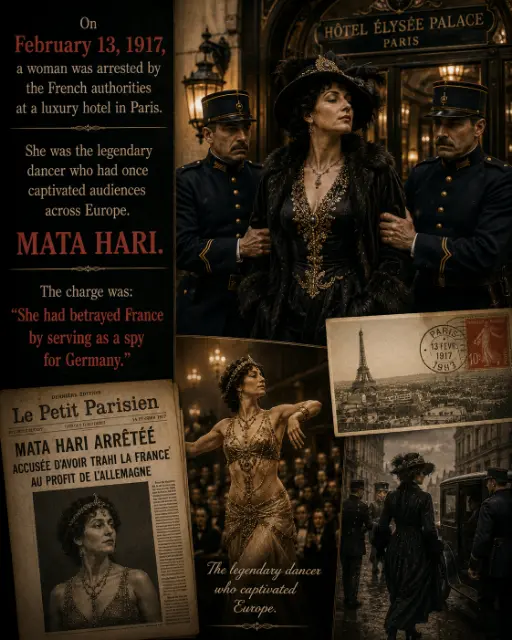
“Arrest H-21!”
On February 13, 1917, a woman was arrested by the French authorities at a luxury hotel in Paris.
She was the legendary dancer who had once captivated audiences across Europe.
Mata Hari.
The charge was:
“She had betrayed France by serving as a spy for Germany.”
The Evidence Was Strikingly Vague
 There is one curious fact that should not be overlooked.
If Mata Hari had truly been the legendary master spy, it would not be surprising if overwhelming evidence had been presented against her.
But that was not what happened.
In court, the prosecution confidently declared:
“The defendant is the German agent known as ‘H-21.'”
“She obtained military secrets from officers and diplomats, causing enormous damage to France.”
Newspaper reporters eagerly recorded every word, and the public followed the proceedings as the trial of a notorious femme fatale.
Meanwhile, Mata Hari calmly defended herself.
“Yes, I accepted money from Germany.”
“But it was compensation for property that had been confiscated.”
“I was working for France as well.”
She insisted that she had also been providing intelligence to the French.
But almost no one was willing to listen.
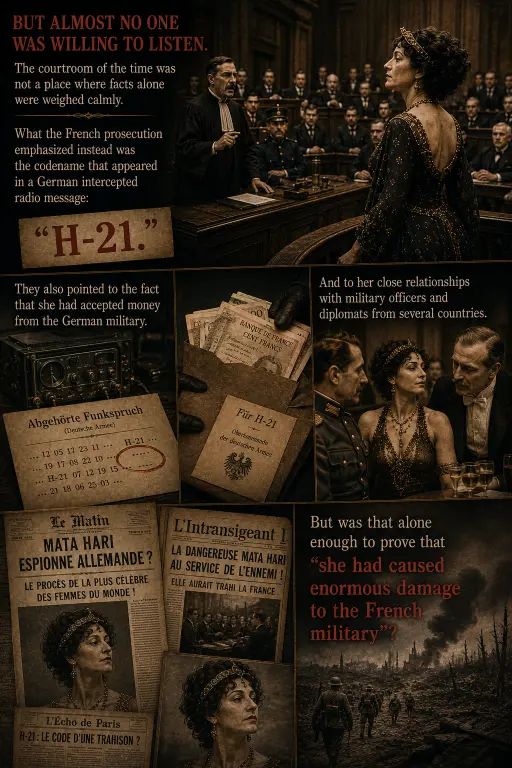 The courtroom of the time was not a place where facts alone were weighed calmly.
What the French prosecution emphasized instead was the codename that appeared in a German intercepted radio message:
“H-21.”
They also pointed to the fact that she had accepted money from the German military.
And to her close relationships with military officers and diplomats from several countries.
But was that alone enough to prove that “she had caused enormous damage to the French military”? 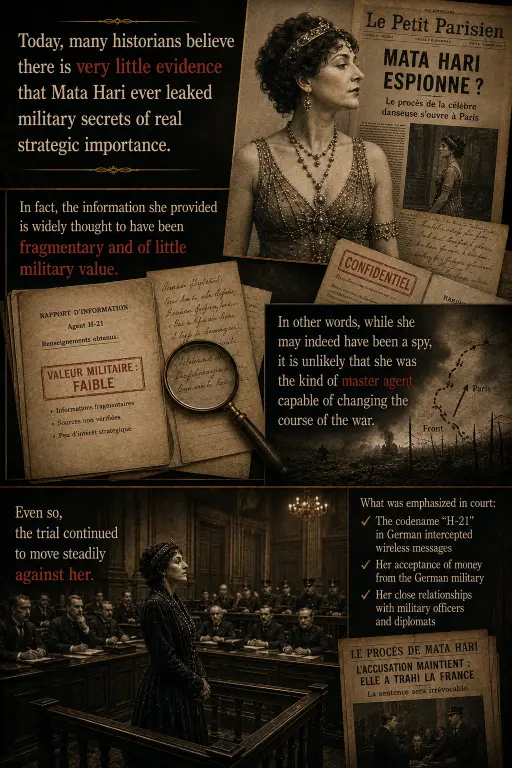 Today, many historians believe there is very little evidence that Mata Hari ever leaked military secrets of real strategic importance.
In fact, the information she provided is widely thought to have been fragmentary and of little military value.
In other words, while she may indeed have been a spy, it is unlikely that she was the kind of master agent capable of changing the course of the war.
Even so, the trial continued to move steadily against her.
The Day of the Verdict
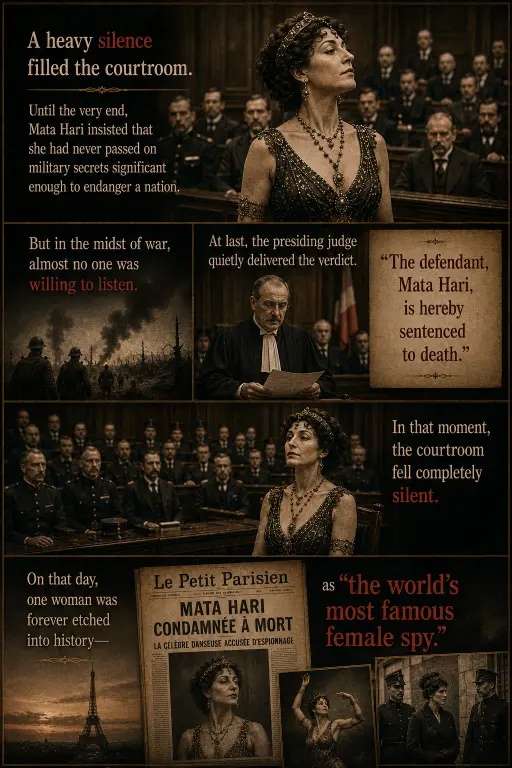 A heavy silence filled the courtroom.
Until the very end, Mata Hari insisted that she had never passed on military secrets significant enough to endanger a nation.
But in the midst of war, almost no one was willing to listen.
At last, the presiding judge quietly delivered the verdict.
“The defendant, Mata Hari, is hereby sentenced to death.”
In that moment, the courtroom fell completely silent.
On that day, one woman was forever etched into history— as “the world’s most famous female spy.”
What France Needed
 So why was Mata Hari sentenced to death?
To understand the answer, we need to look at the situation France was facing at the time.
The First World War had become a long and exhausting conflict.
What had begun with hopes of victory seemed to have no end in sight.
Young men were being sent to the front one after another, and countless lives were being lost.
Day by day, public anger continued to grow.
“What is the government doing?”
“Why won’t this war end?”
“Why hasn’t my son come home?”
Public frustration with the government intensified, and the entire nation became consumed by fear and uncertainty.
At times like these, people look for someone to blame.
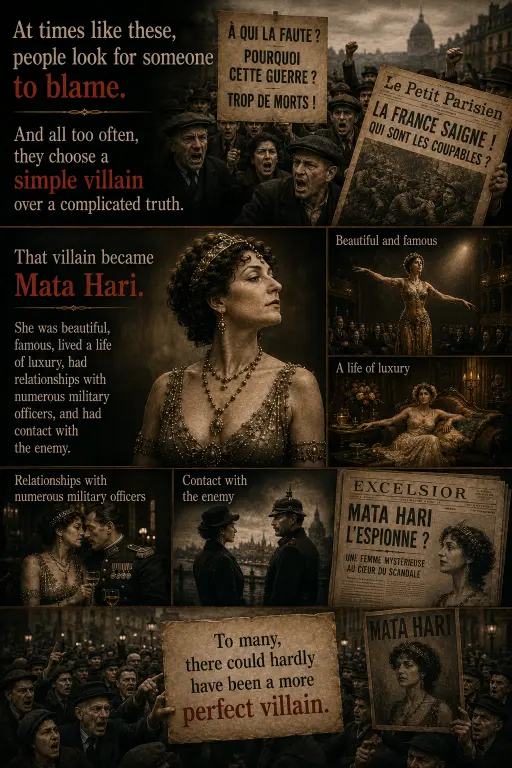 And all too often, they choose a simple villain over a complicated truth.
That villain became Mata Hari.
She was beautiful, famous, lived a life of luxury, had relationships with numerous military officers, and had contact with the enemy.
To many, there could hardly have been a more perfect villain. 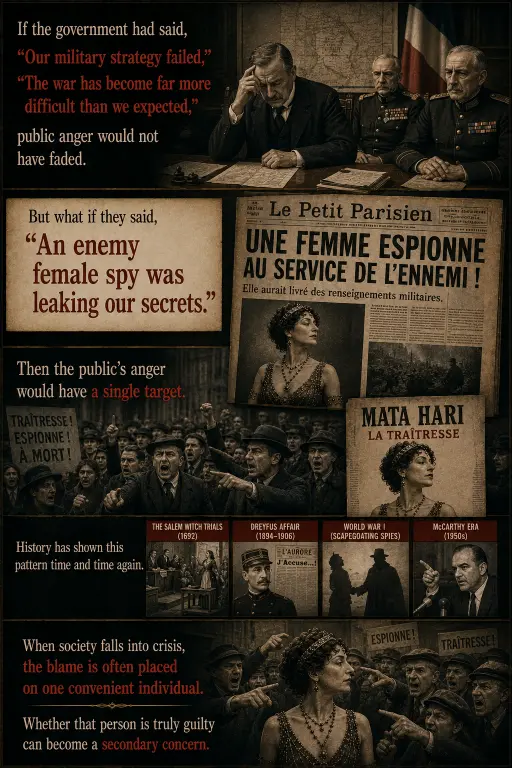 If the government had said, “Our military strategy failed,” or “The war has become far more difficult than we expected,” public anger would not have faded.
But what if they said, “An enemy female spy was leaking our secrets”
Then the public’s anger would have a single target.
History has shown this pattern time and time again.
When society falls into crisis, the blame is often placed on one convenient individual.
Whether that person is truly guilty can become a secondary concern.
The Final Morning
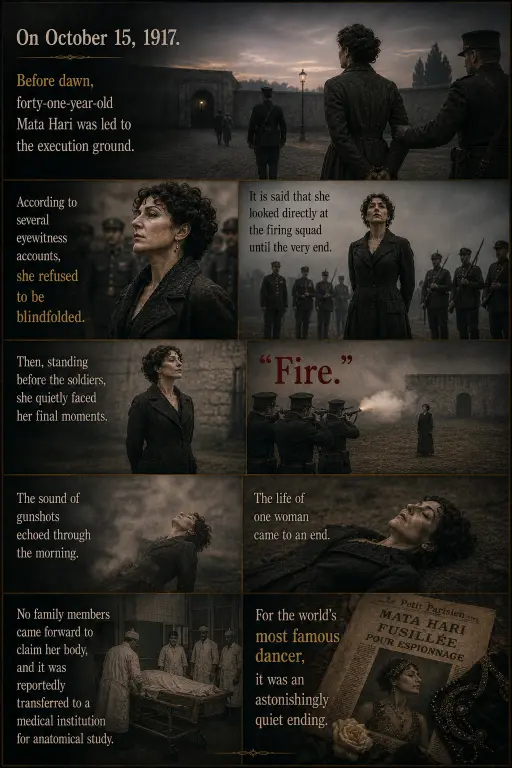 On October 15, 1917.
Before dawn, forty-one-year-old Mata Hari was led to the execution ground.
According to several eyewitness accounts, she refused to be blindfolded.
It is said that she looked directly at the firing squad until the very end.
Then, standing before the soldiers, she quietly faced her final moments.
“Fire.”
The sound of gunshots echoed through the morning.
The life of one woman came to an end.
No family members came forward to claim her body, and it was reportedly transferred to a medical institution for anatomical study.
For the world’s most famous dancer, it was an astonishingly quiet ending.
The Silent Courtroom
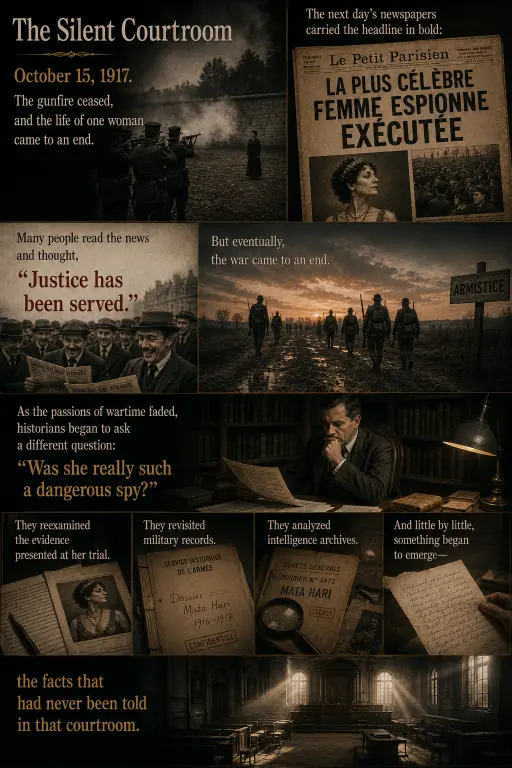 October 15, 1917.
The gunfire ceased, and the life of one woman came to an end.
The next day’s newspapers carried the headline in bold:
“The World’s Most Famous Female Spy Executed.”
Many people read the news and thought, “Justice has been served.”
But eventually, the war came to an end.
As the passions of wartime faded, historians began to ask a different question:
“Was she really such a dangerous spy?”
They reexamined the evidence presented at her trial.
They revisited military records.
They analyzed intelligence archives.
And little by little, something began to emerge— the facts that had never been told in that courtroom.
What We Learned More Than a Century Later
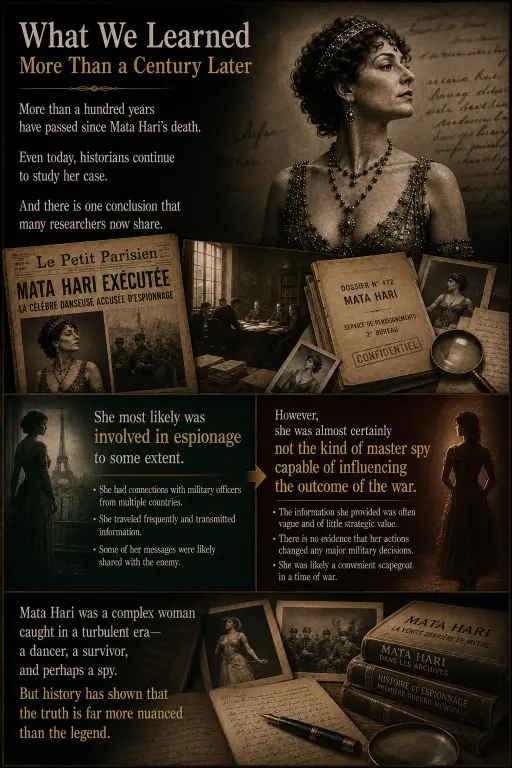 More than a hundred years have passed since Mata Hari’s death. Even today, historians continue to study her case.
And there is one conclusion that many researchers now share.
She most likely was involved in espionage to some extent.
However, she was almost certainly not the kind of master spy capable of influencing the outcome of the war.
Why, Then, Was She Executed?
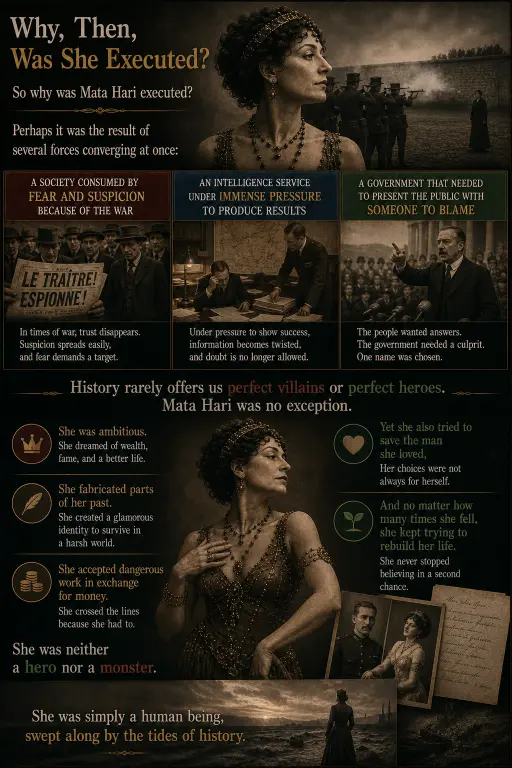 So why was Mata Hari executed?
Perhaps it was the result of several forces converging at once:
a society consumed by fear and suspicion because of the war, an intelligence service under immense pressure to produce results, and a government that needed to present the public with someone to blame.
History rarely offers us perfect villains or perfect heroes.
Mata Hari was no exception.
She was ambitious. She fabricated parts of her past.
She accepted dangerous work in exchange for money.
Yet she also tried to save the man she loved, and no matter how many times she fell, she kept trying to rebuild her life.
She was neither a hero nor a monster. She was simply a human being, swept along by the tides of history.
Afterwords
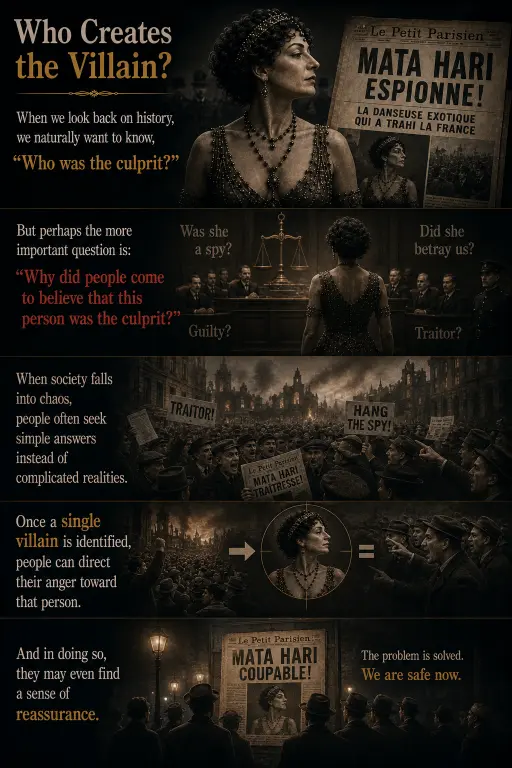
Who Creates the Villain?
When we look back on history, we naturally want to know, “Who was the culprit?”
But perhaps the more important question is:
“Why did people come to believe that this person was the culprit?”
When society falls into chaos, people often seek simple answers instead of complicated realities.
Once a single villain is identified, people can direct their anger toward that person.
And in doing so, they may even find a sense of reassurance.
But the villain is not always the person who truly deserves all the blame.
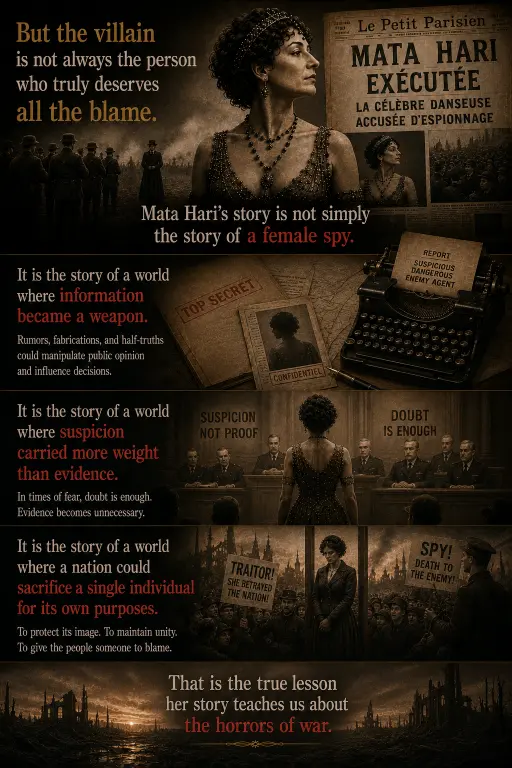 Mata Hari’s story is not simply the story of a female spy.
It is the story of a world where information became a weapon, where suspicion carried more weight than evidence, and where a nation could sacrifice a single individual for its own purposes.
That is the true lesson her story teaches us about the horrors of war.
More Than a Century Later, the Lesson Still Remains
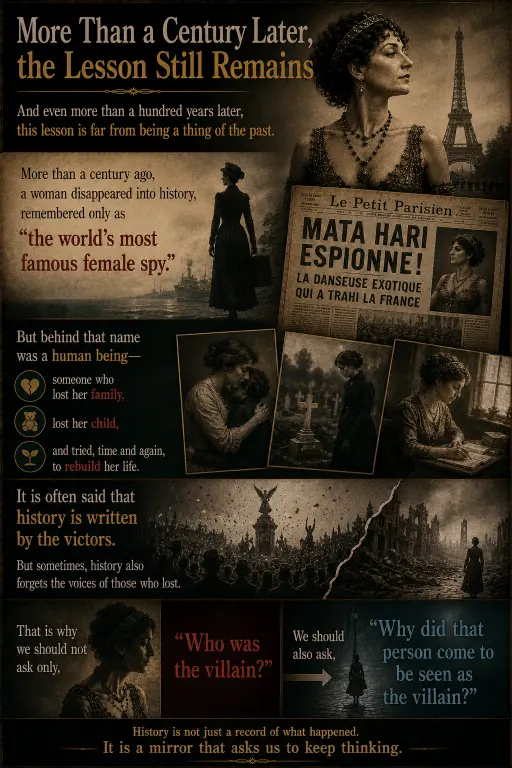 And even more than a hundred years later, this lesson is far from being a thing of the past.
More than a century ago, a woman disappeared into history, remembered only as “the world’s most famous female spy.“
But behind that name was a human being— someone who lost her family, lost her child, and tried, time and again, to rebuild her life.
It is often said that history is written by the victors.
But sometimes, history also forgets the voices of those who lost.
That is why we should not ask only, “Who was the villain?”
We should also ask, “Why did that person come to be seen as the villain?”
Author: Fuji
 Human history is truly complex, isn’t it?
There are countless websites introducing historical figures and events, but many of them are just plain explanations—not exactly exciting to read.
On the other hand, reading books takes a lot of time and effort.
That’s where I come in.
Through “stories that are more engaging than explanations and shorter than books,” I aim to bring the world’s history and humanity’s records to you in a more accessible and interesting way.
If my stories inspire you to love history a little more, I’d be absolutely thrilled!

Become Part of the Chronicle
If this article inspired you, consider supporting the project.
Become a character in the Chronicle.
Receive your own custom card and stand alongside queens, warriors, inventors, rebels, and legends from history.
Your support helps keep these stories alive and allows me to create more articles, illustrations, and historical cards.
Join the Chronicle and leave your mark on history.

Comment