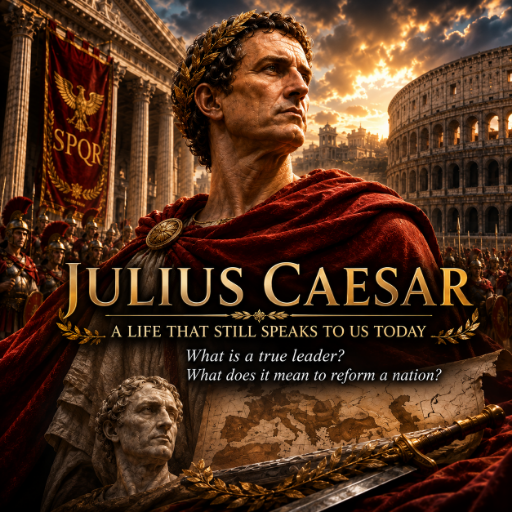
Julius Caesar ― The Man Who Changed History
Introduction
Many people have heard the name Julius Caesar at least once.
He conquered Gaul, crossed the Rubicon, defeated numerous political rivals, and ultimately rose to become the most powerful man in Rome.
Yet Caesar was far more than a brilliant military commander.
He was also an exceptional statesman, writer, and reformer.
More importantly, his life marked a decisive turning point that set Rome on the path from a Republic to an Empire.
More than two thousand years later, his story continues to challenge us with timeless questions:
What makes a truly great leader?
What is the nature of ambition?
How much power should any one person be allowed to hold?
1. Who Was Julius Caesar?
Basic Information
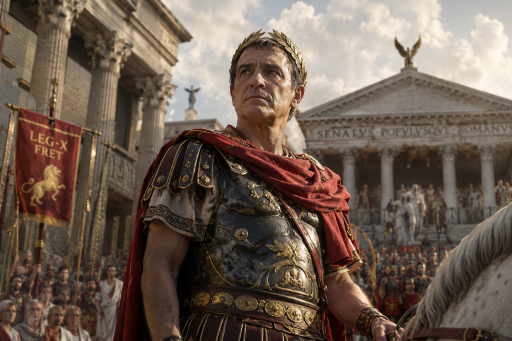
Gaius Julius Caesar was a Roman politician, general, and writer who was born around 100 BC.
He is best known for conquering Gaul (modern-day France, Belgium, and parts of neighboring countries), earning a reputation as one of the greatest military commanders in Roman history.
Through his exceptional political skill, he also carried out major reforms that helped stabilize a Rome plagued by internal conflict.
His achievements ultimately led him to become Dictator Perpetuo (Dictator for Life)—an unprecedented position in the Roman Republic.
However, his extraordinary concentration of power provoked growing opposition.
On March 15, 44 BC, he was assassinated in the Roman Senate by a group of conspirators led by Marcus Junius Brutus and Gaius Cassius Longinus.
Ironically, Caesar’s death did not save the Roman Republic.
Instead, it accelerated its collapse and paved the way for the rise of the Roman Empire under his adopted heir, Augustus.
Caesar was not only a brilliant military commander and politician but also an accomplished writer.
His most famous works, Commentarii de Bello Gallico (Commentaries on the Gallic War) and Commentarii de Bello Civili (Commentaries on the Civil War), remain invaluable historical sources for understanding the late Roman Republic.
Their clear and elegant Latin has also made them enduring classics that are still widely used in the study of the Latin language today.
Family Background and Early Life
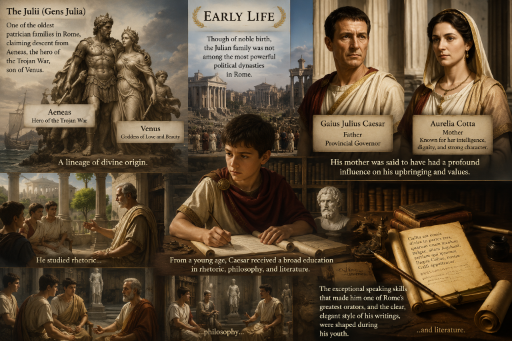 Caesar was born into the Julian clan (Gens Julia), one of the oldest patrician families in Rome.
The Julii claimed that their lineage could be traced back to Aeneas, the legendary hero of the Trojan War.
According to Roman mythology, Aeneas was the son of Venus, the goddess of love and beauty.
This gave the family a prestigious tradition of claiming divine ancestry.
Despite its noble heritage, however, the Julian family was no longer among the most powerful political dynasties in Rome by the time Caesar was born.
Although respected for its ancient lineage, it did not hold overwhelming influence in Roman politics.
Caesar’s father, Gaius Julius Caesar, served as a provincial governor, while his mother, Aurelia Cotta, was widely admired for her intelligence, dignity, and strong character.
Ancient sources suggest that she played a significant role in shaping Caesar’s upbringing and values.
From an early age, Caesar received a broad education that included rhetoric, philosophy, and literature.
The exceptional speaking skills that later earned him a reputation as one of Rome’s greatest orators, as well as the clear and elegant writing style displayed in his books, were built upon the education he received during his youth.
Rome at the Time of Caesar’s Birth
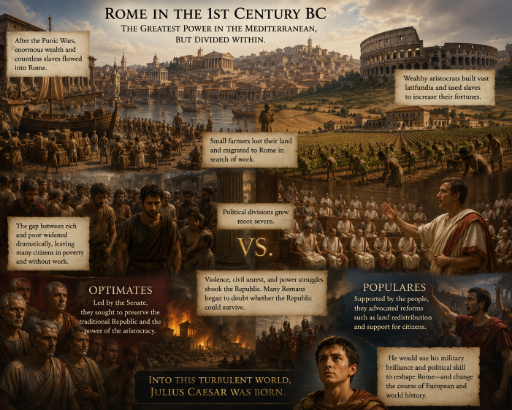 When Caesar was born in the 1st century BC, Rome had grown into the most powerful state in the Mediterranean world.
After defeating Carthage in the Punic Wars and conquering Greece, Asia Minor, and many other territories, enormous wealth and countless slaves flowed into Rome.
Yet behind this prosperity lay deep and growing social problems.
A small number of wealthy aristocrats amassed vast estates known as latifundia, where large numbers of enslaved people worked the land. As these estates expanded, many small farmers found themselves unable to compete.
Losing their land and livelihoods, they migrated to Rome in search of work.
As a result, the gap between rich and poor widened dramatically, leaving many Roman citizens unemployed and struggling in poverty.
Political divisions were also becoming increasingly severe.
The conservative Optimates, led by the Roman Senate, sought to preserve the traditional Republic and the political power of the aristocracy.
In contrast, the Populares appealed to the common people, advocating reforms such as land redistribution and greater support for ordinary citizens.
Over time, these political conflicts escalated into violence.
Civil unrest, power struggles, and armed conflicts became increasingly common, leading many Romans to question whether the Republic could survive.
It was into this turbulent world that Julius Caesar was born.
In the years to come, he would use his military brilliance and political skill to reshape Rome.
His decisions would ultimately transform not only the fate of the Roman Republic but also the course of European—and world—history.
2. Rome at the Time of Caesar’s Birth
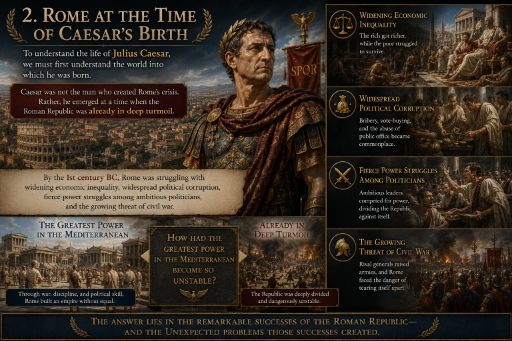 To understand the life of Julius Caesar, we must first understand the world into which he was born.
Caesar was not the man who created Rome’s crisis.
Rather, he emerged at a time when the Roman Republic was already in deep turmoil.
By the 1st century BC, Rome was struggling with widening economic inequality, widespread political corruption, fierce power struggles among ambitious politicians, and the growing threat of civil war.
How had the greatest power in the Mediterranean become so unstable?
The answer lies in the remarkable successes of the Roman Republic—and the unexpected problems those successes created.
Rome Dominates the Mediterranean World
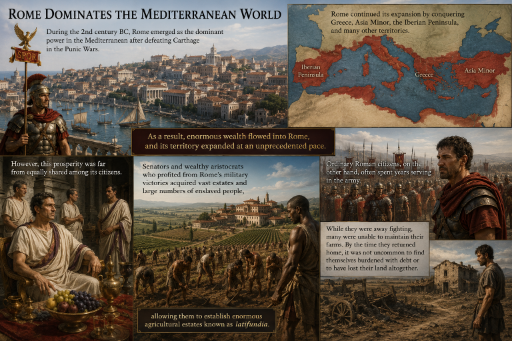 During the 2nd century BC, Rome emerged as the dominant power in the Mediterranean after defeating Carthage in the Punic Wars.
It continued its expansion by conquering Greece, Asia Minor, the Iberian Peninsula, and many other territories.
As a result, enormous wealth flowed into Rome, and its territory expanded at an unprecedented pace.
However, this prosperity was far from equally shared among its citizens.
Senators and wealthy aristocrats who profited from Rome’s military victories acquired vast estates and large numbers of enslaved people, allowing them to establish enormous agricultural estates known as latifundia.
Ordinary Roman citizens, on the other hand, often spent years serving in the army.
While they were away fighting, many were unable to maintain their farms.
By the time they returned home, it was not uncommon to find themselves burdened with debt or to have lost their land altogether.
A Growing Gap Between Rich and Poor
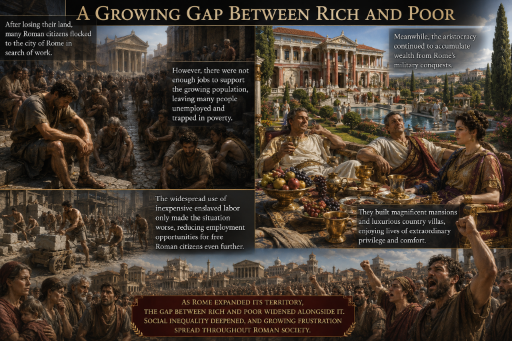 After losing their land, many Roman citizens flocked to the city of Rome in search of work.
However, there were not enough jobs to support the growing population, leaving many people unemployed and trapped in poverty.
The widespread use of inexpensive enslaved labor only made the situation worse, reducing employment opportunities for free Roman citizens even further.
Meanwhile, the aristocracy continued to accumulate wealth from Rome’s military conquests.
They built magnificent mansions and luxurious country villas, enjoying lives of extraordinary privilege and comfort.
As Rome expanded its territory, the gap between rich and poor widened alongside it.
Social inequality deepened, and growing frustration spread throughout Roman society.
A Republic Plagued by Political Corruption
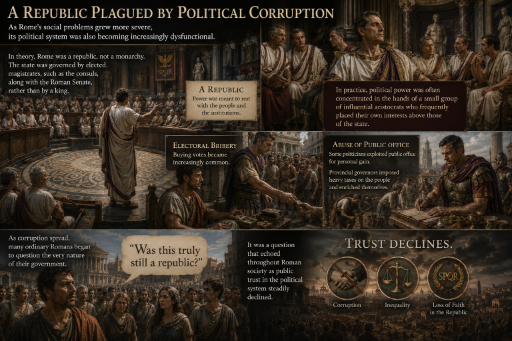 As Rome’s social problems grew more severe, its political system was also becoming increasingly dysfunctional.
In theory, Rome was a republic, not a monarchy.
The state was governed by elected magistrates, such as the consuls, along with the Roman Senate, rather than by a king.
In practice, however, political power was often concentrated in the hands of a small group of influential aristocrats who frequently placed their own interests above those of the state.
Electoral bribery became increasingly common, and some politicians exploited public office for personal gain.
Among the governors of Rome’s provinces, there were those who imposed heavy taxes on local populations to enrich themselves.
As corruption spread, many ordinary Romans began to question the very nature of their government.
“Was this truly still a republic?”
It was a question that echoed throughout Roman society as public trust in the political system steadily declined.
The Rivalry Between Two Political Factions
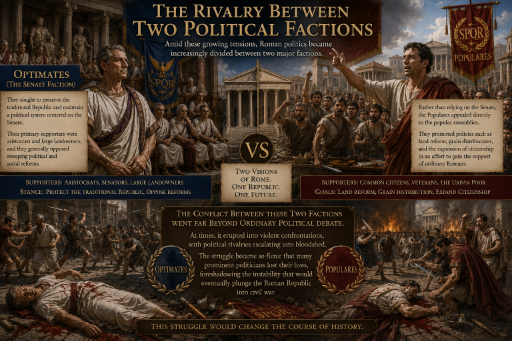 Amid these growing tensions, Roman politics became increasingly divided between two major factions.
The first was the Optimates, the faction aligned with the Roman Senate.
They sought to preserve the traditional Republic and maintain a political system centered on the Senate.
Their primary supporters were aristocrats and large landowners, and they generally opposed sweeping political and social reforms.
The second faction was known as the Populares.
Rather than relying on the Senate, the Populares appealed directly to the popular assemblies.
They promoted policies such as land reform, grain distributions, and the expansion of citizenship in an effort to gain the support of ordinary Romans.
The conflict between these two factions went far beyond ordinary political debate.
At times, it erupted into violent confrontations, with political rivalries escalating into bloodshed.
The struggle became so fierce that many prominent politicians lost their lives, foreshadowing the instability that would eventually plunge the Roman Republic into civil war.
The Age of Civil War
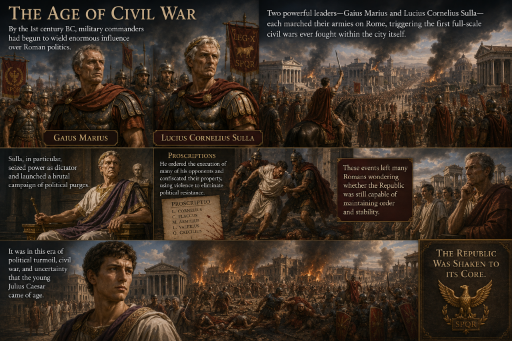 By the 1st century BC, military commanders had begun to wield enormous influence over Roman politics.
Two powerful leaders—Gaius Marius and Lucius Cornelius Sulla—each marched their armies on Rome, triggering the first full-scale civil wars ever fought within the city itself. Sulla, in particular, seized power as dictator and launched a brutal campaign of political purges.
Through his proscriptions, he ordered the execution of many of his opponents and confiscated their property, using violence to eliminate political resistance.
These events left many Romans wondering whether the Republic was still capable of maintaining order and stability.
It was in this era of political turmoil, civil war, and uncertainty that the young Julius Caesar came of age.
Romans Began to Seek a Strong Leader
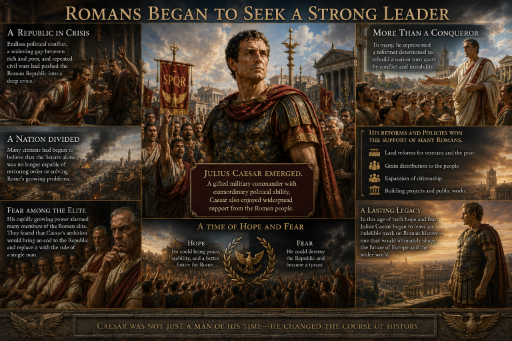 Endless political conflict, a widening gap between rich and poor, and repeated civil wars had pushed the Roman Republic into a deep crisis. Many citizens had begun to believe that the Senate alone was no longer capable of restoring order or solving Rome’s growing problems.
It was in this atmosphere that Julius Caesar emerged.
A gifted military commander with extraordinary political ability, Caesar also enjoyed widespread support from the Roman people.
He was more than a conqueror.
To many, he represented a reformer determined to rebuild a nation torn apart by conflict and instability.
At the same time, however, his rapidly growing power alarmed many members of the Roman elite.
They feared that Caesar’s ambition would bring an end to the Republic and replace it with the rule of a single man.
It was in this age of both hope and fear that Julius Caesar began to leave an indelible mark on Roman history—one that would ultimately shape the future of Europe and the wider world.
3. Caesar’s Early Years
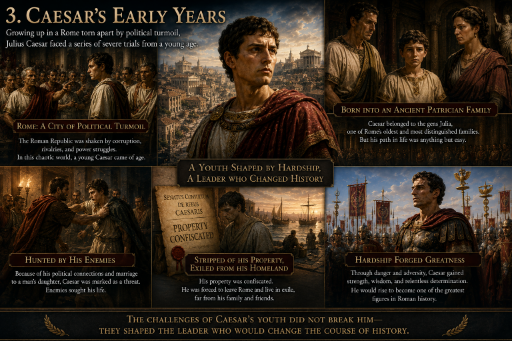 Growing up in a Rome torn apart by political turmoil, Julius Caesar faced a series of severe trials from a young age.
Although he was born into an ancient patrician family, his life was far from easy. As a young man, he found himself hunted by his enemies, stripped of his property, and forced to flee his homeland in order to survive.
Yet it was these hardships that forged the man who would one day be remembered as one of the greatest figures in Roman history.
The challenges of Caesar’s youth did not break him—they shaped the leader who would eventually change the course of history.
Marriage to Cornelia
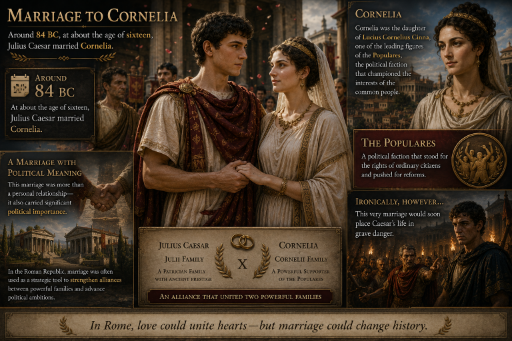 Around 84 BC, at about the age of sixteen, Julius Caesar married Cornelia.
Cornelia was the daughter of Lucius Cornelius Cinna, one of the leading figures of the Populares, the political faction that championed the interests of the common people.
This marriage was more than a personal relationship—it also carried significant political importance.
In the Roman Republic, marriage was often used as a strategic tool to strengthen alliances between powerful families and advance political ambitions.
Ironically, however, this very marriage would soon place Caesar’s life in grave danger.
Confrontation with the Dictator Sulla
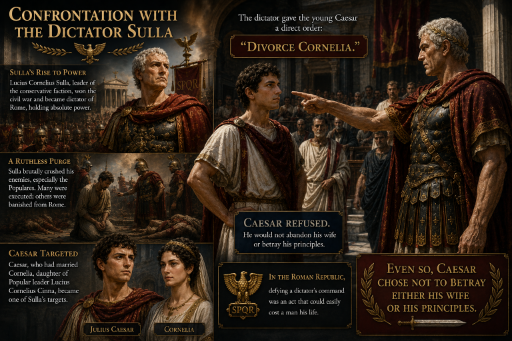 At that time, Lucius Cornelius Sulla, the leader of the conservative faction, had emerged victorious from the civil war and ruled Rome as dictator, holding virtually unchecked power.
Determined to eliminate his political enemies, Sulla launched a ruthless campaign against the Populares.
Many of their leaders were executed, while others were forced into exile.
Caesar, who was married to Cornelia, the daughter of the prominent Popularis leader Lucius Cornelius Cinna, soon became one of Sulla’s targets.
The dictator gave the young Caesar a direct order:
“Divorce Cornelia.”
Caesar refused.
In the Roman Republic, defying the command of a dictator was an act that could easily cost a man his life.
Even so, Caesar chose not to betray either his wife or his principles.
A Life on the Run
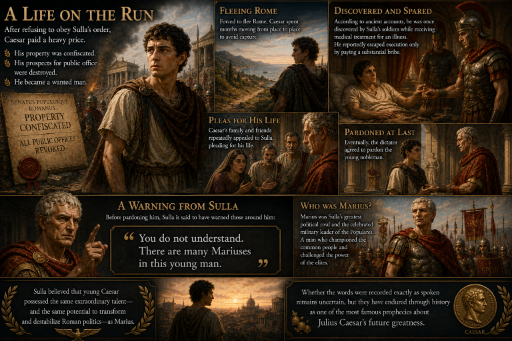 After refusing to obey Sulla’s order, Caesar paid a heavy price.
His property was confiscated, his prospects for public office were destroyed, and he became a wanted man.
Forced to flee Rome, Caesar spent months moving from place to place to avoid capture.
According to ancient accounts, he was once discovered by Sulla’s soldiers while receiving medical treatment for an illness.
He reportedly escaped execution only by paying a substantial bribe.
Caesar’s family and friends repeatedly appealed to Sulla, pleading for his life.
Eventually, the dictator agreed to pardon the young nobleman.
Before doing so, however, Sulla is said to have warned those around him:
“You do not understand. There are many Mariuses in this young man.”
The Marius he referred to was Gaius Marius, Sulla’s greatest political rival and the celebrated military leader of the Populares.
In other words, Sulla believed that the young Caesar possessed the same extraordinary talent—and the same potential to transform and destabilize Roman politics—as Marius.
Whether the words were recorded exactly as spoken remains uncertain, but they have endured through history as one of the most famous prophecies about Julius Caesar’s future greatness.
Gaining Experience as a Soldier
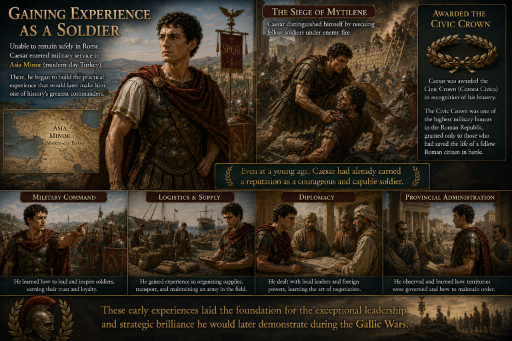 Unable to remain safely in Rome, Caesar entered military service in Asia Minor (modern-day Turkey).
There, he began to build the practical experience that would later make him one of history’s greatest commanders.
During the Siege of Mytilene, Caesar distinguished himself by rescuing fellow soldiers under enemy fire.
In recognition of his bravery, he was awarded the Civic Crown (Corona Civica).
The Civic Crown was one of the highest military honors in the Roman Republic, granted only to those who had saved the life of a fellow Roman citizen in battle.
Even at a young age, Caesar had already earned a reputation as a courageous and capable soldier.
His service in the eastern provinces also provided him with valuable firsthand experience in military logistics, command, diplomacy, and provincial administration.
These early experiences laid the foundation for the exceptional leadership and strategic brilliance he would later demonstrate during the Gallic Wars.
Hardship Forged a Future Legend
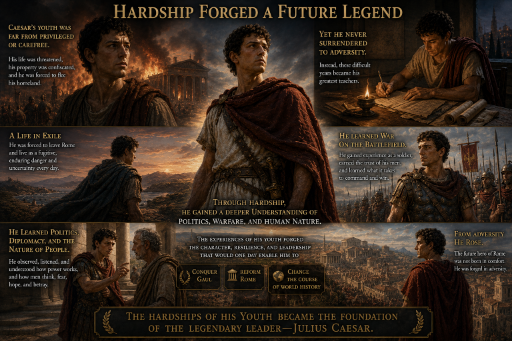 Caesar’s youth was far from privileged or carefree.
He survived repeated hardships—his life was threatened, his property was confiscated, and he was forced to flee his homeland.
Yet he never surrendered to adversity.
Instead, these difficult years became his greatest teachers.
Through hardship, he gained a deeper understanding of politics, warfare, and human nature.
The experiences of his youth forged the character, resilience, and leadership that would one day enable him to conquer Gaul, reform Rome, and change the course of world history.
The future hero of Rome was not born in comfort. He was forged in adversity.
4. Kidnapped by Pirates — The Boldness of the Young Caesar
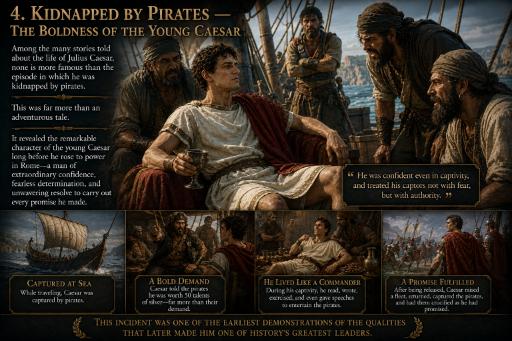 Among the many stories told about the life of Julius Caesar, none is more famous than the episode in which he was kidnapped by pirates.
This was far more than an adventurous tale.
It revealed the remarkable character of the young Caesar long before he rose to power in Rome—a man of extraordinary confidence, fearless determination, and unwavering resolve to carry out every promise he made.
The incident would become one of the earliest demonstrations of the qualities that later made him one of history’s greatest leaders.
Captured by Pirates
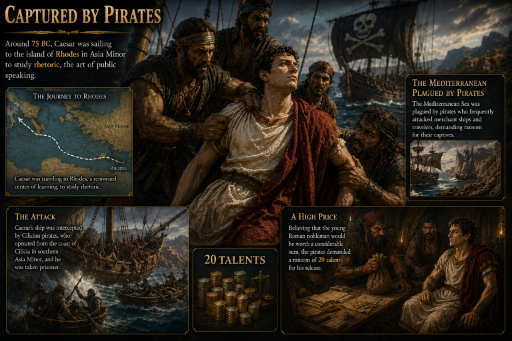 Around 75 BC, Caesar was sailing to the island of Rhodes in Asia Minor to study rhetoric, the art of public speaking.
At the time, the Mediterranean Sea was plagued by pirates who frequently attacked merchant ships and travelers, demanding ransom for their captives.
Caesar’s ship was intercepted by Cilician pirates, who operated from the coast of Cilicia in southern Asia Minor, and he was taken prisoner.
Believing that the young Roman nobleman would be worth a considerable sum, the pirates demanded a ransom of 20 talents for his release.
“I’m Worth More Than That”
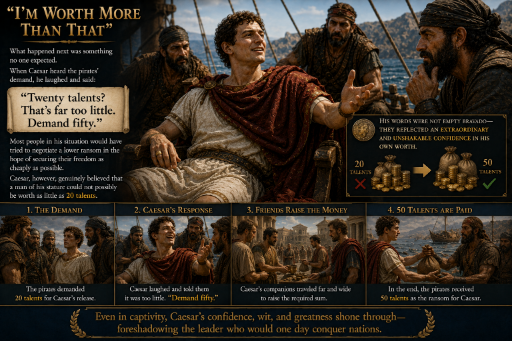 What happened next was something no one expected.
When Caesar heard the pirates’ demand, he laughed and said:
“Twenty talents? That’s far too little. Demand fifty.”
Most people in his situation would have tried to negotiate a lower ransom in the hope of securing their freedom as cheaply as possible.
Caesar, however, genuinely believed that a man of his stature could not possibly be worth as little as 20 talents.
His words were not empty bravado—they reflected an extraordinary and unshakable confidence in his own worth.
In the end, Caesar’s companions traveled throughout the region, raised the necessary funds, and paid the pirates a ransom of 50 talents for his release.
A Prisoner Who Behaved Like a Commander
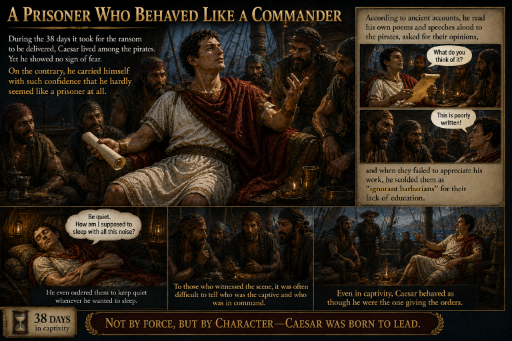 During the 38 days it took for the ransom to be delivered, Caesar lived among the pirates.
Yet he showed no sign of fear.
On the contrary, he carried himself with such confidence that he hardly seemed like a prisoner at all.
According to ancient accounts, he read his own poems and speeches aloud to the pirates, asked for their opinions, and when they failed to appreciate his work, he scolded them as “ignorant barbarians” for their lack of education.
He even ordered them to keep quiet whenever he wanted to sleep, saying:
“Be quiet. How am I supposed to sleep with all this noise?”
To those who witnessed the scene, it was often difficult to tell who was the captive and who was in command.
Even in captivity, Caesar behaved as though he were the one giving the orders.
“When I’m Free, I’ll Crucify You All”
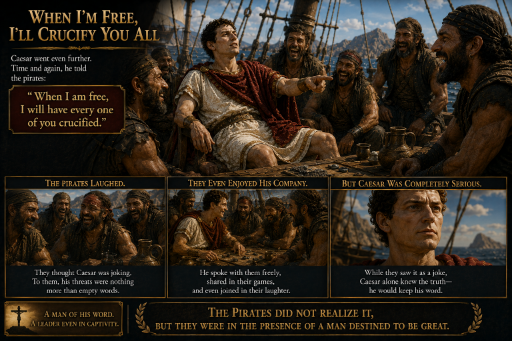 Caesar went even further. Time and again, he told the pirates:
“When I am free, I will have every one of you crucified.”
The pirates simply laughed.
Because Caesar spoke with them so casually—and even joined them in their games—they assumed he was joking.
None of them believed he would ever carry out such a threat.
Only Caesar knew he was completely serious.
A Man Who Always Kept His Word
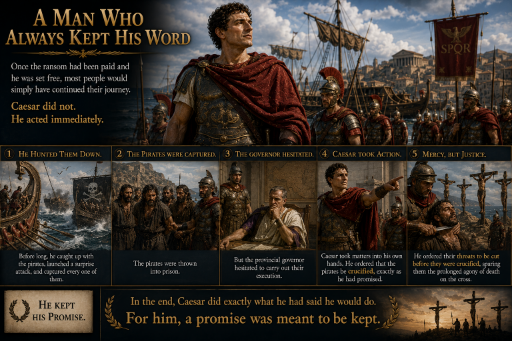 Once the ransom had been paid and he was set free, most people would simply have continued their journey.
Caesar did not.
He acted immediately.
Traveling to a nearby city, he obtained warships, gathered a force of soldiers, and sailed back out to sea.
Before long, he caught up with the pirates, launched a surprise attack, and captured every one of them.
The pirates were thrown into prison, but the provincial governor hesitated to carry out their execution.
Caesar took matters into his own hands. He ordered that the pirates be crucified, exactly as he had promised.
According to ancient tradition, however, Caesar also showed a measure of mercy.
Because the pirates had treated him relatively well during his captivity, he ordered their throats to be cut before they were crucified, sparing them the prolonged agony of death on the cross.
In the end, Caesar did exactly what he had said he would do.
For him, a promise was meant to be kept.
What This Incident Reveals About Caesar
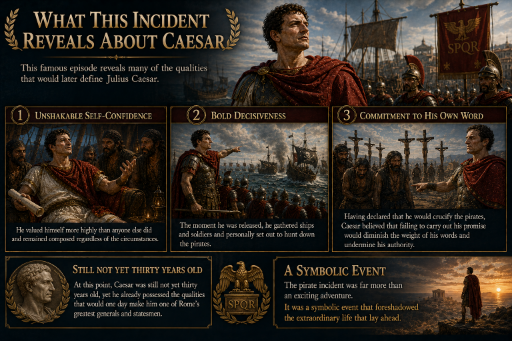 This famous episode reveals many of the qualities that would later define Julius Caesar.
The first is his unshakable self-confidence.
He valued himself more highly than anyone else did and remained composed regardless of the circumstances.
The second is his bold decisiveness.
The moment he was released, he gathered ships and soldiers and personally set out to hunt down the pirates.
The third is his commitment to his own word.
Having declared that he would crucify the pirates, Caesar evidently believed that failing to carry out his promise would diminish the weight of his words and undermine his authority.
At this point, Caesar was still not yet thirty years old, yet he already possessed the qualities that would one day make him one of Rome’s greatest generals and statesmen.
The pirate incident was far more than an exciting adventure.
It was a symbolic event that foreshadowed the extraordinary life that lay ahead.
5. Rising as a Politician
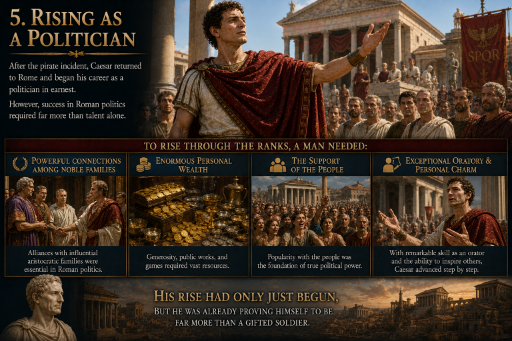 After the pirate incident, Caesar returned to Rome and began his career as a politician in earnest.
However, success in Roman politics required far more than talent alone.
To rise through the ranks, a man needed powerful connections among Rome’s noble families, enormous personal wealth, and, above all, the support of the people.
Armed with exceptional skill as an orator and a remarkable ability to inspire and attract others, Caesar steadily climbed the political ladder.
His rise had only just begun, but he was already proving himself to be far more than a gifted soldier.
The Orator Who Captivated the People
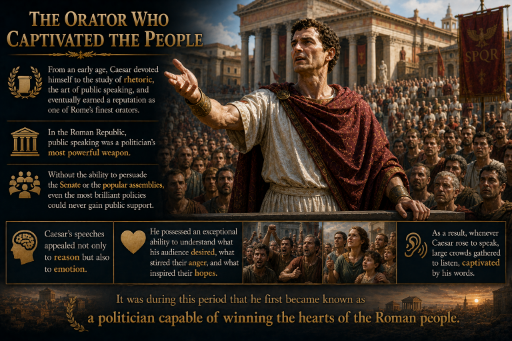 From an early age, Caesar devoted himself to the study of rhetoric, the art of public speaking, and eventually earned a reputation as one of Rome’s finest orators.
In the Roman Republic, public speaking was a politician’s most powerful weapon.
Without the ability to persuade the Senate or the popular assemblies, even the most brilliant policies could never gain public support.
Caesar’s speeches appealed not only to reason but also to emotion.
He possessed an exceptional ability to understand what his audience desired, what stirred their anger, and what inspired their hopes.
As a result, whenever Caesar rose to speak, large crowds gathered to listen, captivated by his words.
It was during this period that he first became known as a politician capable of winning the hearts of the Roman people.
Winning Popularity—Even Through Debt
 Popularity alone, however, was not enough to achieve success in Roman politics.
To win elections, ambitious politicians were expected to sponsor lavish public festivals, gladiatorial games, and other spectacular entertainments for the people.
Such events required enormous sums of money.
Caesar was no exception.
He repeatedly financed magnificent games and public celebrations, spending generously to win the favor of the Roman people. Naturally, his personal fortune was not enough to cover these extraordinary expenses. 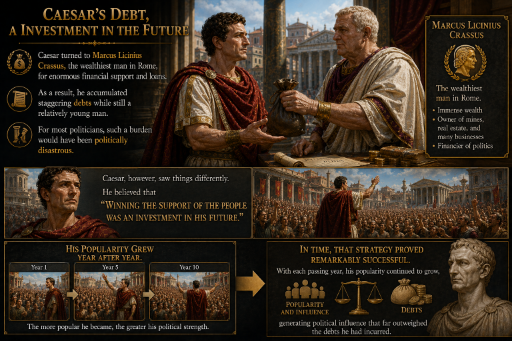 Caesar turned to Marcus Licinius Crassus, the wealthiest man in Rome, for enormous financial support and loans.
As a result, he accumulated staggering debts while still a relatively young man.
For most politicians, such a burden would have been politically disastrous.
Caesar, however, saw things differently.
He believed that winning the support of the people was an investment in his future.
In time, that strategy proved remarkably successful.
With each passing year, his popularity continued to grow, generating political influence that far outweighed the debts he had incurred.
Rising Through the Ranks of Public Office
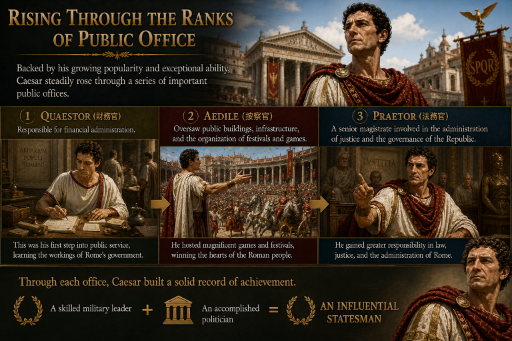 Backed by his growing popularity and exceptional ability, Caesar steadily rose through a series of important public offices.
He first served as a quaestor, an official responsible for financial administration.
Later, he was elected aedile, overseeing public buildings, infrastructure, and the organization of festivals and public games.
The spectacular entertainments he sponsored further increased his popularity among the Roman people.
Caesar was then promoted to praetor, a senior magistrate who played a central role in the administration of justice and the governance of the Republic.
Step by step, he built an impressive record—not only as a talented military leader, but also as an increasingly influential statesman.
Elected Pontifex Maximus
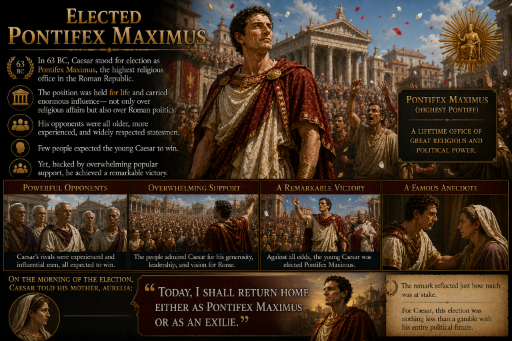 In 63 BC, Caesar stood for election as Pontifex Maximus, the highest religious office in the Roman Republic.
The position was held for life and carried enormous influence—not only over religious affairs but also over Roman politics.
His opponents were all older, more experienced, and widely respected statesmen.
Few people expected the young Caesar to win.
Yet, backed by overwhelming popular support, he achieved a remarkable victory.
According to a famous anecdote, on the morning of the election, Caesar said to his mother,
Aurelia:
“Today, I shall return home either as Pontifex Maximus—or as an exile.”
The remark reflected just how much was at stake.
For Caesar, this election was nothing less than a gamble with his entire political future.
Demonstrating His Military Talent in Hispania
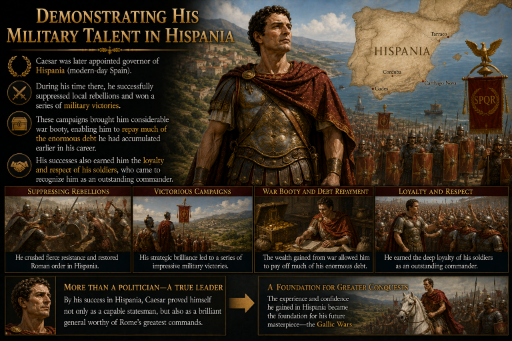 Caesar was later appointed governor of Hispania (modern-day Spain).
During his time there, he successfully suppressed local rebellions and won a series of military victories.
These campaigns brought him considerable war booty, enabling him to repay much of the enormous debt he had accumulated earlier in his career.
His successes also earned him the loyalty and respect of his soldiers, who came to recognize him as an outstanding commander.
By this point, Caesar was no longer regarded merely as a rising politician.
He was increasingly respected as both a skilled statesman and a talented general.
The experience he gained in Hispania would later serve as the foundation for the extraordinary leadership and strategic brilliance he displayed during the Gallic Wars.
Becoming One of Rome’s Most Promising Politicians
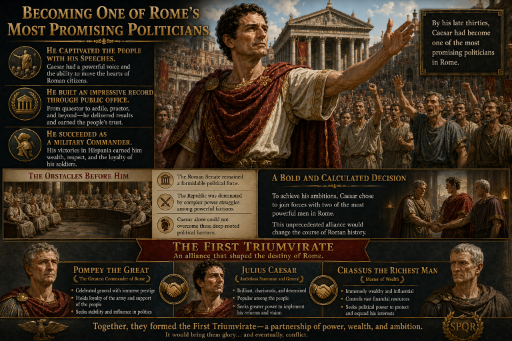 By his late thirties, Caesar had established himself as one of the most promising politicians in Rome.
He had captivated the people with his speeches, built an impressive record through public office, and demonstrated his ability as a successful military commander.
Yet even with these achievements, he could not reshape Rome on his own.
The Roman Senate remained a formidable political force, and the Republic was still dominated by complex power struggles among its leading figures.
To achieve his ambitions, Caesar made a bold and calculated decision.
He chose to join forces with two of the most powerful men in Rome.
That alliance would become known to history as the First Triumvirate—a political partnership that would fundamentally change the future of the Roman Republic.
6. The First Triumvirate — When Rome’s Three Most Powerful Men Joined Forces
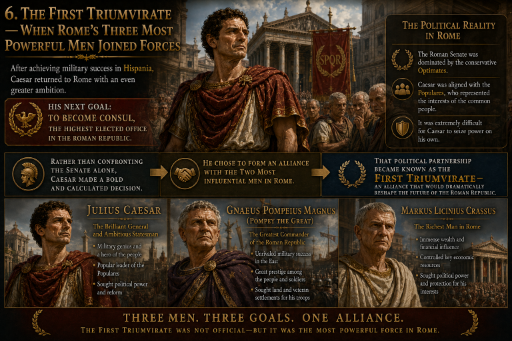 After achieving military success in Hispania, Caesar returned to Rome with an even greater ambition.
His next goal was to become consul, the highest elected office in the Roman Republic.
However, the Roman Senate was still dominated by the conservative Optimates, making it extremely difficult for Caesar, a leader aligned with the Populares, to gain power on his own.
Rather than confronting the Senate alone, Caesar made a bold and calculated decision.
He chose to form an alliance with the two most influential men in Rome.
That political partnership became known as the First Triumvirate—an alliance that would dramatically reshape the future of the Roman Republic.
Rome’s Three Most Powerful Men
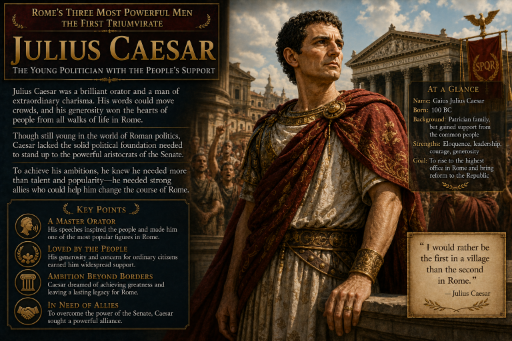 The First Triumvirate was formed by three extraordinary figures.
Julius Caesar — The Young Politician with the People’s Support Caesar possessed exceptional skill as an orator and a remarkable charisma that attracted people from every level of Roman society.
His speeches and public generosity had earned him widespread support among the Roman people.
Even so, he was still relatively young by the standards of Roman politics, and he lacked the political base necessary to challenge the powerful leaders of the Senate on his own.
To achieve his ambitions, Caesar needed strong and influential allies who could help him overcome the entrenched power of the Roman aristocracy.
Gnaeus Pompeius Magnus — Rome’s Greatest General
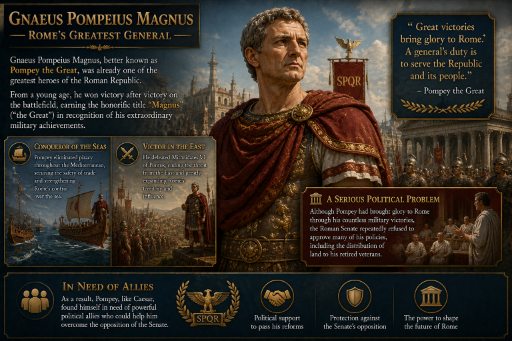 Gnaeus Pompeius Magnus, better known as Pompey the Great, was already one of the greatest heroes of the Roman Republic.
From a young age, he won victory after victory on the battlefield, earning the honorific title “Magnus” (“the Great”) in recognition of his extraordinary military achievements.
Pompey eliminated piracy throughout the Mediterranean Sea and later defeated Mithridates VI of Pontus in the East, greatly expanding Rome’s territory and influence.
Despite these remarkable accomplishments, however, he faced a serious political problem. Although he had brought glory to Rome through his military victories, the Roman Senate repeatedly refused to approve many of his policies, including the distribution of land to his retired veterans.
As a result, Pompey, like Caesar, found himself in need of powerful political allies who could help him overcome the opposition of the Senate.
Marcus Licinius Crassus — The Wealthiest Man in Rome
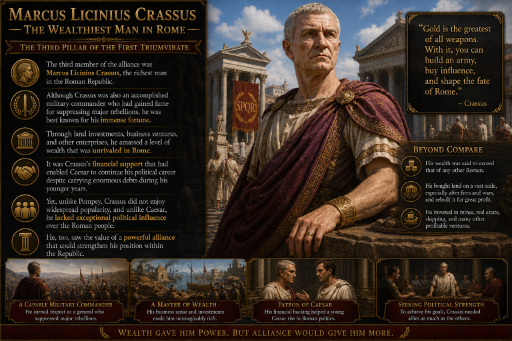 The third member of the alliance was Marcus Licinius Crassus, the richest man in the Roman Republic.
Although Crassus was also an accomplished military commander who had gained fame for suppressing major rebellions, he was best known for his immense fortune.
Through land investments, business ventures, and other enterprises, he amassed a level of wealth that was unrivaled in Rome.
It was Crassus’s financial support that had enabled Caesar to continue his political career despite carrying enormous debts during his younger years.
Yet, unlike Pompey, Crassus did not enjoy widespread popularity, and unlike Caesar, he lacked exceptional political influence over the Roman people.
He, too, saw the value of a powerful alliance that could strengthen his position within the Republic.
Three Men with Complementary Strengths
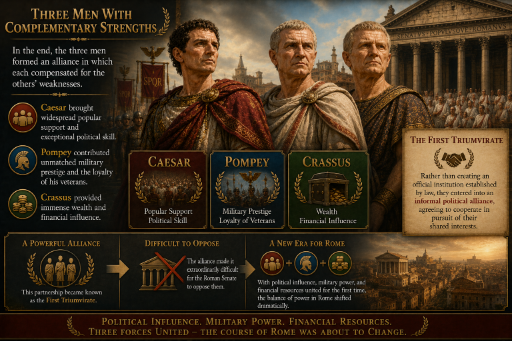 In the end, the three men formed an alliance in which each compensated for the others’ weaknesses.
- Caesar brought widespread popular support and exceptional political skill.
- Pompey contributed unmatched military prestige and the loyalty of his veterans.
- Crassus provided immense wealth and financial influence.
Rather than creating an official institution established by law, they entered into an informal political alliance, agreeing to cooperate in pursuit of their shared interests. This partnership became known as the First Triumvirate. The alliance made it extraordinarily difficult for the Roman Senate to oppose them. With political influence, military power, and financial resources united for the first time, the balance of power in Rome shifted dramatically, ushering in a new era in the history of the Roman Republic.
Elected Consul
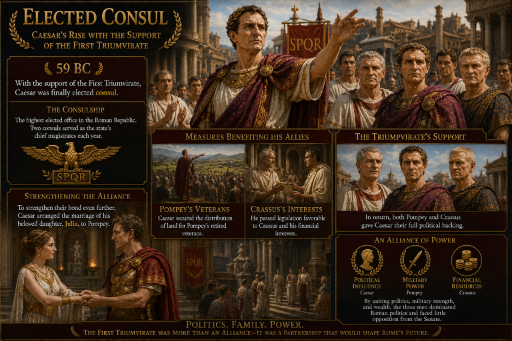 In 59 BC, with the support of the First Triumvirate, Caesar was finally elected consul.
The consulship was the highest elected office in the Roman Republic, with two consuls serving as the state’s chief magistrates each year. Once in office, Caesar pushed through a series of measures that benefited his allies.
He secured the distribution of land to Pompey’s retired veterans and passed legislation favorable to Crassus and his financial interests.
In return, both Pompey and Crassus gave Caesar their full political backing.
To strengthen the alliance even further, Caesar arranged the marriage of his beloved daughter, Julia, to Pompey.
In doing so, he reinforced their partnership not only through politics, but also through family ties.
Appointed Governor of Gaul
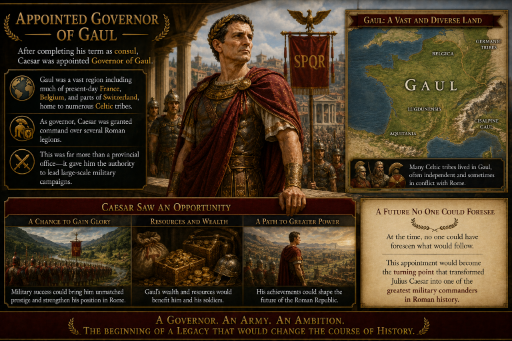 After completing his term as consul, Caesar was appointed Governor of Gaul.
At the time, Gaul encompassed a vast region that included much of present-day France, Belgium, and parts of Switzerland, and was home to numerous Celtic tribes.
As governor, Caesar was granted command over several Roman legions.
This made him far more than a provincial administrator—it gave him the authority to lead large-scale military campaigns.
Caesar recognized the extraordinary opportunity before him and resolved to make the most of it.
At the time, no one could have foreseen what would follow.
This appointment would become the turning point that transformed Julius Caesar into one of the greatest military commanders in Roman history.
A Political Alliance That Changed the Balance of Power in Rome
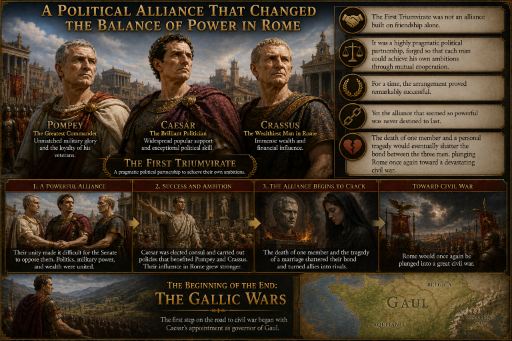 The First Triumvirate was not an alliance built on friendship alone.
It was a highly pragmatic political partnership, forged so that each man could achieve his own ambitions through mutual cooperation.
For a time, the arrangement proved remarkably successful.
Yet the alliance that seemed so powerful was never destined to last.
The death of one member and a personal tragedy would eventually shatter the bond between the three men, plunging Rome once again toward a devastating civil war.
The first step on that path began with Caesar’s appointment as governor—and the conflict that would become known as the Gallic Wars.
7. The Gallic Wars — The Eight-Year Campaign That Made Caesar a Legend
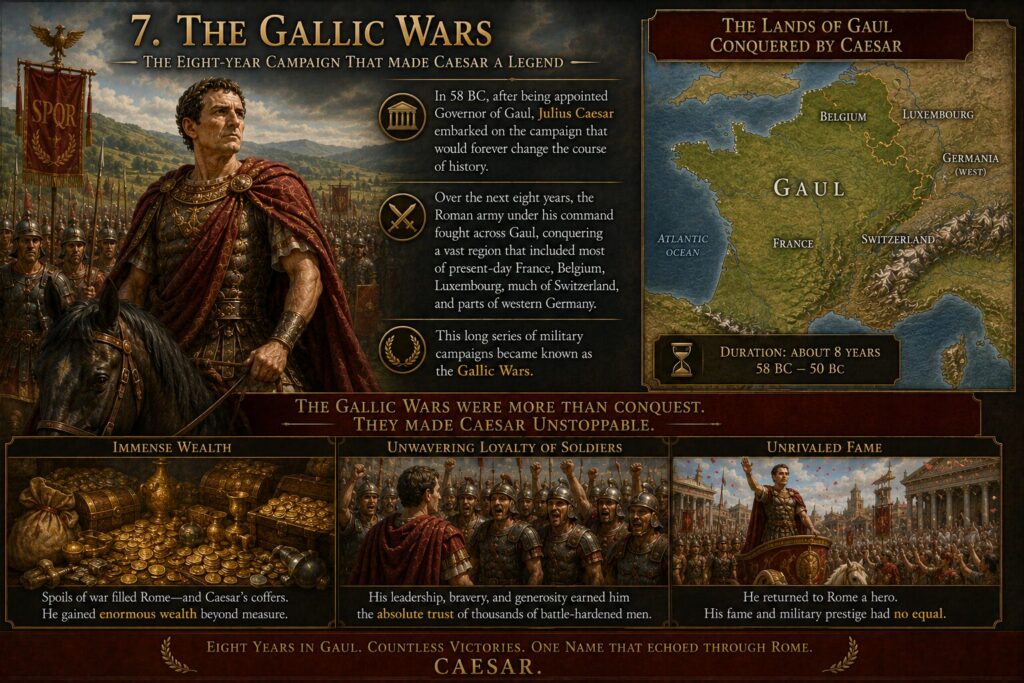 In 58 BC, after being appointed Governor of Gaul, Julius Caesar embarked on the campaign that would forever change the course of history.
Over the next eight years, the Roman army under his command fought across Gaul, conquering a vast region that included most of present-day France, Belgium, Luxembourg, much of Switzerland, and parts of western Germany.
This long series of military campaigns became known as the Gallic Wars.
The Gallic Wars were far more than a campaign of territorial expansion.
Through these victories, Caesar acquired immense wealth and earned the unwavering loyalty of thousands of battle-hardened soldiers.
Above all, he gained a level of fame and military prestige that no one else in Rome could rival.
What Was Gaul?
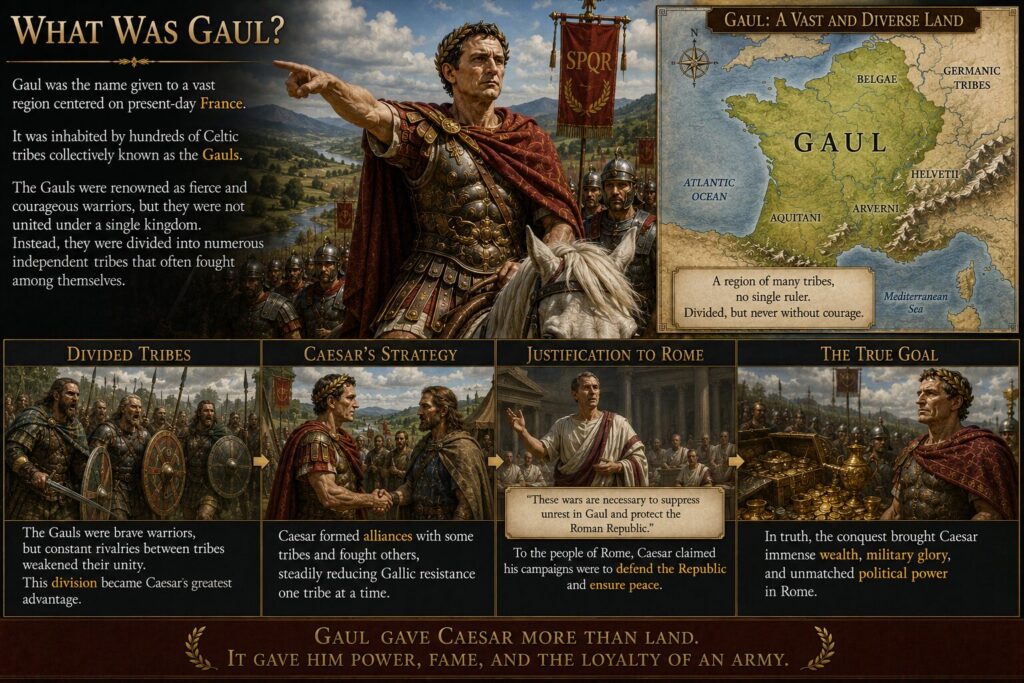 Gaul was the name given to a vast region centered on present-day France.
It was inhabited by hundreds of Celtic tribes collectively known as the Gauls.
The Gauls were renowned as fierce and courageous warriors, but they were not united under a single kingdom.
Instead, they were divided into numerous independent tribes that often fought among themselves.
Caesar skillfully exploited these divisions.
He formed alliances with certain tribes while waging war against others, gradually weakening Gallic resistance one tribe at a time.
To the people of Rome, Caesar justified his campaigns by claiming that they were necessary to suppress unrest in Gaul and protect the Roman Republic.
In reality, however, the conquest also offered him an opportunity to gain immense wealth, military glory, and the political prestige that would strengthen his position in Rome.
A Series of Remarkable Victories
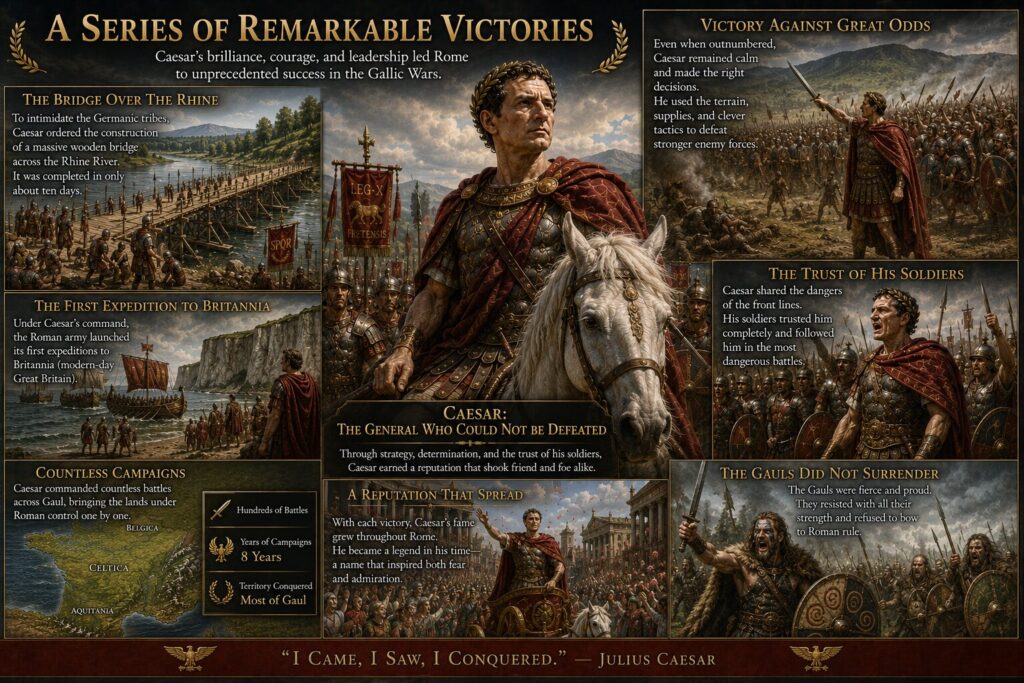 Throughout the Gallic Wars, Caesar commanded countless military campaigns.
To intimidate the Germanic tribes, he ordered the construction of a massive wooden bridge across the Rhine River—a feat completed in only about ten days.
It was also during his command that the Roman army launched its first expeditions to Britannia (modern-day Great Britain).
Even when heavily outnumbered, Caesar remained calm under pressure.
By skillfully exploiting terrain, maintaining efficient supply lines, and adapting quickly to changing circumstances, he won victory after victory.
His soldiers placed immense trust in a commander who often shared the dangers of the front lines, and they followed him even in the most difficult campaigns.
With each success, Caesar’s reputation grew.
Before long, he was widely regarded as the general who could not be defeated.
Yet the Gauls had no intention of surrendering without a fight.
The Rise of Vercingetorix
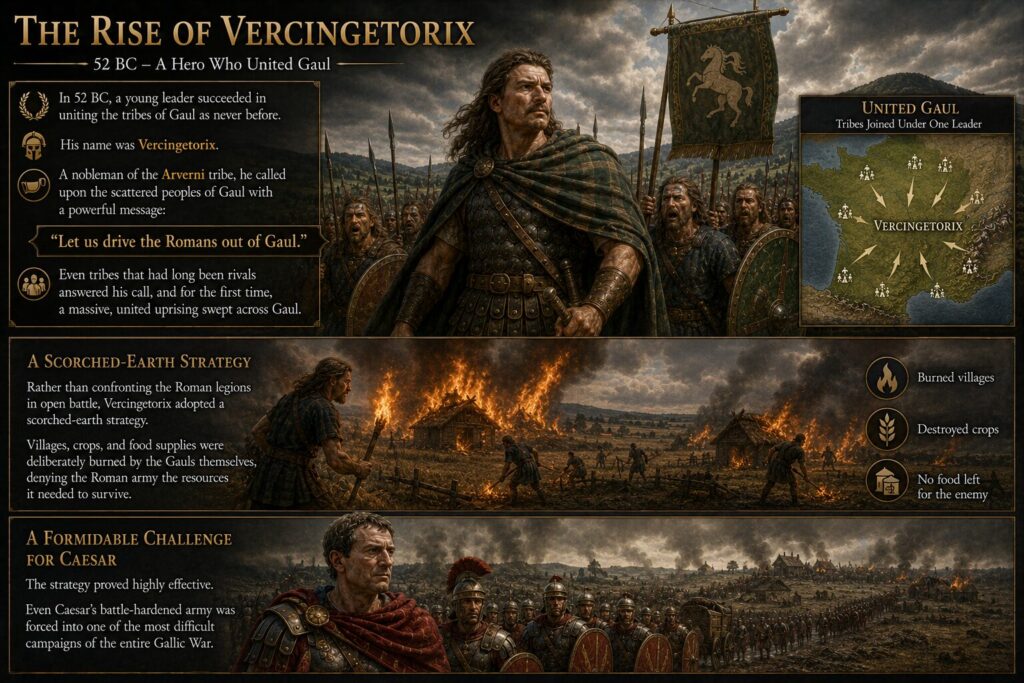 In 52 BC, a young leader succeeded in uniting the tribes of Gaul as never before.
His name was Vercingetorix.
A nobleman of the Arverni tribe, he called upon the scattered peoples of Gaul with a powerful message:
“Let us drive the Romans out of Gaul.”
Even tribes that had long been rivals answered his call, and for the first time, a massive, united uprising swept across Gaul.
Rather than confronting the Roman legions in open battle, Vercingetorix adopted a scorched-earth strategy.
Villages, crops, and food supplies were deliberately burned by the Gauls themselves, denying the Roman army the resources it needed to survive.
The strategy proved highly effective. Even Caesar’s battle-hardened army was forced into one of the most difficult campaigns of the entire Gallic War.
The Battle of Alesia
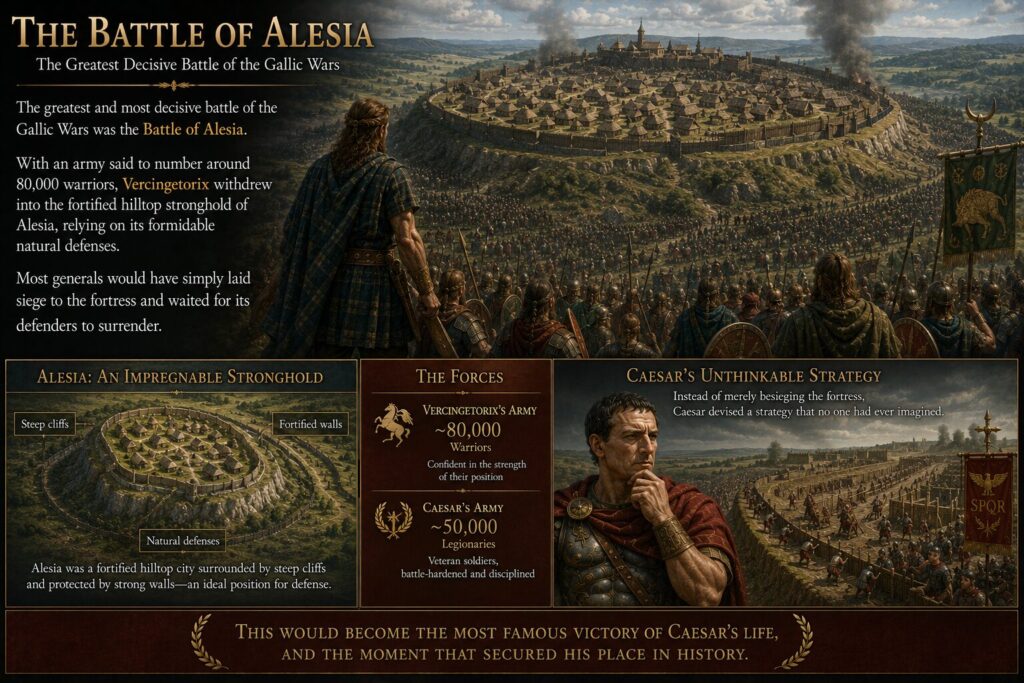 The greatest and most decisive battle of the Gallic Wars was the Battle of Alesia.
With an army said to number around 80,000 warriors, Vercingetorix withdrew into the fortified hilltop stronghold of Alesia, relying on its formidable natural defenses.
Most generals would have simply laid siege to the fortress and waited for its defenders to surrender.
Caesar, however, devised a strategy that no one had ever imagined.
The Ingenious Double Line of Fortifications
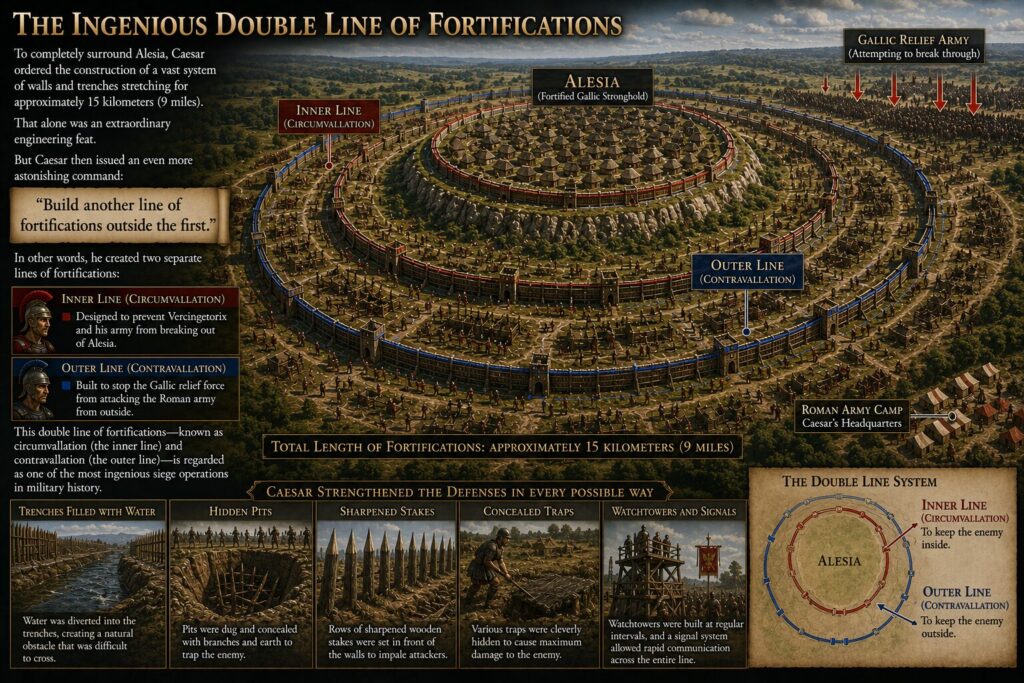 To completely surround Alesia, Caesar ordered the construction of a vast system of walls and trenches stretching for approximately 15 kilometers (9 miles).
That alone was an extraordinary engineering feat.
But Caesar then issued an even more astonishing command:
“Build another line of fortifications outside the first.”
In other words, he created two separate lines of fortifications:
- The inner line was designed to prevent Vercingetorix and his army from breaking out of Alesia.
- The outer line was built to stop the Gallic relief force from attacking the Roman army from outside.
This double line of fortifications—known as circumvallation (the inner line) and contravallation (the outer line)—is regarded as one of the most ingenious siege operations in military history.
Caesar strengthened these defenses even further by digging trenches, diverting water into them, and constructing hidden pits, sharpened wooden stakes, and concealed traps, making it extraordinarily difficult for any enemy to approach the Roman lines.
A Battle Against Desperate Odds
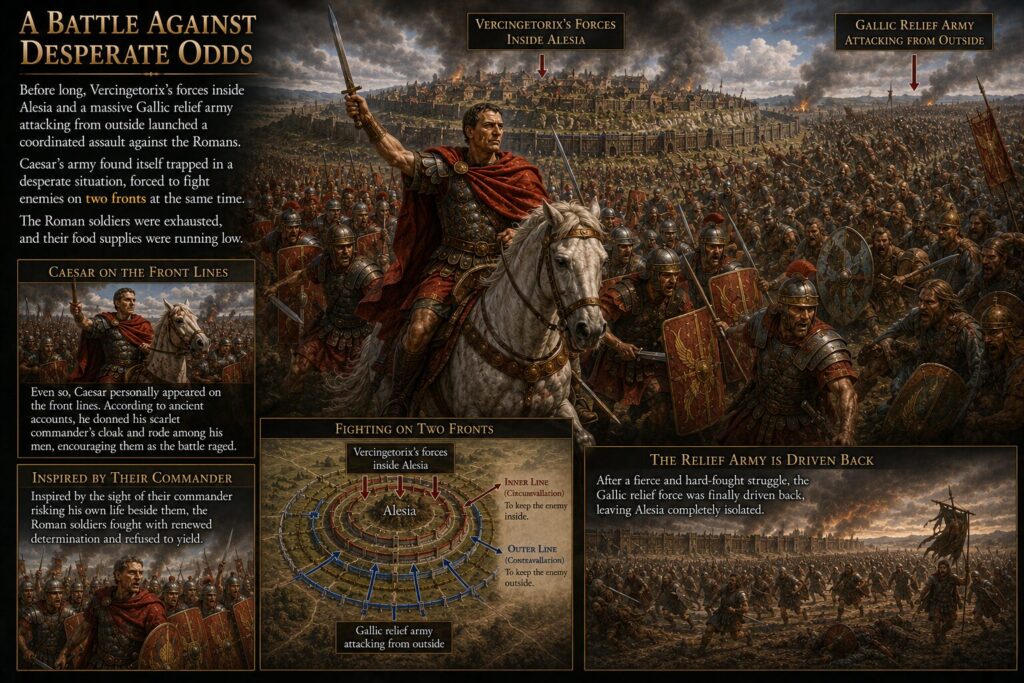 Before long, Vercingetorix’s forces inside Alesia and a massive Gallic relief army attacking from outside launched a coordinated assault against the Romans.
Caesar’s army found itself trapped in a desperate situation, forced to fight enemies on two fronts at the same time.
The Roman soldiers were exhausted, and their food supplies were running low.
Even so, Caesar personally appeared on the front lines.
According to ancient accounts, he donned his scarlet commander’s cloak and rode among his men, encouraging them as the battle raged.
Inspired by the sight of their commander risking his own life beside them, the Roman soldiers fought with renewed determination and refused to yield.
After a fierce and hard-fought struggle, the Gallic relief force was finally driven back, leaving Alesia completely isolated.
The Surrender of Vercingetorix
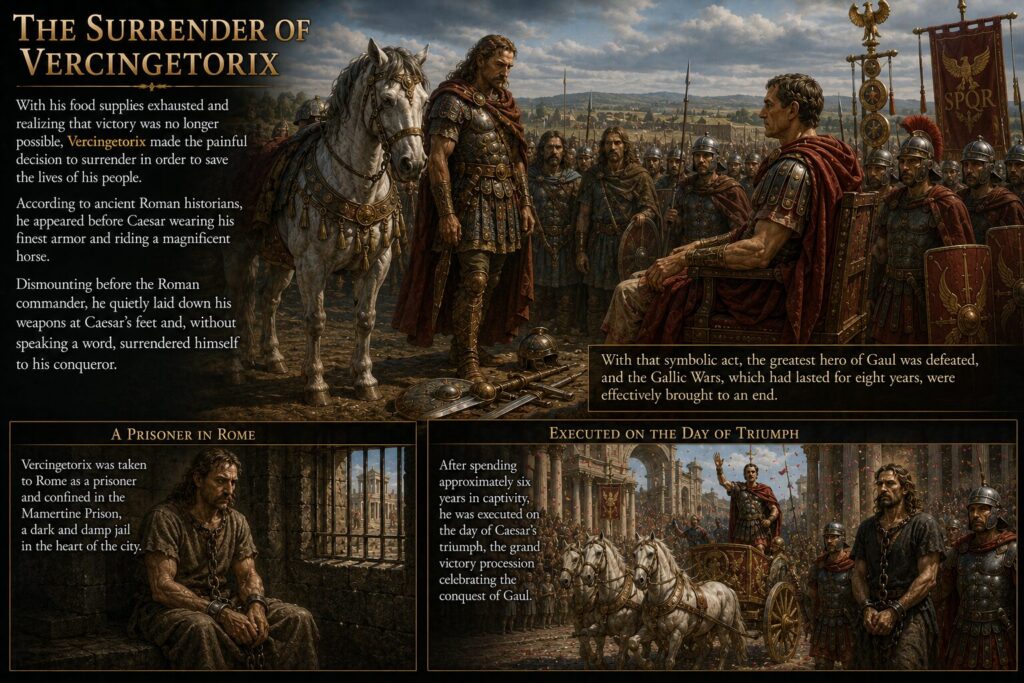 With his food supplies exhausted and realizing that victory was no longer possible, Vercingetorix made the painful decision to surrender in order to save the lives of his people.
According to ancient Roman historians, he appeared before Caesar wearing his finest armor and riding a magnificent horse. Dismounting before the Roman commander, he quietly laid down his weapons at Caesar’s feet and, without speaking a word, surrendered himself to his conqueror.
With that symbolic act, the greatest hero of Gaul was defeated, and the Gallic Wars, which had lasted for eight years, were effectively brought to an end.
Vercingetorix was taken to Rome as a prisoner.
After spending approximately six years in captivity, he was executed on the day of Caesar’s triumph, the grand victory procession celebrating the conquest of Gaul.
The Gallic Wars Changed the Course of History
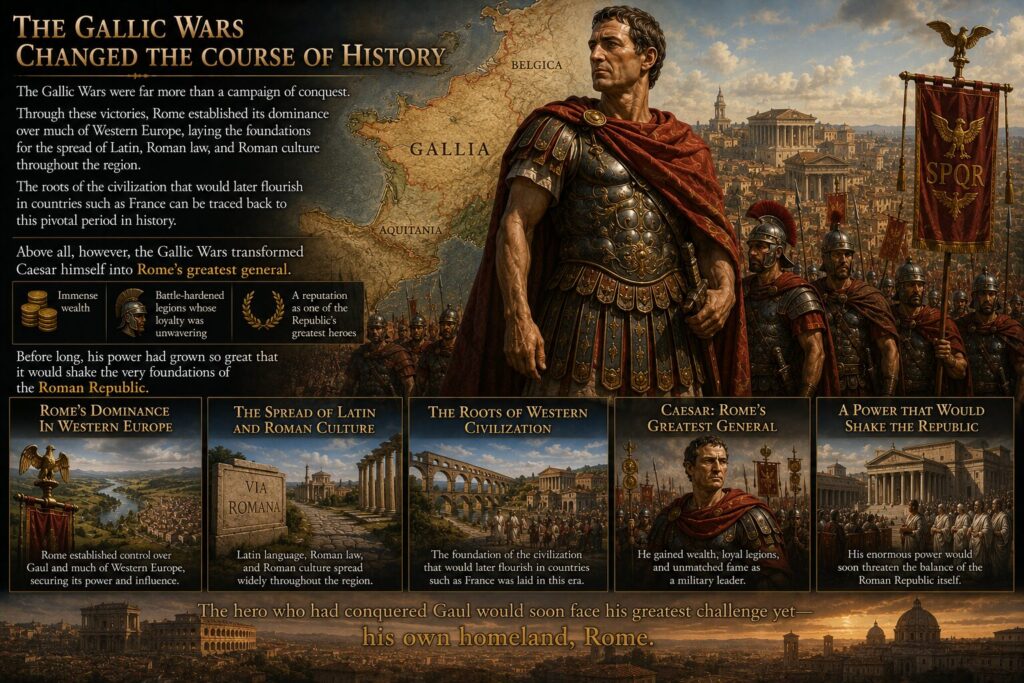 The Gallic Wars were far more than a campaign of conquest.
Through these victories, Rome established its dominance over much of Western Europe, laying the foundations for the spread of Latin, Roman law, and Roman culture throughout the region.
The roots of the civilization that would later flourish in countries such as France can be traced back to this pivotal period in history.
Above all, however, the Gallic Wars transformed Caesar himself into Rome’s greatest general. He emerged from the conflict with immense wealth, battle-hardened legions whose loyalty was unwavering, and a reputation as one of the Republic’s greatest heroes.
Before long, his power had grown so great that it would shake the very foundations of the Roman Republic.
The hero who had conquered Gaul would soon face his greatest challenge yet— his own homeland, Rome.
8. Caesar the Writer — The Man Who Made History with Both Sword and Pen
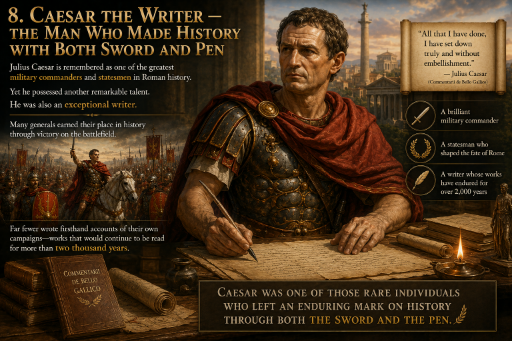 Julius Caesar is remembered as one of the greatest military commanders and statesmen in Roman history.
Yet he possessed another remarkable talent.
He was also an exceptional writer.
Many generals earned their place in history through victory on the battlefield.
Far fewer wrote firsthand accounts of their own campaigns—works that would continue to be read for more than two thousand years.
Caesar was one of those rare individuals who left an enduring mark on history through both the sword and the pen. —
Commentarii de Bello Gallico — Caesar’s Masterpiece
 Caesar’s most famous work is the Commentarii de Bello Gallico (Commentaries on the Gallic War).
This work is an eight-book historical account of the Gallic Wars, covering the campaigns from 58 BC to 52 BC and written largely by Caesar himself.
The eighth book, however, was completed after Caesar’s death by his trusted officer Aulus Hirtius, who continued the narrative.
The Commentaries are far more than a simple record of military campaigns.
They also contain detailed descriptions of Gaul’s geography, peoples, customs, religions, and methods of warfare, making the work one of the most valuable surviving sources for understanding ancient Europe.
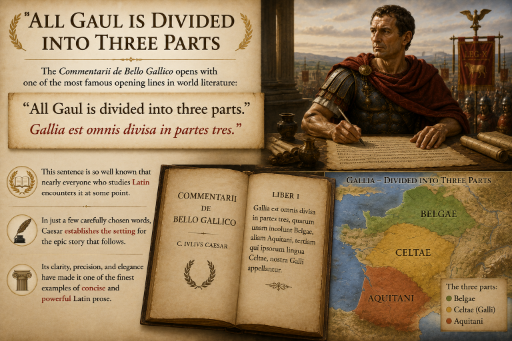
“All Gaul Is Divided into Three Parts”
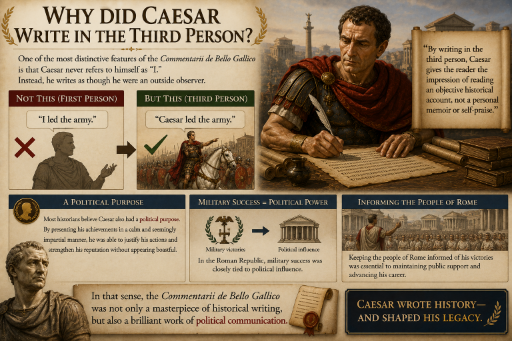 The Commentarii de Bello Gallico opens with one of the most famous opening lines in world literature:
“All Gaul is divided into three parts.”
Gallia est omnis divisa in partes tres.
This sentence is so well known that nearly everyone who studies Latin encounters it at some point.
In just a few carefully chosen words, Caesar establishes the setting for the epic story that follows.
Its clarity, precision, and elegance have made it one of the finest examples of concise and powerful Latin prose.
Why Did Caesar Write in the Third Person?
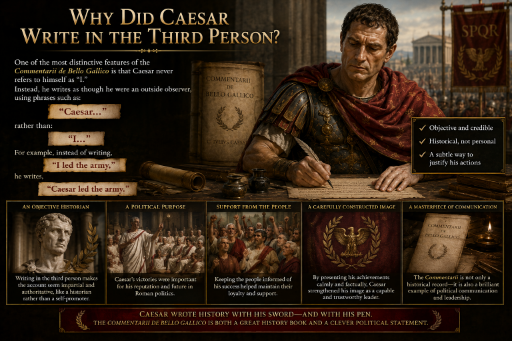 One of the most distinctive features of the Commentarii de Bello Gallico is that Caesar never refers to himself as “I.”
Instead, he writes as though he were an outside observer, using phrases such as: “Caesar…” rather than: “I…”
For example, instead of writing, “I led the army,” he writes, “Caesar led the army.”
This style gives readers the impression that they are reading an objective historical account rather than a personal memoir or a work of self-praise.
Of course, most historians believe that Caesar also had a political purpose.
By presenting his achievements in a calm and seemingly impartial manner, he was able to justify his actions and strengthen his reputation without appearing openly boastful.
In the Roman Republic, military success was closely tied to political influence.
Keeping the people of Rome informed of his victories was essential to maintaining public support and advancing his career.
In that sense, the Commentarii de Bello Gallico was not only a masterpiece of historical writing, but also a brilliant work of political communication.
Why Is It Still Highly Regarded Today?
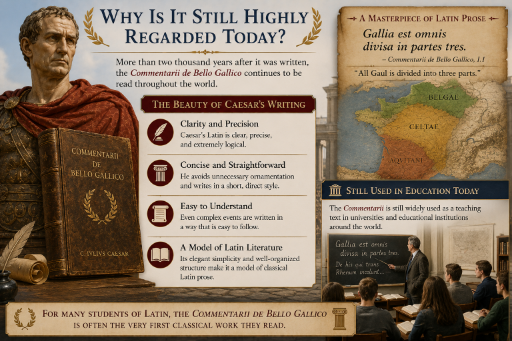 More than two thousand years after it was written, the Commentarii de Bello Gallico continues to be read throughout the world.
One of the main reasons is the remarkable quality of Caesar’s writing.
His Latin prose is admired for its clarity, precision, and logical structure.
Rather than relying on elaborate ornamentation, Caesar wrote in a concise and straightforward style that made even complex events easy to follow.
Because of its elegant simplicity and well-organized presentation of information, the work has long been regarded as a model of classical Latin literature.
For this reason, it is still used today as a teaching text in universities and educational institutions around the world.
In fact, for many students of Latin, the Commentarii de Bello Gallico is one of the very first classical works they read.
Historical Value as a Primary Source
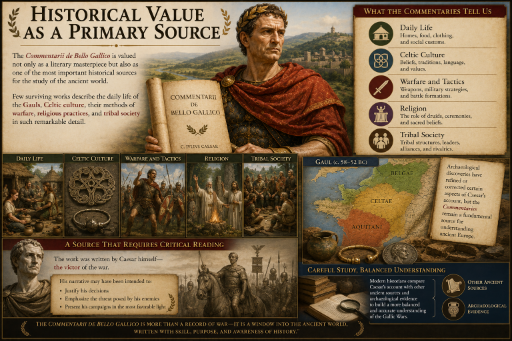 The Commentarii de Bello Gallico is valued not only as a literary masterpiece but also as one of the most important historical sources for the study of the ancient world.
Few surviving works describe the daily life of the Gauls, Celtic culture, their methods of warfare, religious practices, and tribal society in such remarkable detail.
Although archaeological discoveries have refined or corrected certain aspects of Caesar’s account, the Commentaries remain one of the fundamental primary sources for understanding ancient Europe.
At the same time, historians recognize that the work was written by Caesar himself—the victor of the war.
For that reason, his narrative may have been intended to justify his decisions, emphasize the threat posed by his enemies, or present his campaigns in the most favorable light.
Modern historians therefore read the Commentarii de Bello Gallico with careful attention, comparing its accounts with other ancient sources and archaeological evidence to build a more balanced understanding of the Gallic Wars.
The Man Who Changed History with Both Sword and Pen
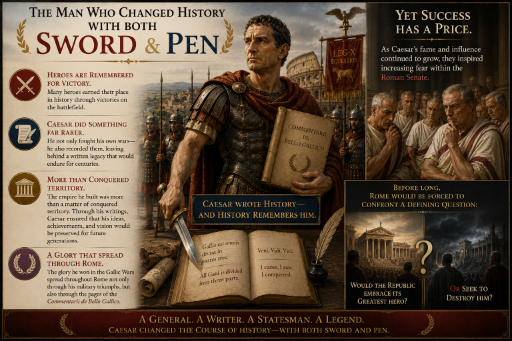 Many heroes earned their place in history through victories on the battlefield.
Caesar did something far rarer.
He not only fought his own wars—he also recorded them, leaving behind a written legacy that would endure for centuries.
The empire he built was more than a matter of conquered territory.
Through his writings, Caesar ensured that his ideas, achievements, and vision would be preserved for future generations.
The glory he won in the Gallic Wars spread throughout Rome not only through his military triumphs, but also through the pages of the Commentarii de Bello Gallico.
Yet that extraordinary success came at a price.
As Caesar’s fame and influence continued to grow, they inspired increasing fear within the Roman Senate.
Before long, Rome would be forced to confront a defining question:
Would the Republic embrace its greatest hero—or seek to destroy him?
9. Crossing the Rubicon — “The Die Is Cast”
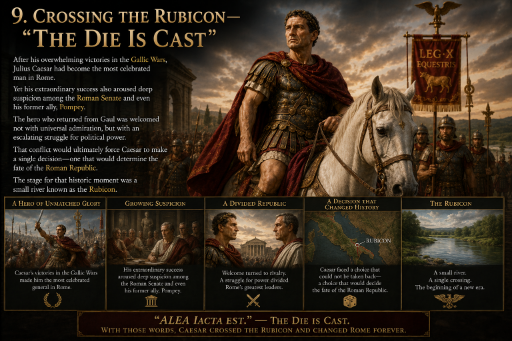 After his overwhelming victories in the Gallic Wars, Julius Caesar had become the most celebrated man in Rome.
Yet his extraordinary success also aroused deep suspicion among the Roman Senate and even his former ally, Pompey.
The hero who returned from Gaul was welcomed not with universal admiration, but with an escalating struggle for political power.
That conflict would ultimately force Caesar to make a single decision—one that would determine the fate of the Roman Republic.
The stage for that historic moment was a small river known as the Rubicon.
The Collapse of the Alliance
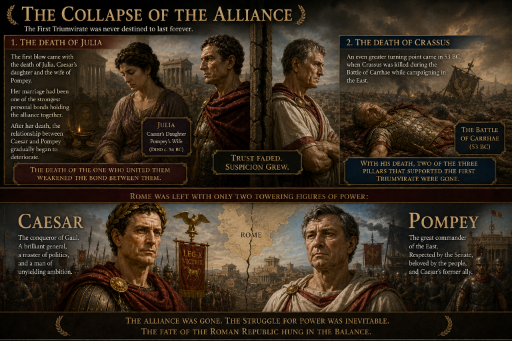 The First Triumvirate was never destined to last forever.
The first blow came with the death of Julia, Caesar’s daughter and the wife of Pompey.
Her marriage had been one of the strongest personal bonds holding the alliance together.
After her death, the relationship between Caesar and Pompey gradually began to deteriorate.
An even greater turning point came in 53 BC, when Crassus was killed during the Battle of Carrhae while campaigning in the East.
With his death, two of the three pillars that had supported the First Triumvirate were gone.
Rome was left with only two towering figures of power:
Caesar and Pompey.
The Senate’s Order
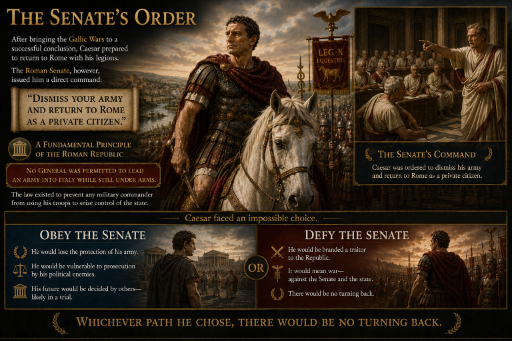 After bringing the Gallic Wars to a successful conclusion, Caesar prepared to return to Rome with his legions.
The Roman Senate, however, issued him a direct command:
“Dismiss your army and return to Rome as a private citizen.”
There was an important principle at the heart of the Roman Republic.
No general was permitted to lead an army into Italy while still under arms.
The law existed to prevent any military commander from using his troops to seize control of the state.
If Caesar obeyed the Senate’s order, he would lose the protection of his army and would likely face prosecution by his political enemies.
If he refused, however, he would be committing an act of rebellion against the Republic itself.
Whichever path he chose, there would be no turning back.
The Rubicon River
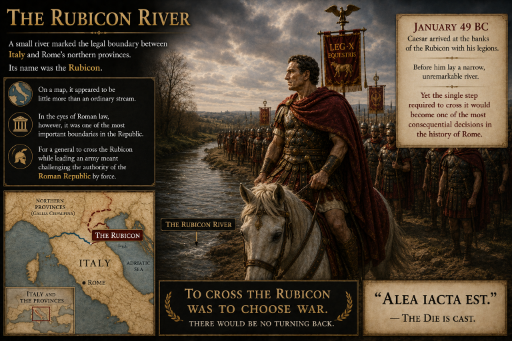 A small river marked the legal boundary between Italy and Rome’s northern provinces.
Its name was the Rubicon.
On a map, it appeared to be little more than an ordinary stream.
In the eyes of Roman law, however, it was one of the most important boundaries in the Republic.
For a general to cross the Rubicon while leading an army meant challenging the authority of the Roman Republic by force.
In January 49 BC, Caesar arrived at the banks of the Rubicon with his legions.
Before him lay a narrow, unremarkable river.
Yet the single step required to cross it would become one of the most consequential decisions in the history of Rome.
“The Die Is Cast”
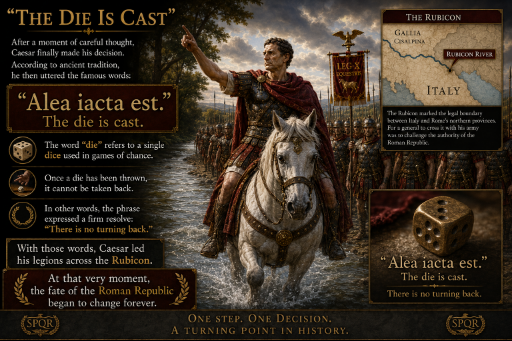 After a moment of careful thought, Caesar finally made his decision.
According to ancient tradition, he then uttered the famous words:
“Alea iacta est.”
“The die is cast.”
The word “die” refers to a single dice used in games of chance.
Once a die has been thrown, it cannot be taken back.
In other words, the phrase expressed a firm resolve:
“There is no turning back.”
With those words, Caesar led his legions across the Rubicon.
At that very moment, the fate of the Roman Republic began to change forever.
Why a Small River Changed World History
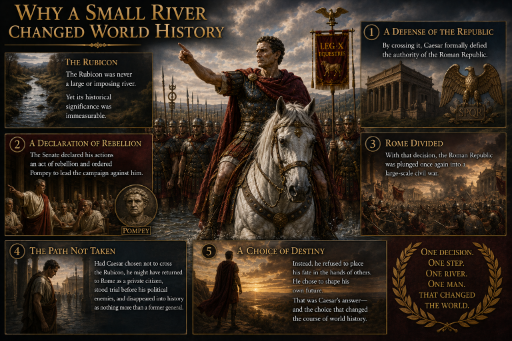 The Rubicon was never a large or imposing river.
Yet its historical significance was immeasurable.
By crossing it, Caesar formally defied the authority of the Roman Republic.
The Senate declared his actions an act of rebellion and ordered Pompey to lead the campaign against him.
With that decision, the Roman Republic was plunged once again into a large-scale civil war.
Had Caesar chosen not to cross the Rubicon, he might have returned to Rome as a private citizen, stood trial before his political enemies, and disappeared into history as nothing more than a former general.
Instead, he refused to place his fate in the hands of others.
He chose to shape his own future.
That was Caesar’s answer—and the choice that changed the course of world history.
“Crossing the Rubicon”
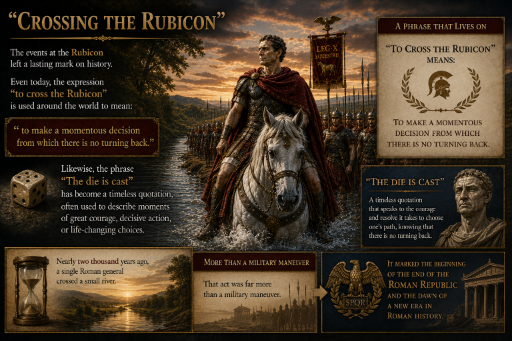 The events at the Rubicon left a lasting mark on history.
Even today, the expression “to cross the Rubicon” is used around the world to mean:
“to make a momentous decision from which there is no turning back.”
Likewise, the phrase “The die is cast” has become a timeless quotation, often used to describe moments of great courage, decisive action, or life-changing choices.
Nearly two thousand years ago, a single Roman general crossed a small river.
Yet that act was far more than a military maneuver.
It marked the beginning of the end of the Roman Republic and the dawn of a new era in Roman history.
From Hero to the Republic’s Greatest Enemy
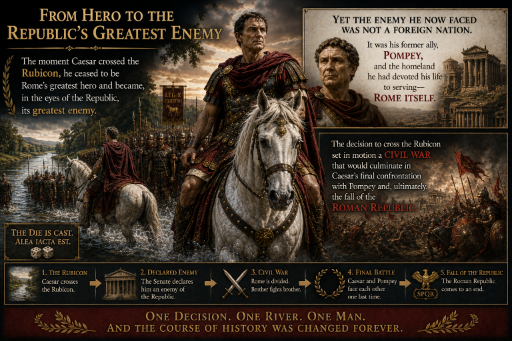 The moment Caesar crossed the Rubicon, he ceased to be Rome’s greatest hero and became, in the eyes of the Republic, its greatest enemy.
Yet the enemy he now faced was not a foreign nation.
It was his former ally, Pompey, and the homeland he had devoted his life to serving—Rome itself.
The decision to cross the Rubicon set in motion a civil war that would culminate in Caesar’s final confrontation with Pompey and, ultimately, the fall of the Roman Republic.
10. The Roman Civil War — The Final Confrontation Between Former Allies
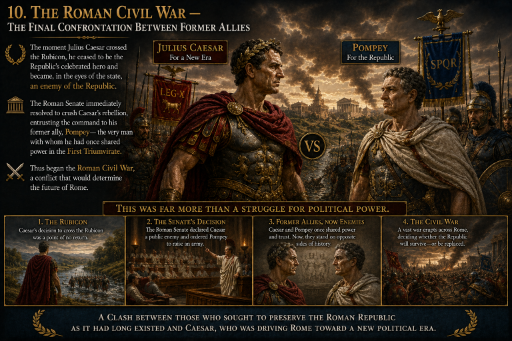 The moment Julius Caesar crossed the Rubicon, he ceased to be the Republic’s celebrated hero and became, in the eyes of the state, an enemy of the Republic.
The Roman Senate immediately resolved to crush Caesar’s rebellion, entrusting the command to his former ally, Pompey—the very man with whom he had once shared power in the First Triumvirate.
Thus began the Roman Civil War, a conflict that would determine the future of Rome.
This was far more than a struggle for political power.
It was also a clash between those who sought to preserve the Roman Republic as it had long existed and Caesar, who was driving Rome toward a new political era.
The Confrontation with Pompey
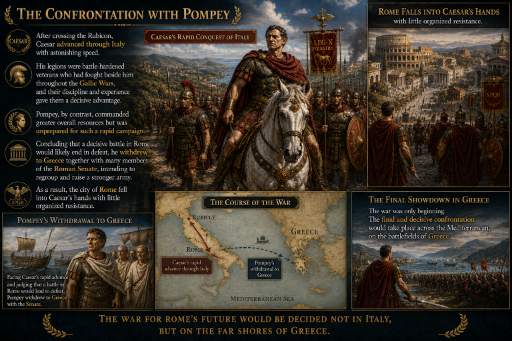 After crossing the Rubicon, Caesar advanced through Italy with astonishing speed.
His legions were battle-hardened veterans who had fought beside him throughout the Gallic Wars, and their discipline and experience gave them a decisive advantage.
Pompey, by contrast, commanded greater overall resources but was unprepared for such a rapid campaign.
Concluding that a decisive battle in Rome would likely end in defeat, he withdrew to Greece together with many members of the Roman Senate, intending to regroup and raise a stronger army.
As a result, the city of Rome fell into Caesar’s hands with little organized resistance.
The war, however, was only just beginning.
The final and decisive confrontation would take place across the Mediterranean, on the battlefields of Greece.
The Battle of Pharsalus
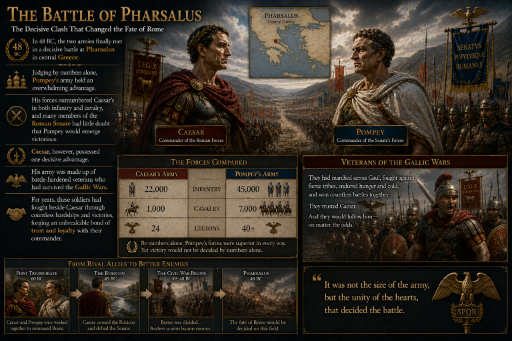 In 48 BC, the two armies finally met in a decisive battle at Pharsalus in central Greece.
Judging by numbers alone, Pompey’s army held an overwhelming advantage.
His forces outnumbered Caesar’s in both infantry and cavalry, and many members of the Roman Senate had little doubt that Pompey would emerge victorious.
Caesar, however, possessed one decisive advantage.
His army was made up of battle-hardened veterans who had survived the Gallic Wars.
For years, these soldiers had fought beside Caesar through countless hardships and victories, forging an unbreakable bond of trust and loyalty with their commander.
Caesar’s Decisive Strategy
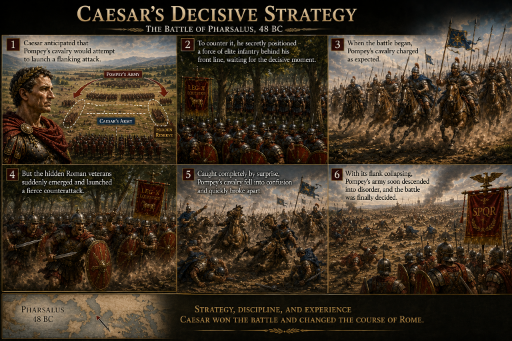 Caesar anticipated that Pompey’s cavalry would attempt to launch a flanking attack.
To counter it, he secretly positioned a force of elite infantry behind his front line, waiting for the decisive moment.
When the battle began, Pompey’s cavalry charged as expected.
But the hidden Roman veterans suddenly emerged and launched a fierce counterattack.
Caught completely by surprise, Pompey’s cavalry fell into confusion and quickly broke apart.
With its flank collapsing, Pompey’s army soon descended into disorder, and the battle was finally decided.
Pompey’s Flight
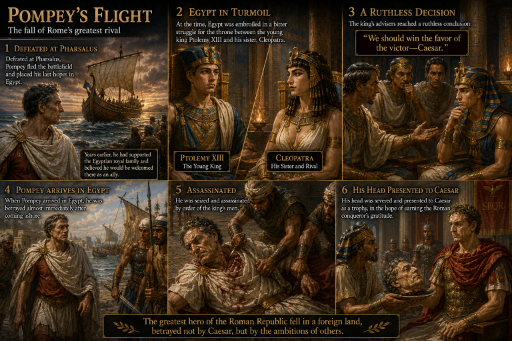 Defeated at Pharsalus, Pompey fled the battlefield and placed his last hopes in Egypt.
Years earlier, he had supported the Egyptian royal family and believed he would be welcomed there as an ally.
His expectations, however, would be tragically betrayed.
At the time, Egypt was embroiled in a bitter struggle for the throne between the young king Ptolemy XIII and his sister, Cleopatra.
The king’s advisers reached a ruthless conclusion:
“We should win the favor of the victor—Caesar.”
When Pompey arrived in Egypt, he was betrayed almost immediately after coming ashore and was assassinated.
His head was severed and presented to Caesar as a trophy, in the hope of earning the Roman conqueror’s gratitude.
Caesar’s Reaction
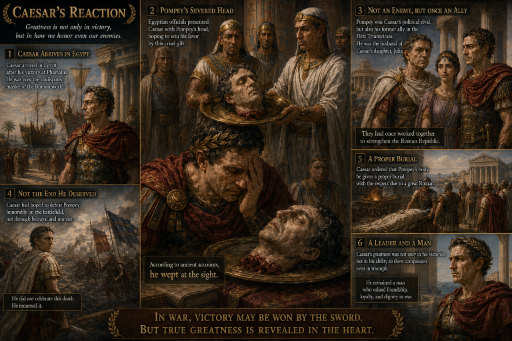 When Caesar arrived in Egypt, he was presented with Pompey’s severed head.
The Egyptian advisers expected him to rejoice at the death of his greatest rival.
Instead, Caesar’s reaction astonished them.
According to ancient accounts, he wept at the sight. Pompey had indeed become his enemy.
But he had also once been Caesar’s ally, a man with whom he had shared power in the First Triumvirate, and the husband of his beloved daughter, Julia.
Caesar had wanted to defeat Pompey honorably on the battlefield—not to see him murdered through treachery.
He therefore ordered that Pompey’s remains be given a proper burial.
In that moment, Caesar demonstrated not only the composure of a victorious commander, but also the compassion of a man who had not forgotten friendship, loyalty, or dignity in war.
A Fateful New Encounter
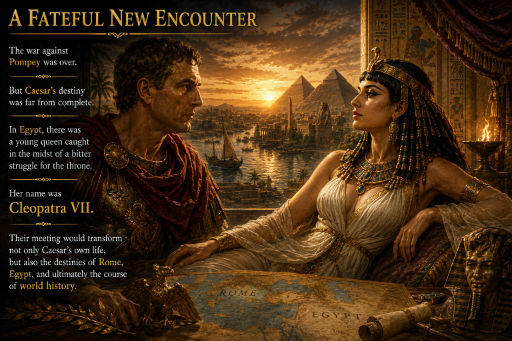 The war against Pompey was over.
But Caesar’s destiny was far from complete.
In Egypt, there was a young queen caught in the midst of a bitter struggle for the throne.
Her name was Cleopatra VII.
Their meeting would transform not only Caesar’s own life, but also the destinies of Rome, Egypt, and ultimately the course of world history.
11. Meeting Cleopatra — The Fateful Encounter That Linked Rome and Egypt
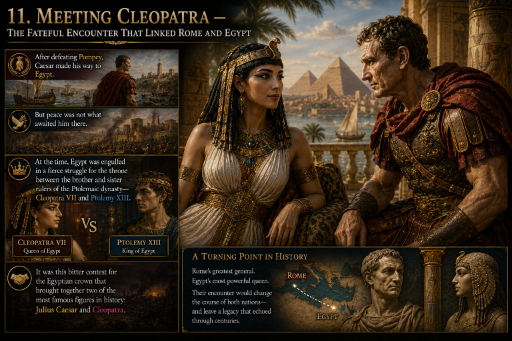 After defeating Pompey, Caesar made his way to Egypt.
But peace was not what awaited him there.
At the time, Egypt was engulfed in a fierce struggle for the throne between the brother and sister rulers of the Ptolemaic dynasty—Cleopatra VII and Ptolemy XIII.
It was this bitter contest for the Egyptian crown that brought together two of the most famous figures in history:
Julius Caesar and Cleopatra.
Cleopatra — The Young Queen of Egypt
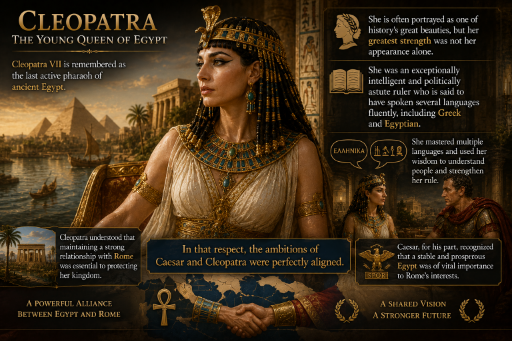 Cleopatra VII is remembered as the last active pharaoh of ancient Egypt.
She is often portrayed as one of history’s great beauties, but her greatest strength was not her appearance alone.
She was an exceptionally intelligent and politically astute ruler who is said to have spoken several languages fluently, including Greek and Egyptian.
Cleopatra understood that maintaining a strong relationship with Rome was essential to protecting her kingdom.
Caesar, for his part, recognized that a stable and prosperous Egypt was of vital importance to Rome’s interests.
In that respect, the ambitions of Caesar and Cleopatra were perfectly aligned.
A Secret Meeting
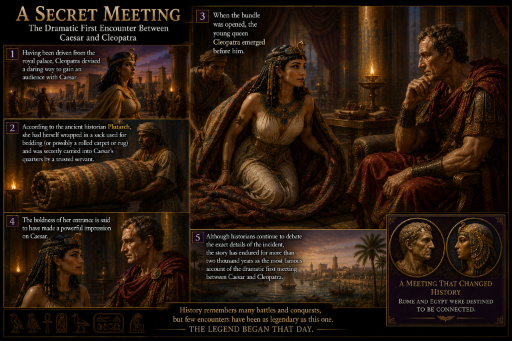 Having been driven from the royal palace, Cleopatra devised a daring way to gain an audience with Caesar.
According to the ancient historian Plutarch, she had herself wrapped in a sack used for bedding (or possibly a rolled carpet or rug) and was secretly carried into Caesar’s quarters by a trusted servant.
When the bundle was opened, the young queen Cleopatra emerged before him.
The boldness of her entrance is said to have made a powerful impression on Caesar.
Although historians continue to debate the exact details of the incident, the story has endured for more than two thousand years as the most famous account of the dramatic first meeting between Caesar and Cleopatra.
A Political Alliance Between Two Powerful Leaders
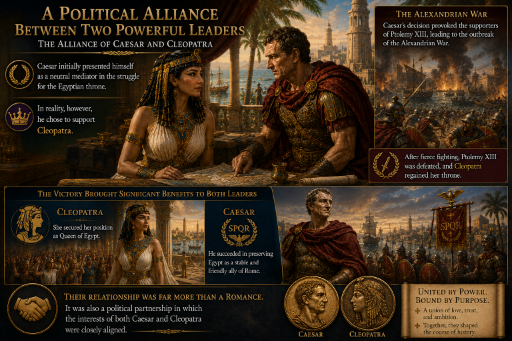 Caesar initially presented himself as a neutral mediator in the struggle for the Egyptian throne.
In reality, however, he chose to support Cleopatra.
His decision provoked the supporters of Ptolemy XIII, leading to the outbreak of the Alexandrian War.
After fierce fighting, Ptolemy XIII was defeated, and Cleopatra regained her throne.
The victory brought significant benefits to both leaders:
- Cleopatra secured her position as Queen of Egypt.
- Caesar succeeded in preserving Egypt as a stable and friendly ally of Rome.
Their relationship was therefore far more than a romance.
It was also a political partnership in which the interests of both Caesar and Cleopatra were closely aligned.
The Birth of Caesarion
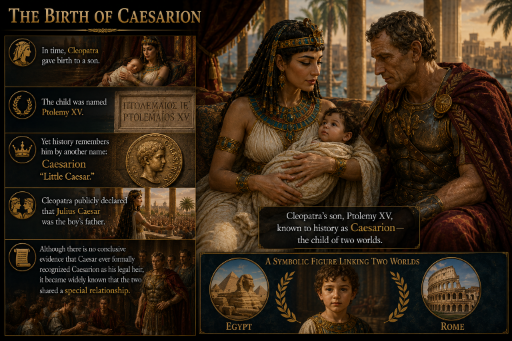 In time, Cleopatra gave birth to a son.
The child was named Ptolemy XV.
Yet history remembers him by another name:
Caesarion—meaning “Little Caesar.”
Cleopatra publicly declared that Julius Caesar was the boy’s father.
Although there is no conclusive evidence that Caesar ever formally recognized Caesarion as his legal heir, it became widely known that the two shared a special relationship.
As the son of Egypt’s queen and, according to Cleopatra’s claim, Rome’s greatest general, Caesarion became a symbolic figure linking the worlds of Egypt and Rome.
The Queen of Egypt Arrives in Rome
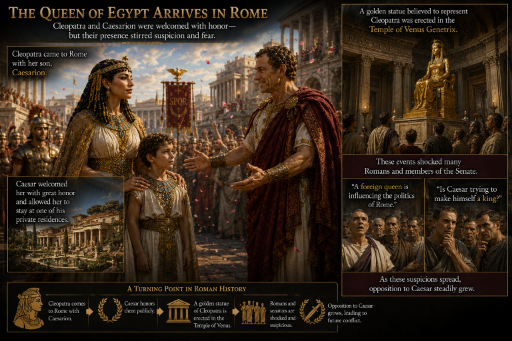 Afterward, Cleopatra traveled to Rome together with Caesarion.
Caesar welcomed her with great honor and arranged for her to stay at one of his private residences.
Ancient sources also report that a golden statue believed to represent Cleopatra was erected in the Temple of Venus Genetrix. These events, however, shocked many Roman citizens and members of the Senate.
Some began to fear:
“A foreign queen is influencing the politics of Rome.”
Others wondered:
“Is Caesar trying to make himself a king?”
As these suspicions spread, opposition to Caesar steadily grew.
The Political Significance of Their Relationship
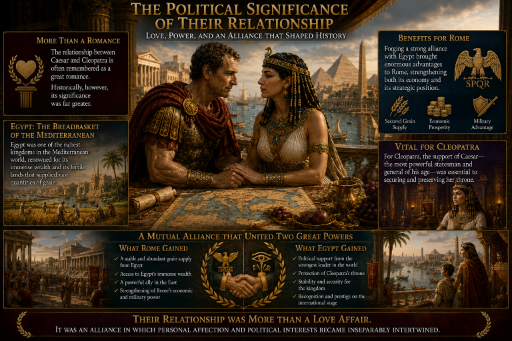 The relationship between Caesar and Cleopatra is often remembered as a great romance.
Historically, however, its significance was far greater.
At the time, Egypt was one of the richest kingdoms in the Mediterranean world, renowned for its immense wealth and its fertile lands that supplied vast quantities of grain.
Forging a strong alliance with Egypt brought enormous advantages to Rome, strengthening both its economy and its strategic position.
For Cleopatra, the support of Caesar—the most powerful statesman and general of his age—was essential to securing and preserving her throne.
Their relationship, therefore, was more than a love affair.
It was an alliance in which personal affection and political interests became inseparably intertwined.
Growing Fears
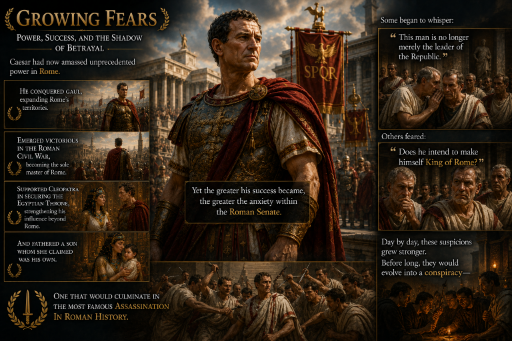 Caesar had now amassed unprecedented power in Rome.
He had conquered Gaul, emerged victorious in the Roman Civil War, supported Cleopatra in securing the Egyptian throne, and fathered a son whom she claimed was his own.
Yet the greater his success became, the greater the anxiety within the Roman Senate.
Some began to whisper:
“This man is no longer merely the leader of the Republic.”
Others feared:
“Does he intend to make himself King of Rome?”
Day by day, these suspicions grew stronger.
Before long, they would evolve into a conspiracy— one that would culminate in the most famous assassination in Roman history.
12. Dictator for Life — The Reformer Who Sought to Transform Rome
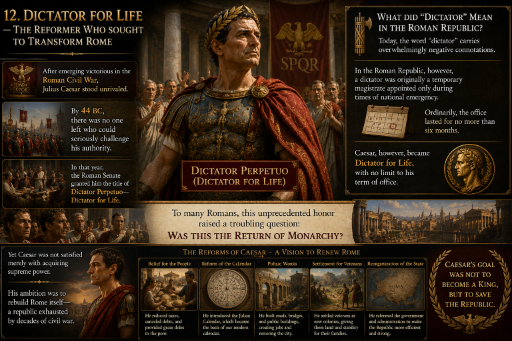 After emerging victorious in the Roman Civil War, Julius Caesar stood unrivaled.
By 44 BC, there was no one left who could seriously challenge his authority.
In that year, the Roman Senate granted him the title of Dictator Perpetuo—Dictator for Life.
Today, the word “dictator” carries overwhelmingly negative connotations.
In the Roman Republic, however, a dictator was originally a temporary magistrate appointed only during times of national emergency.
Ordinarily, the office lasted for no more than six months.
Caesar, however, became Dictator for Life, with no limit to his term of office.
To many Romans, this unprecedented honor raised a troubling question:
Was this the return of monarchy?
Yet Caesar was not satisfied merely with acquiring supreme power.
His ambition was to rebuild Rome itself—a republic exhausted by decades of civil war.
The Introduction of the Julian Calendar
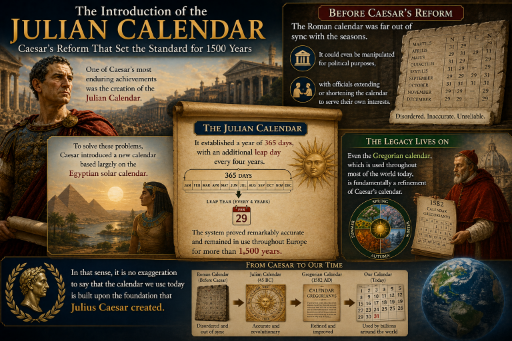 One of Caesar’s most enduring achievements was the creation of the Julian Calendar.
Before his reform, the Roman calendar had drifted significantly out of alignment with the seasons.
It could even be manipulated for political purposes, with officials extending or shortening the calendar to serve their own interests.
To solve these problems, Caesar introduced a new calendar based largely on the Egyptian solar calendar.
It established a year of 365 days, with an additional leap day every four years.
The system proved remarkably accurate and remained in use throughout Europe for more than 1,500 years.
Even the Gregorian calendar, which is used throughout most of the world today, is fundamentally a refinement of Caesar’s calendar.
In that sense, it is no exaggeration to say that the calendar we use today is built upon the foundation that Julius Caesar created.
Reforming the Debt System
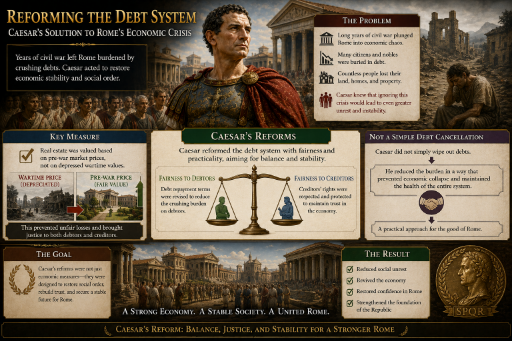 After years of civil war, many Roman citizens and even members of the aristocracy were burdened with heavy debts.
The economy had fallen into disorder, and countless people had lost their land and property.
Caesar believed that if this crisis were left unresolved, social unrest would only continue to grow.
To address the problem, he introduced reforms to the repayment of debts, including valuing real estate according to its pre-war market value rather than its depressed wartime price.
His reforms sought to balance the interests of both debtors and creditors.
Rather than simply canceling debts outright, Caesar aimed to reduce the burden while preserving economic stability and preventing further financial chaos.
It was a practical policy designed to restore social order and rebuild confidence in the Roman economy.
Caesar’s Colonial Policy
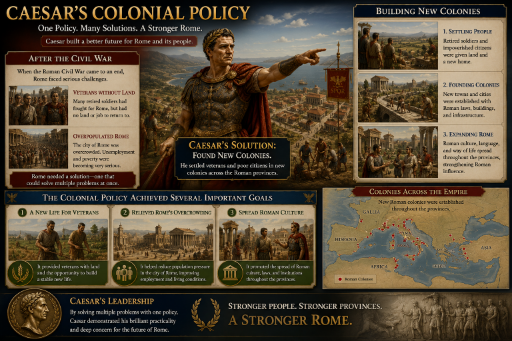 When the Roman Civil War came to an end, many veterans found themselves without land or employment.
At the same time, the city of Rome was suffering from severe overcrowding, with unemployment and poverty becoming increasingly serious problems.
To address these challenges, Caesar established new Roman colonies throughout the provinces, settling retired soldiers and impoverished citizens in these newly founded communities.
This colonial policy achieved several important goals at once:
- It provided veterans with land and the opportunity to build new lives.
- It helped relieve the growing population pressure in the city of Rome.
- It promoted the spread of Roman culture and institutions throughout the provinces.
Caesar’s ability to solve multiple problems with a single policy demonstrates the remarkable practicality and political skill that characterized his leadership.
Expanding Roman Citizenship
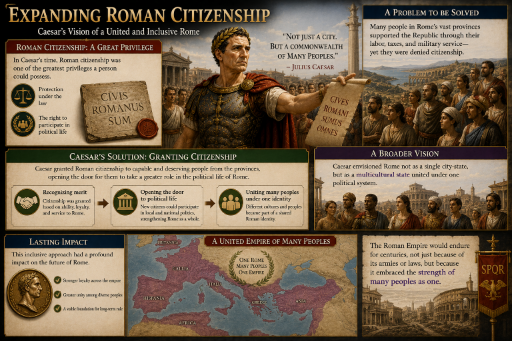 In Caesar’s time, Roman citizenship was one of the greatest privileges a person could possess.
Citizens enjoyed the protection of Roman law and, in many cases, had the right to participate in political life.
Yet many of the people living in Rome’s vast provinces—despite supporting the Republic through their labor, taxes, and military service—were denied these rights.
Caesar sought to change this.
He granted Roman citizenship to capable and deserving people from the provinces, opening the door for them to take a greater role in the political life of Rome.
This reflected a broader vision of Rome—not merely as a single city-state, but as a multicultural state united under one political system.
This way of thinking would have a profound influence on the later Roman Empire, helping it govern and maintain its vast territories for centuries.
Reforming Provincial Administration
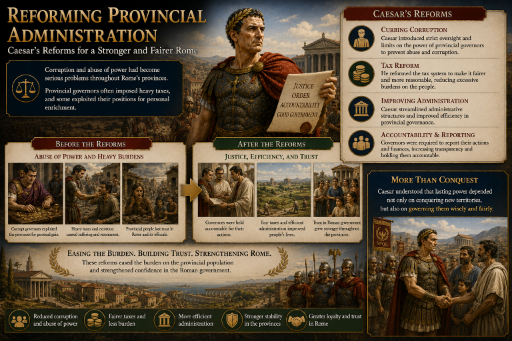 Corruption and abuse of power had become serious problems throughout Rome’s provinces.
Provincial governors often imposed heavy taxes, and some exploited their positions for personal enrichment.
Recognizing that such practices threatened the stability of the Republic, Caesar introduced reforms to improve provincial administration and curb corruption among governors.
He also worked to streamline the tax system and make local government more efficient.
These reforms eased the burden on the provincial population and strengthened confidence in the Roman government.
Caesar understood that lasting power depended not only on conquering new territories, but also on governing them wisely and fairly.
Why Did Caesar Pursue These Reforms?
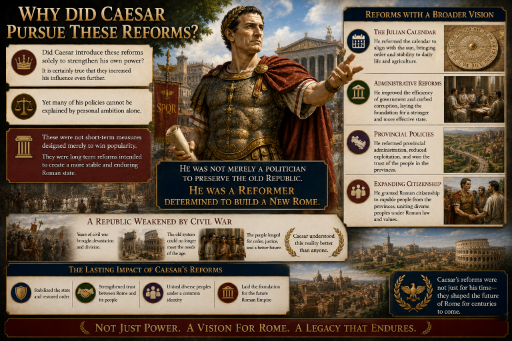 Did Caesar introduce these reforms solely to strengthen his own power?
It is certainly true that they increased his influence even further.
Yet many of his policies cannot be explained by personal ambition alone.
The Julian Calendar, administrative reforms, provincial policies, and the expansion of Roman citizenship all point to a broader vision.
These were not short-term measures designed merely to win popularity.
They were long-term reforms intended to create a more stable and enduring Roman state.
After decades of civil war, the Roman Republic had become too weakened to function effectively under its old institutions alone.
Caesar understood this reality better than anyone.
He was not simply a politician trying to preserve the old Republic.
He was a reformer determined to build a new Rome.
Power Beyond Measure
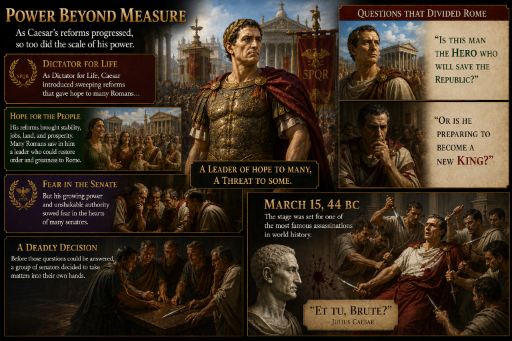 Yet as Caesar’s reforms progressed, so too did the scale of his power.
As Dictator for Life, he introduced sweeping changes that gave hope to many Romans—but they also inspired growing fear within the Roman Senate.
Some began to ask:
“Is this man the hero who will save the Republic?”
Others wondered:
“Or is he preparing to become a new king?”
Before those questions could be answered, a group of senators decided to take matters into their own hands.
Then came March 15, 44 BC.
The stage was set for one of the most famous assassinations in world history.
13. The Assassination — The Last Day of the Roman Republic
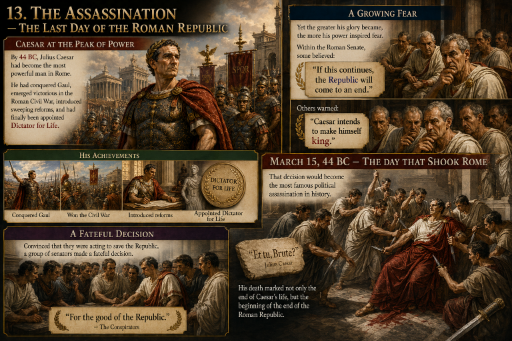 By 44 BC, Julius Caesar had become the most powerful man in Rome. He had conquered Gaul, emerged victorious in the Roman Civil War, introduced sweeping reforms, and had finally been appointed Dictator for Life. Yet the greater his glory became, the more his power inspired fear. Within the Roman Senate, some believed: “If this continues, the Republic will come to an end.” Others warned: “Caesar intends to make himself king.” Convinced that they were acting to save the Republic, a group of senators made a fateful decision. That decision would become the most famous political assassination in history.
The Ides of March
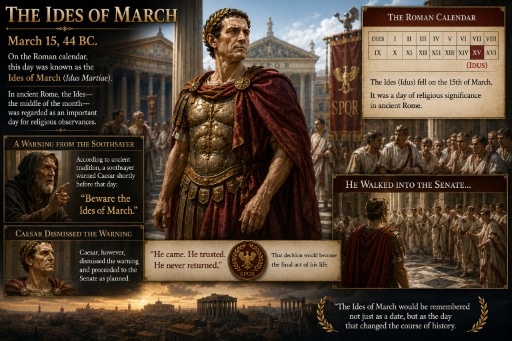 March 15, 44 BC.
On the Roman calendar, this day was known as the Ides of March (Idus Martiae).
In ancient Rome, the Ides—the middle of the month—was regarded as an important day for religious observances.
According to ancient tradition, a soothsayer warned Caesar shortly before that day:
“Beware the Ides of March.”
Caesar, however, dismissed the warning and proceeded to the Senate as planned.
That decision would become the final act of his life.
The Conspiracy
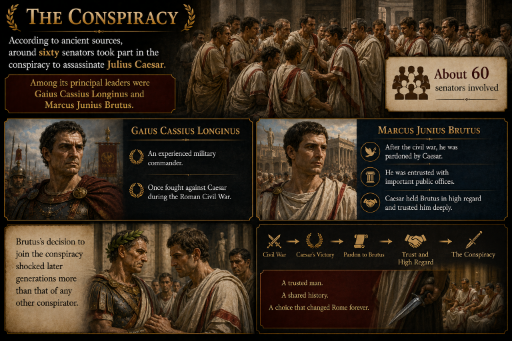 According to ancient sources, around sixty senators took part in the conspiracy to assassinate Julius Caesar. Among its principal leaders were Gaius Cassius Longinus and Marcus Junius Brutus.
Cassius was an experienced military commander who had once fought against Caesar during the Roman Civil War.
Brutus, however, occupied a very different position.
After the civil war, he had been pardoned by Caesar and was even entrusted with important public offices.
Ancient writers also record that Caesar held Brutus in particularly high regard and trusted him deeply.
For that reason, Brutus’s decision to join the conspiracy shocked later generations more than that of any other conspirator.
The Assassination in the Senate
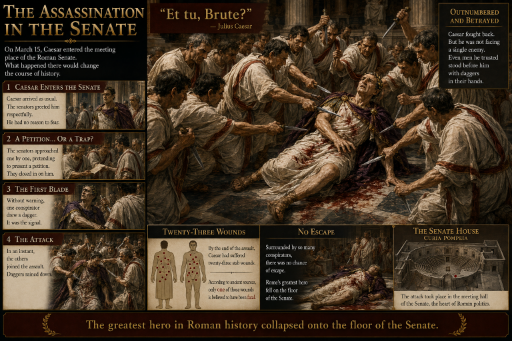 On March 15, Caesar entered the meeting place of the Roman Senate. As he took his seat, a group of senators gradually gathered around him.
At first, they approached under the pretense of presenting a petition. Then, without warning, one of the conspirators drew a dagger.
In an instant, the others joined the attack.
Caesar tried to defend himself.
But he was not facing a single assassin.
Even men he had trusted stood before him with daggers in their hands.
By the end of the assault, Caesar had suffered twenty-three stab wounds.
According to ancient sources, only one of those wounds is believed to have been fatal.
Yet there was no escape from the coordinated attack of so many conspirators.
The greatest hero in Roman history collapsed onto the floor of the Senate.
“Et tu, Brute?”
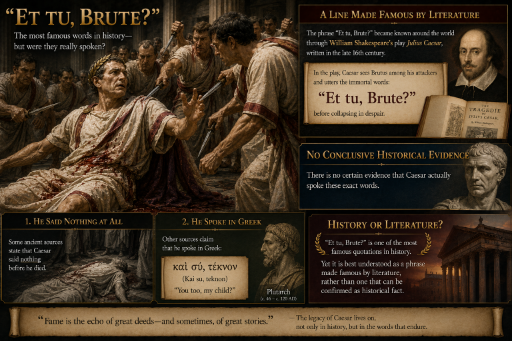 When people think of Caesar’s final moments, one famous line almost always comes to mind:
“Et tu, Brute?”
“You too, Brutus?”
In reality, however, there is no conclusive historical evidence that Caesar actually spoke these words.
The phrase became famous around the world largely through William Shakespeare’s play Julius Caesar, written in the late sixteenth century.
In the play, Caesar sees Brutus among his attackers and utters the immortal words:
“Et tu, Brute?” before collapsing in despair.
The ancient historical sources, however, do not agree on what happened.
Some suggest that Caesar said nothing at all before he died.
Others claim that he spoke in Greek:
“καὶ σύ, τέκνον” (Kai su, teknon) “You too, my child?”
For this reason, “Et tu, Brute?” remains one of the most famous quotations in history—but it is best understood as a phrase made famous by literature, rather than one that can be confirmed as historical fact.
The Conspirators’ Miscalculation
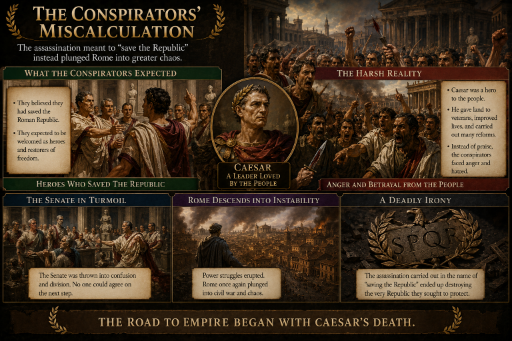 The conspirators believed that they would be welcomed as heroes who had saved the Roman Republic.
The reality, however, was very different.
By the time of his death, Julius Caesar had earned the support of a large portion of the Roman people.
He had rewarded his veterans with land, improved the lives of ordinary citizens, and introduced a wide range of reforms.
Instead of celebrating the assassins, many Romans reacted with anger and grief.
The Senate was thrown into turmoil, and Rome once again descended into political instability.
Ironically, the assassination carried out in the name of saving the Republic ultimately pushed the Republic into even greater chaos.
The Hero Was Dead—But History Was Not
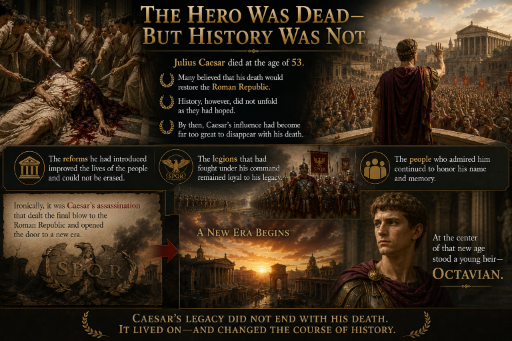 Julius Caesar died at the age of 53.
Many believed that his death would restore the Roman Republic.
History, however, did not unfold as they had hoped.
By then, Caesar’s influence had become far too great to disappear with his death.
The reforms he had introduced, the legions that had fought under his command, and the people who admired him all survived the man himself.
Ironically, it was Caesar’s assassination that dealt the final blow to the Roman Republic and opened the door to a new era.
At the center of that new age stood a young heir— Octavian.
14. After His Death — How the Assassins Brought About the Fall of the Republic
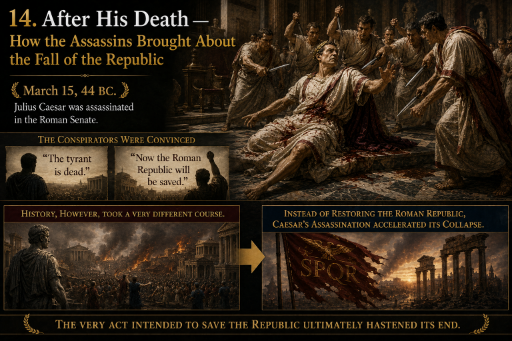 March 15, 44 BC. Julius Caesar was assassinated in the Roman Senate.
The conspirators were convinced they had achieved their goal.
“The tyrant is dead.”
“Now the Roman Republic will be saved.”
History, however, took a very different course.
Instead of restoring the Roman Republic, Caesar’s assassination accelerated its collapse.
The very act intended to save the Republic ultimately hastened its end.
Mark Antony’s Funeral Oration
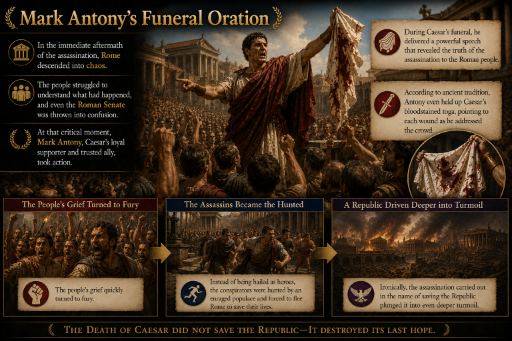 In the immediate aftermath of the assassination, Rome descended into chaos.
The people struggled to understand what had happened, and even the Roman Senate was thrown into confusion.
At that critical moment, Mark Antony, Caesar’s loyal supporter and trusted ally, took action.
During Caesar’s funeral, he delivered a powerful speech that revealed the truth of the assassination to the Roman people. According to ancient tradition, Antony even held up Caesar’s bloodstained toga, pointing to each wound as he addressed the crowd.
The people’s grief quickly turned to fury.
Instead of being hailed as heroes, the conspirators found themselves hunted by an enraged populace and were forced to flee Rome to save their lives.
Ironically, the assassination carried out in the name of saving the Republic plunged it into even deeper turmoil.
The Young Heir: Octavian
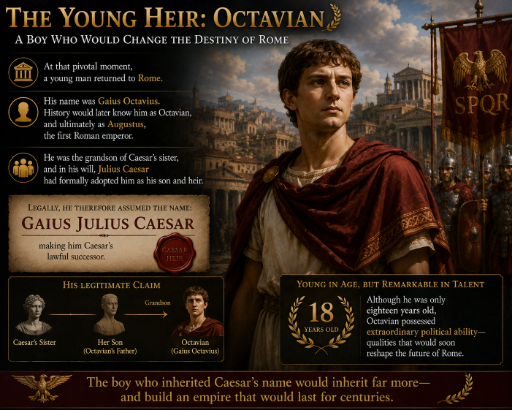 At that pivotal moment, a young man returned to Rome.
His name was Gaius Octavius.
History would later know him as Octavian, and ultimately as Augustus, the first Roman emperor.
He was the grandson of Caesar’s sister, and in his will, Julius Caesar had formally adopted him as his son and heir.
Legally, he therefore assumed the name:
Gaius Julius Caesar making him Caesar’s lawful successor.
Although he was only eighteen years old, Octavian possessed extraordinary political ability—qualities that would soon reshape the future of Rome.
Civil War Begins Again
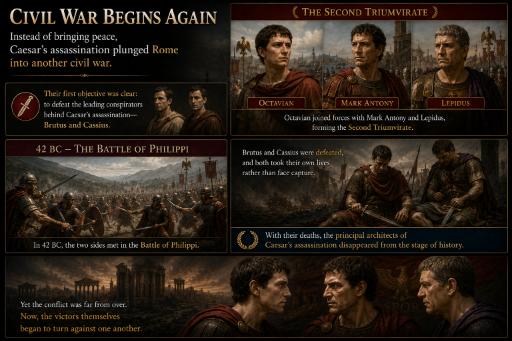 Instead of bringing peace, Caesar’s assassination plunged Rome into another civil war.
Octavian joined forces with Mark Antony and Lepidus, forming the Second Triumvirate.
Their first objective was clear: to defeat the leading conspirators behind Caesar’s assassination—Brutus and Cassius.
In 42 BC, the two sides met in the Battle of Philippi.
Brutus and Cassius were defeated, and both took their own lives rather than face capture.
With their deaths, the principal architects of Caesar’s assassination disappeared from the stage of history.
Yet the conflict was far from over.
Now, the victors themselves began to turn against one another.
Antony and Octavian
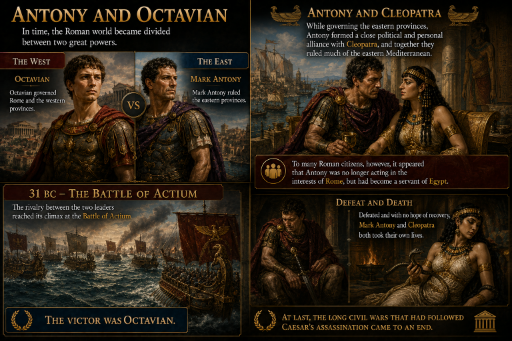 In time, the Roman world became divided between two great powers.
In the West stood Octavian.
In the East ruled Mark Antony.
While governing the eastern provinces, Antony formed a close political and personal alliance with Cleopatra, and together they ruled much of the eastern Mediterranean.
To many Roman citizens, however, it appeared that Antony was no longer acting in the interests of Rome.
Instead, they believed he had become a servant of Egypt.
In 31 BC, the rivalry between the two leaders reached its climax at the Battle of Actium.
The victor was Octavian. Defeated and with no hope of recovery, Mark Antony and Cleopatra both took their own lives.
At last, the long civil wars that had followed Caesar’s assassination came to an end.
Augustus — The First Roman Emperor
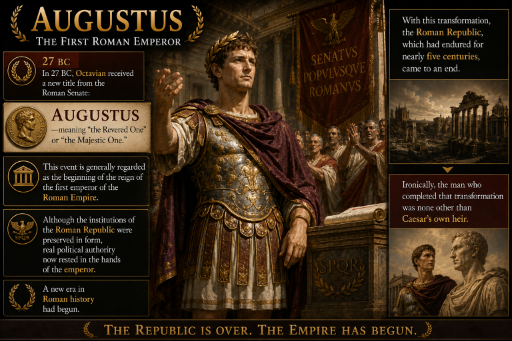 In 27 BC, Octavian received a new title from the Roman Senate:
Augustus—meaning “the Revered One” or “the Majestic One.”
This event is generally regarded as the beginning of the reign of the first emperor of the Roman Empire.
Although the institutions of the Roman Republic were preserved in form, real political authority now rested in the hands of the emperor.
A new era in Roman history had begun.
With this transformation, the Roman Republic, which had endured for nearly five centuries, came to an end.
Ironically, the man who completed that transformation was none other than Caesar’s own heir.
One of History’s Greatest Ironies
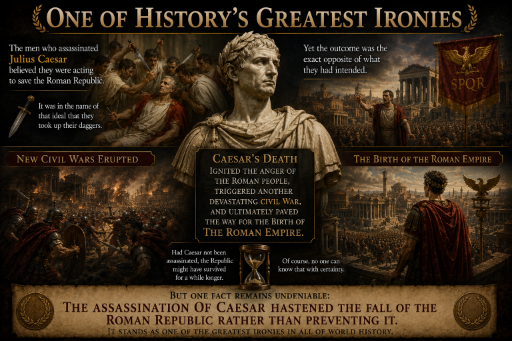 The men who assassinated Julius Caesar believed they were acting to save the Roman Republic.
It was in the name of that ideal that they took up their daggers.
Yet the outcome was the exact opposite of what they had intended.
Caesar’s death ignited the anger of the Roman people, triggered another devastating civil war, and ultimately paved the way for the birth of the Roman Empire.
Had Caesar not been assassinated, the Republic might have survived for a while longer.
Of course, no one can know that with certainty.
But one fact remains undeniable:
The assassination of Caesar hastened the fall of the Roman Republic rather than preventing it.
It stands as one of the greatest ironies in all of world history.
A Man Dies, but an Era Lives On
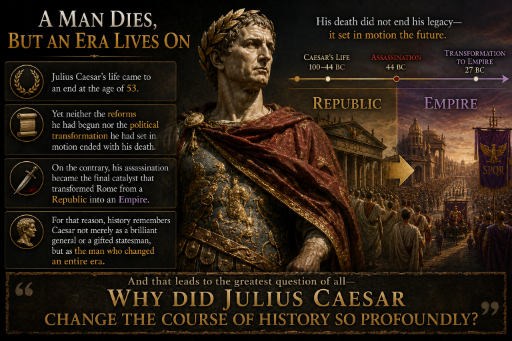 Julius Caesar‘s life came to an end at the age of 53.
Yet neither the reforms he had begun nor the political transformation he had set in motion ended with his death.
On the contrary, his assassination became the final catalyst that transformed Rome from a Republic into an Empire.
For that reason, history remembers Caesar not merely as a brilliant general or a gifted statesman, but as the man who changed an entire era.
And that leads to the greatest question of all—
Why did Julius Caesar change the course of history so profoundly?
15. Why Did Caesar Change the Course of History?
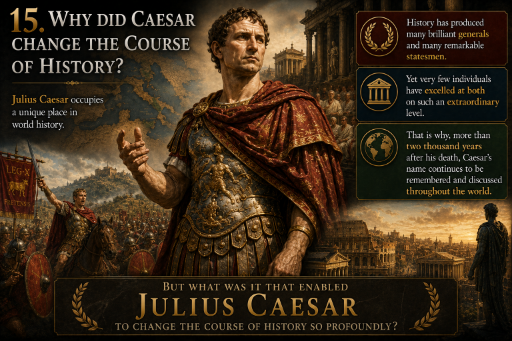 Julius Caesar occupies a unique place in world history.
History has produced many brilliant generals and many remarkable statesmen.
Yet very few individuals have excelled at both on such an extraordinary level.
That is why, more than two thousand years after his death, Caesar’s name continues to be remembered and discussed throughout the world.
But what was it that enabled Julius Caesar to change the course of history so profoundly?
An Exceptional Military Commander
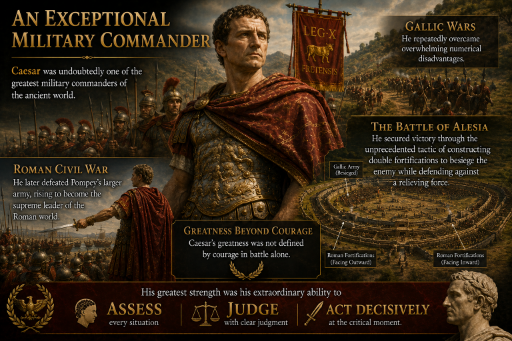 Caesar was undoubtedly one of the greatest military commanders of the ancient world.
During the Gallic Wars, he repeatedly overcame overwhelming numerical disadvantages, and at the Battle of Alesia, he secured victory through the unprecedented tactic of constructing double fortifications to besiege the enemy while defending against a relieving force.
He later defeated Pompey’s larger army in the Roman Civil War, rising to become the supreme leader of the Roman world.
Yet Caesar’s greatness was not defined by courage in battle alone.
His greatest strength was his extraordinary ability to assess every situation with clear judgment and to make bold, decisive decisions at the critical moment.
A Brilliant Statesman
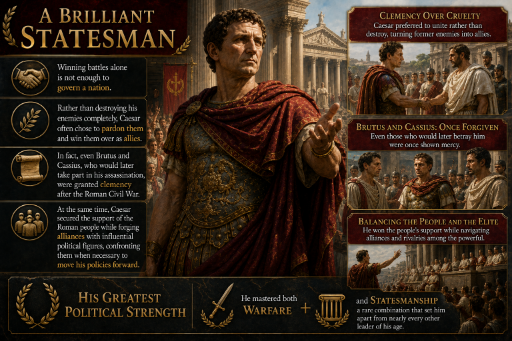 Winning battles alone is not enough to govern a nation.
Rather than destroying his enemies completely, Caesar often chose to pardon them and win them over as allies.
In fact, even Brutus and Cassius, who would later take part in his assassination, were granted clemency after the Roman Civil War.
At the same time, Caesar secured the support of the Roman people while forging alliances with influential political figures, confronting them when necessary to move his policies forward.
His greatest political strength lay in his ability to master both warfare and statesmanship—a rare combination that set him apart from nearly every other leader of his age.
A Masterful Writer
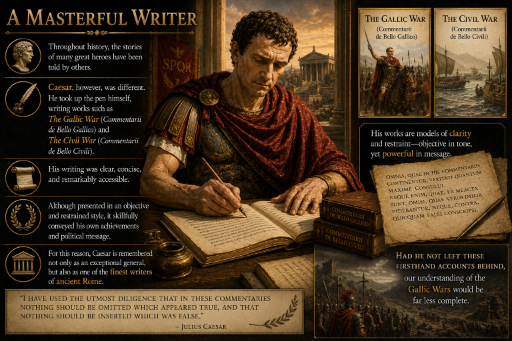 Throughout history, the stories of many great heroes have been told by others.
Caesar, however, was different.
He took up the pen himself, writing works such as The Gallic War (Commentarii de Bello Gallico) and The Civil War (Commentarii de Bello Civili).
His writing was clear, concise, and remarkably accessible.
Although presented in an objective and restrained style, it skillfully conveyed his own achievements and political message.
For this reason, Caesar is remembered not only as an exceptional general, but also as one of the finest writers of ancient Rome.
Had he not left these firsthand accounts behind, our understanding of the Gallic Wars would be far less complete.
A Bold Reformer
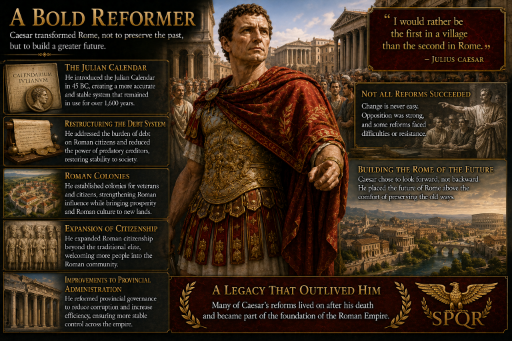 Caesar was not a politician who sought to preserve the status quo.
Through reforms such as the introduction of the Julian Calendar, the restructuring of the debt system, the establishment of Roman colonies, the expansion of Roman citizenship, and improvements to provincial administration, he sought to transform Roman society itself.
Of course, not every reform achieved complete success.
Yet Caesar consistently placed greater importance on building the Rome of the future than on preserving the institutions of the past.
For that reason, many of his reforms outlived him and went on to become part of the foundation upon which the Roman Empire was built.
A Captivating Orator
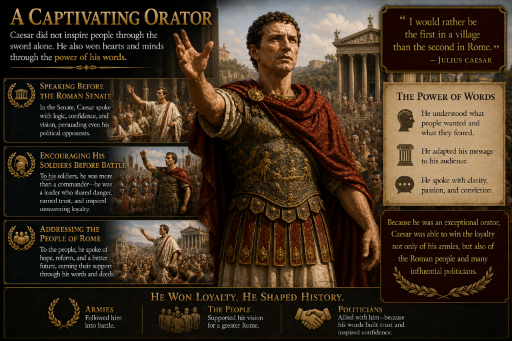 Caesar did not inspire people through the sword alone.
He also won hearts and minds through the power of his words.
Whether speaking before the Roman Senate, encouraging his soldiers before battle, or addressing the people of Rome, he possessed a remarkable ability to understand what his audience needed to hear—and to express it with clarity and conviction.
Because he was an exceptional orator, Caesar was able to win the loyalty not only of his armies, but also of the Roman people and many influential politicians.
An Inspiring Leader
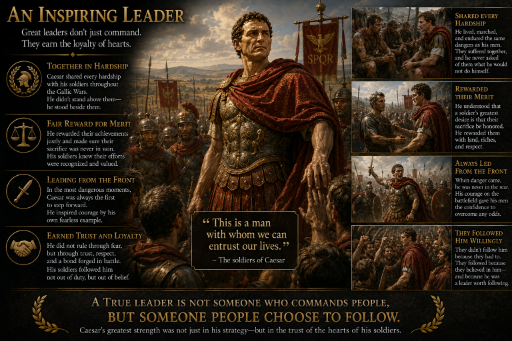
The people who stood by Caesar until the very end were the soldiers who had fought alongside him throughout the Gallic Wars.
Time and again, they faced mortal danger.
Yet they continued to follow him without hesitation.
It was not because they obeyed him out of fear.
Caesar shared every hardship with his men, rewarded their achievements fairly, and never hesitated to place himself at the front when the situation was most dangerous.
His soldiers believed,
“This is a man with whom we can entrust our lives.”
Perhaps that is the true mark of a great leader.
Not someone who simply commands others,
but someone whom others willingly choose to follow.
One Extraordinary Man Changed an Era
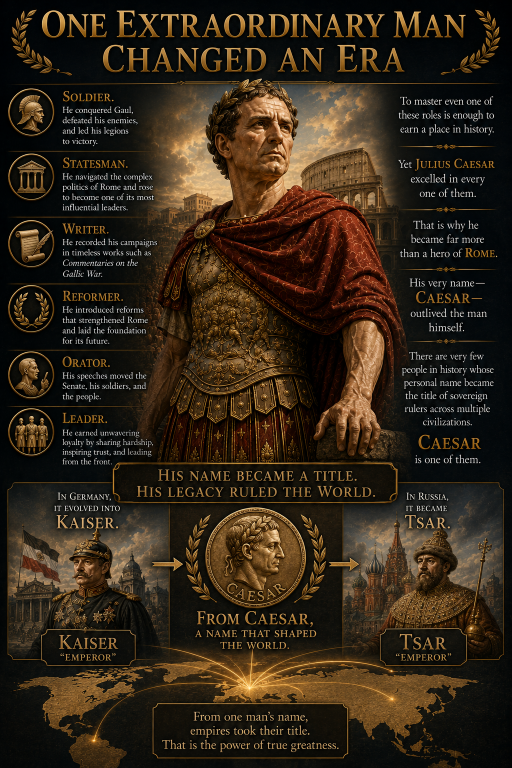
Soldier.
Statesman.
Writer.
Reformer.
Orator.
Leader.
To master even one of these roles is enough to earn a place in history.
Yet Julius Caesar excelled in every one of them.
That is why he became far more than a hero of Rome.
His very name—Caesar—outlived the man himself.
In Germany, it evolved into Kaiser.
In Russia, it became Tsar.
Both came to signify “Emperor.”
There are very few people in history whose personal name became the title of sovereign rulers across multiple civilizations.
Caesar is one of them.
The Man Who Changed History
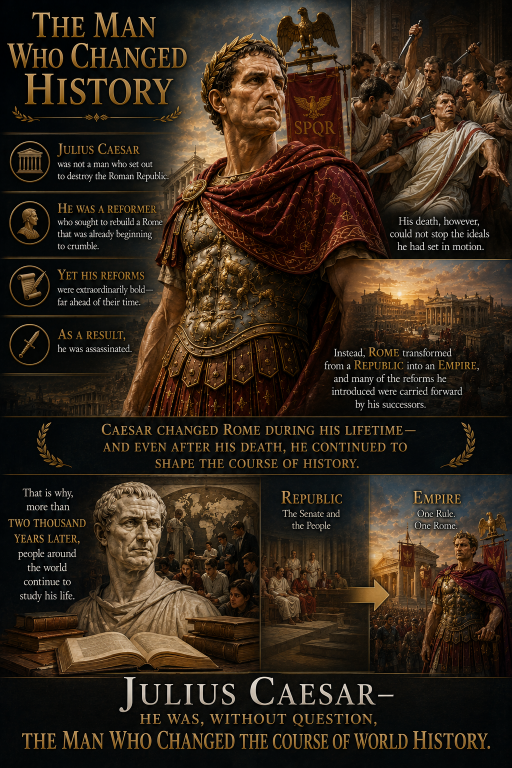
Julius Caesar was not a man who set out to destroy the Roman Republic.
He was a reformer who sought to rebuild a Rome that was already beginning to crumble.
Yet his reforms were extraordinarily bold—far ahead of their time.
As a result, he was assassinated.
His death, however, could not stop the ideals he had set in motion.
Instead, Rome transformed from a Republic into an Empire, and many of the reforms he introduced were carried forward by his successors.
Caesar changed Rome during his lifetime—and even after his death, he continued to shape the course of history.
That is why, more than two thousand years later, people around the world continue to study his life.
Julius Caesar—
He was, without question,
the man who changed the course of world history.
Conclusion
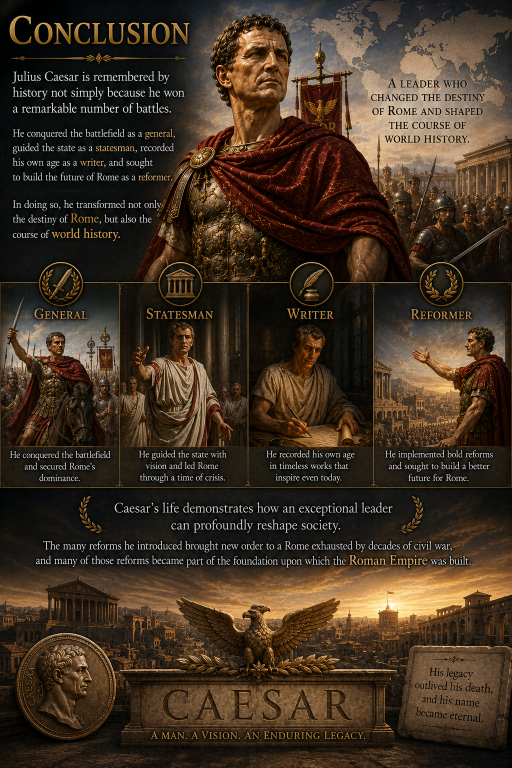
Julius Caesar is remembered by history not simply because he won a remarkable number of battles.
He conquered the battlefield as a general, guided the state as a statesman, recorded his own age as a writer, and sought to build the future of Rome as a reformer.
In doing so, he transformed not only the destiny of Rome, but also the course of world history.
Caesar’s life demonstrates how an exceptional leader can profoundly reshape society.
The many reforms he introduced brought new order to a Rome exhausted by decades of civil war, and many of those reforms became part of the foundation upon which the Roman Empire was built.
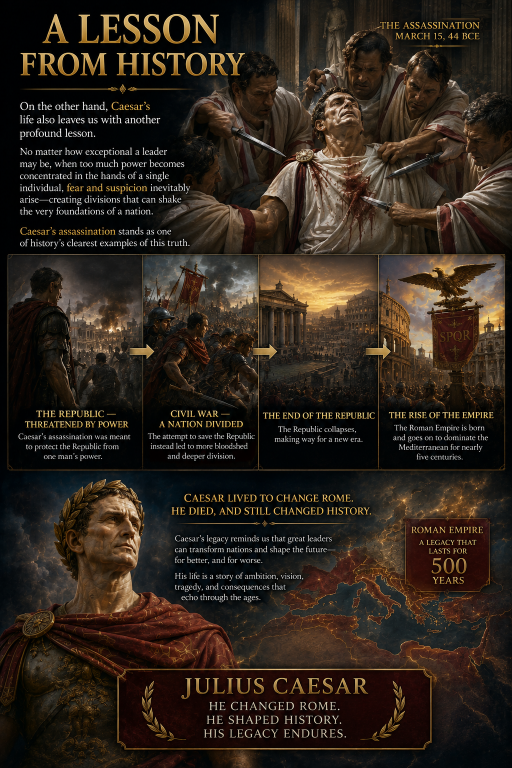
On the other hand, Caesar’s life also leaves us with another profound lesson.
No matter how exceptional a leader may be, when too much power becomes concentrated in the hands of a single individual, fear and suspicion inevitably arise—creating divisions that can shake the very foundations of a nation.
Caesar’s assassination stands as one of history’s clearest examples of this truth.
Yet history took an ironic turn.
The men who killed Caesar in the name of saving the Roman Republic ultimately unleashed another devastating civil war, and the Republic they sought to protect came to an end.
In its place arose the Roman Empire, which would dominate the Mediterranean world for nearly five centuries.
Caesar transformed Rome during his lifetime—and even after his death, he continued to shape the course of history.
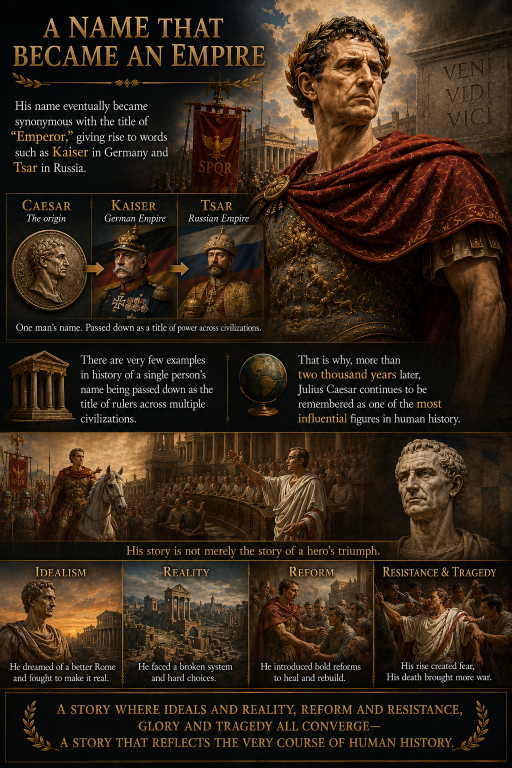
His name eventually became synonymous with the title of “Emperor,” giving rise to words such as Kaiser in Germany and Tsar in Russia.
There are very few examples in history of a single person’s name being passed down as the title of rulers across multiple civilizations.
That is why, more than two thousand years later, Julius Caesar continues to be remembered as one of the most influential figures in human history.
His story is not merely the story of a hero’s triumph.
It is a story in which idealism and reality, reform and resistance, glory and tragedy all converge—a story that reflects the very course of human history itself.
And even today, his life continues to ask us timeless questions:
“What is a true leader?”
“What does it mean to reform a nation?”
The life of Julius Caesar is an enduring story—one that will always be worth studying, reflecting upon, and seeking answers from.
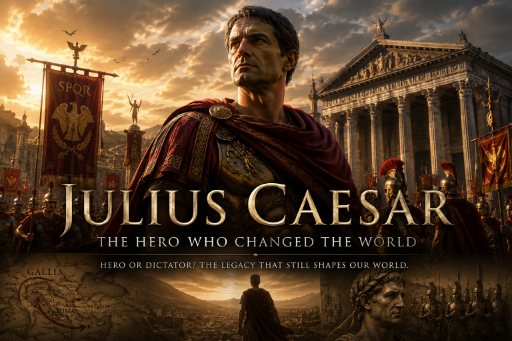
Read the Story
Experience Julius Caesar’s life through a cinematic historical narrative.
👉 Julius Caesar — The Hero Who Changed the World

Become Part of the Chronicle
If this article inspired you, consider supporting the project.
Become a character in the Chronicle.
Receive your own custom card and stand alongside queens, warriors, inventors, rebels, and legends from history.
Your support helps keep these stories alive and allows me to create more articles, illustrations, and historical cards.
Join the Chronicle and leave your mark on history.

Comment